Category Archives: Places

VM_365 Day 214 Neolithic Serrated Flint blade from Margate

VM 214

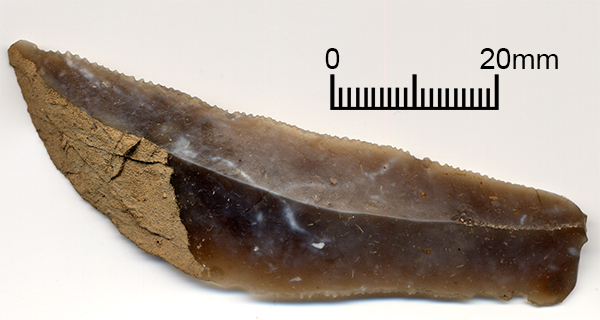
The VM_365 project’s image for Day 214 is a fine, serrated flint blade excavated from a pit dating to the Neolithic period on a site near Margate Railway Station in 2004.

The  blade is fine, partly-worn and serrated along both edges with approximately 11 serrations per 10mm.  The fine blade shows some wear indicating that it has seen some use. It has a break at the proximal-end which has removed the striking platform and crushing along the ridge of the blade along with a couple of notches taken out of one edge suggest that the blade had been hafted or mounted on a handle.

The fine serrations distributed so regularly along both edges of this blade attest to the skill and craft of the Neolithic flint worker.


VM_365 Day 212 Early Bronze Age Urn Conundrum

VM 212
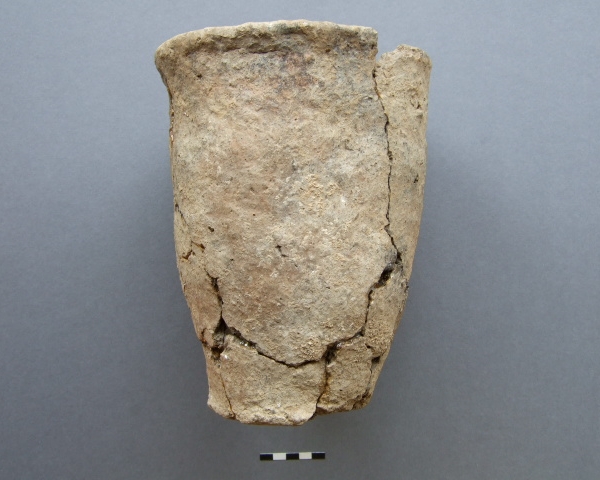
The image for Day 212 of the VM_365 project shows an Early Bronze Age Urn found buried with a crouched inhumation within a ring ditch at the former Dumpton Greyhound Stadium, Ramsgate in 2000. It was excavated by Kent Archaeological Rescue Unit (KARU) and is now in the Trust’s stores.
This vessel presents a slight conundrum. Rather inconveniently our Ancestors did not always do things according to strict tradition. In this instance we do know that this ‘Urn’ is definitely of Early Bronze Age date, since it came from a crouched inhumation within a burial ring-ditch. However it rather obviously lacks any decoration and the form is not altogether informative either. Superficially, its rather basic form is quite untypical of any of the four main Early Bronze Age often richly decorated ceramic traditions – Beaker, Food Vessel, Collared Urn or Biconical Urn. However, its fabric is coarsely grog-tempered – hence its rather lumpy surface. This aspect and its buff-fired surface is much closer to some of the manufacturing trends associated with the Collared Urn tradition, current between c.2000-1600 BC so that, despite being a rather unimaginative creation, it can be confidently placed into this period at least.
This vessel joins the vessel shown on Day 200 as an example of an outlying variation in what are usually quite standard vessel forms.
The Virtual Museum would like to thank Nigel Macpherson-Grant for this information about the vessel.

VM_365 Day 210 Barbed and Tanged arrowhead from Laundry Road, Minster

VM 210

The image for Day 210 of the VM_365 project is another taken from our slide archive.

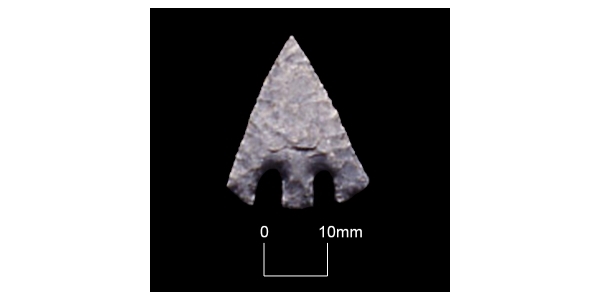
The object shown is a Late Neolithic flint tanged and barbed arrowhead, found in the fill of a segment excavated through an enclosure at Laundry Road, Minster in 1995. Another ditch section contained pottery dating to the Beaker period, suggesting that the whole enclosure was of late Neolithic/Early Bronze Age date.

Other similar flint arrowheads from locations in Thanet have been featured in previous VM_365 posts, on Day 141, Day 162, and Day 168.

VM_365 Day 208 Three glass vessels from Margate with a tale to tell

VM 208

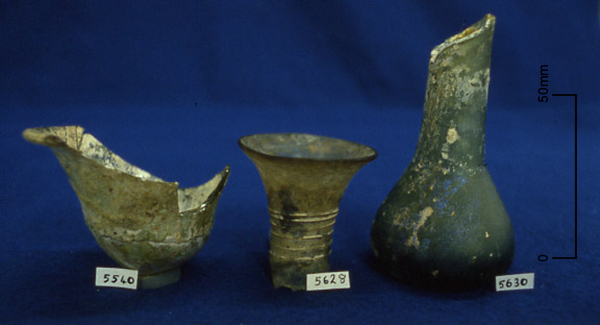
Today’s VM_365 image for Day 208 of the project shows three glass vessels which were part of the Rowe Bequest, a collection donated to the people of Margate by Dr Arthur Rowe.

In 1986, David Perkins, the first Director of the Trust for Thanet Archaeology, was involved in cataloguing the artefacts belonging to the Rowe Bequest which had been housed in the Old Margate Museum prior to the Second World War. A number of the artefacts in the Rowe Bequest were associated with the Anglo Saxon cemetery at Half Mile Ride, Margate. Using  Rowe’s notes and modern archaeological research, Perkins was able to publish a reappraisal of the cemetery in the county journal.

While cataloguing the items, Dave Perkins identified the three glass vessels, pictured above, which had been packed along with the artefacts from the Half Mile Ride collection but were not been mentioned in the museum records.

The first of the vessels (on the left) is a green glass Base Cup dating to around the 7th century. A stand obscures the pointed base of the vessel in the photograph; it was originally manufactured so that the contents of the vessel had to be fully consumed before it could be put down on its rim. Perkins confirmed that the Base Cup was from one of the graves of the Half Mile Ride cemetery.

Despite being from two seperate vessels of different dates, the two other fragments shown in the centre and on the right, had been reconstructed incorrectly to form a ‘single’ vessel and had been described in the old catalogue as Roman, suggesting they were probably from the Twenties Brickfield approximatley 300 metres to the north west of the Half Mile Ride graves. Dave Perkins was able to show that this catalogue entry was not right.

The body and base on the right are from the lower part of a flask of thick blue green glass dating to the Roman period. The rim and neck in the centre are actually from a clear glass pouch bottle with glass thread decoration around the neck,  actually of Anglo Saxon date. The pouch bottle also dates to around the 7th century. Perkins was able to confirm that it also came from the Half Mile Ride cemetery.

References

Perkins, D. R. J. 2000. Jutish Glass Production in Kent: And the Problem of the Base Cups. Archaeologia Cantiana CXX, 297-310.

Perkins, D. R. J. 1987. The Jutish Cemetery at Half Mile Ride, Margate: A Re-appraisal. Archaeologia Cantiana CIV, 219-236.
 

VM_265 Day 205 The Birchington III Bronze Age hoard

VM 205

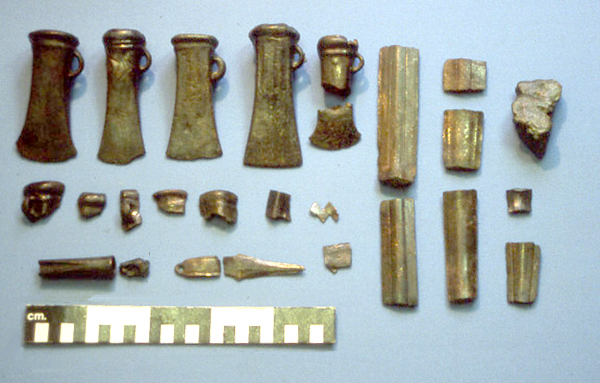
Today’s VM_365 image for Day 205 is of a Late Bronze Age Bronze Hoard given the name  Birchington III to distinguish it from other hoards. The bronzes were found by a metal detectorist near Quex Park, Birchington in 1996.

The objects include socketed axes; blade, collar and body fragments from socketed axes; fragments of blades from swords in the Ewart Park Anglo-Welsh tradition; a blade fragment from a point of a sword in the Continental Carp’s Tongue tradition; other sword blade fragments; parts of a small knife as well as part of the blade of a socketed chisel and finally, a bun ingot.

The hoard contains a large quantity of  material from the continent, probably brought in as scrap as part of cross Channel trading and presumably intended to be melted down and reused as were many of the Bronze hoards found on Thanet.

VM_365 Day 204 Bronze Age ‘Bugle’ fitting from Anglo Saxon grave

VM 204

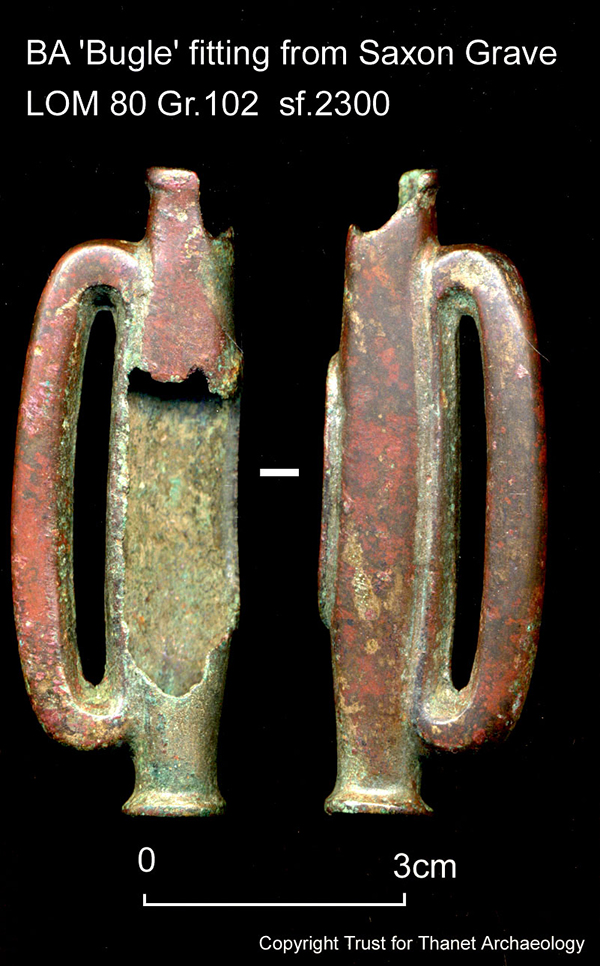
Today’s VM_365 image shows a Bronze Age ‘Bugle’ fitting that was found within an Anglo-Saxon grave at  Lord of the Manor, Ramsgate in 1980.

The ‘Bugle’ fitting is named after its similarity in shape to a bugle. This particular example is a cast copper alloy tubular fitting with a hollow body and an opening on the non loop side and at either end. Fittings such as these are attributed to the Late Bronze Age and are thought to form part of a harness or part of its equipment. The most likely use for this object would be for the fastening of a leather strap although its exact function is unknown. Other suggestions for its use have included a dog whistle used in rounding up livestock.

How did it come to be in a grave over a thousand years later? It seems that at all times in history objects from the past have been seen to be interesting enough to be collected and curated as curiosities. This object may have been prized by the occupant of the grave, or have been placed there by a family member as a talisman. Alternatively it may have come to be in the grave by sheer coincidence from the soil backfilled within it.


VM_365 Day 203 A Beaker from Dumpton Down Broadstairs

VM 203

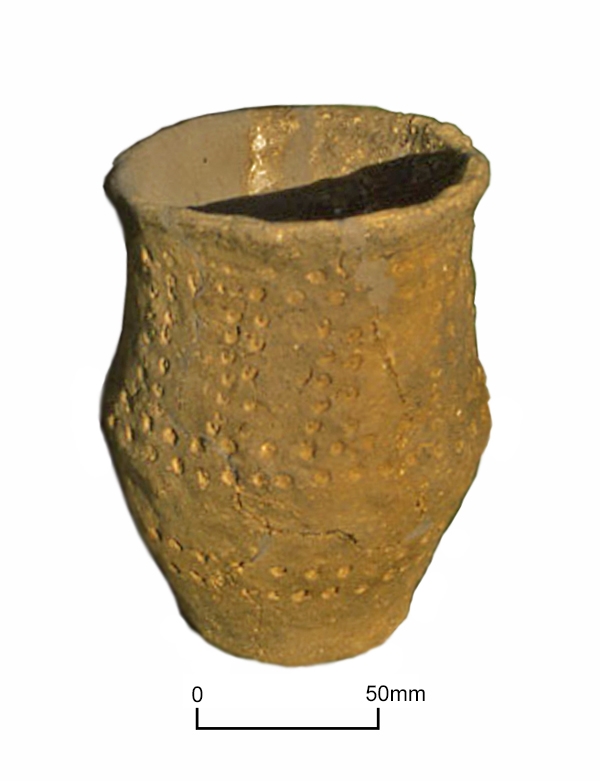
Today’s image for VM_365 Day 203 is of aLate Neolithic/Early Bronze Age Beaker, found in an excavation at South Dumpton Down near Broadstairs in 1992, which was led by David Perkins, the first director of the Trust for Thanet Archaeology.
The beaker was found among a complex group of graves that were enclosed by the ring ditch of a roundbarrow. The graves that were excavated at the centre of the ring ditch contained the remains of seven individuals laid in a variety of orientations. Some of the burials were in crouched positions, others were truncated and disarticulated.
The complexity of the grave group led to some confusion about  what the exact association was between the Beaker and any of the individuals in the grave  group. The confusion was aggravated by the presence of Food Vessel type pottery within the grave group, which is not often associated with Beaker graves. Recent reflection on the exact sequence of events represented by the deposits that were excavated and the initial interpretation made of them, points to the probability that the burial sequence was not properly understood. It seems that the graves within the barrow accumulated over a period of time, cutting through earlier burials and truncating them.
The earliest of the graves appears to be that of an adult buried on its left hand side in a rectangular grave, accompanied by the Beaker. This fits recent discoveries of Beaker burials in Thanet, which generally seem have been made in well cut rectangular graves, probably enclosing a coffin or chamber.
The Beaker is quite crudely made in comparison with vessels like the one from North Foreland shown in VM_365 Day 176, with an unusual scheme of impressed decoration with possible connections to the Netherland’sPotbeker‘ tradition. In the classificatory models that have been proposed for Beakers it belongs to Clarke’s Mid Rhine Group, or Lanting and Van der Waals‘ (1972) Step 3 classification.
The South Dumpton Down Beaker is currently on long term loan to Dover Museum and can be seen in the Bronze Age gallery at the Museum. More information on Thanet’s Beakers can be found in the Beaker gallery of the Trust’s Virtual Museum.

VM_365 Day 202 The Beck bronze hoard Minnis Bay

VM 202

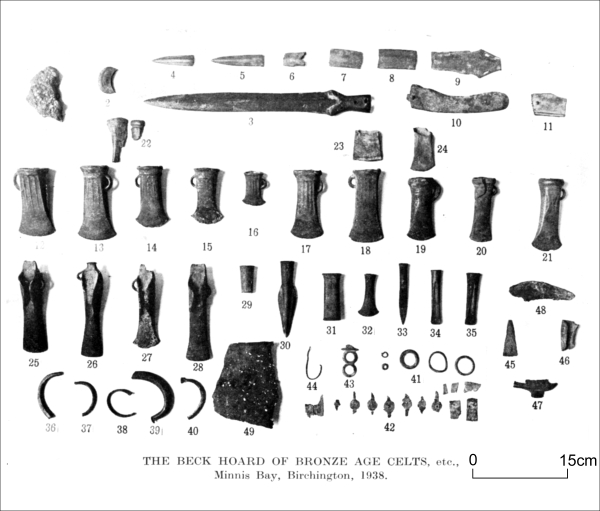
Today’s image for Day 202 of the VM_365 project is of the bronze objects, pottery and other artefacts in what has become known as the Beck Hoard.

In 1938 a boy called James Beck noticed some dark patches on the flat wave cut platform on the beach beyond the cliffs at Minnis Bay, Birchington. With the assistance of Antoinette-Powell Cotton who lived nearby at Quex Park, James excavated and recorded several of the pits and the finds within them.

In one of the pits the large bronze hoard shown today’s image was recovered, along with some large sherds of pottery. The hoard contained swords, palstave and socketed axes, spear heads along with smaller bronze objects, ingots and fittings. The details of the Beck hoard were published in Archaeologia Cantiana by G.F. Pinfold, curator of the Powell-Cotton Museum and Major Percy Powell-Cotton.

The pits were once  much deeper, having been cut from a land surface that stood at a higher elevation, which had been truncated by wave action to the level of the eroded platform that lies at the base of the present cliff line.

The Beck hoard is one of several that have been found on the present coastline of the north side of Thanet, the earliest discovery being the Mutrix Farm hoard which was shown in VM_365 Day 81. Rapid erosion of the soft deposits along this coastline is eating its way into the valleys and hill tops that would have been some distance from the sea in the Bronze Age landscape.

VM_365 Day 201 Memories of metal on ring stamped Bronze Age pottery from Margate

VM 201

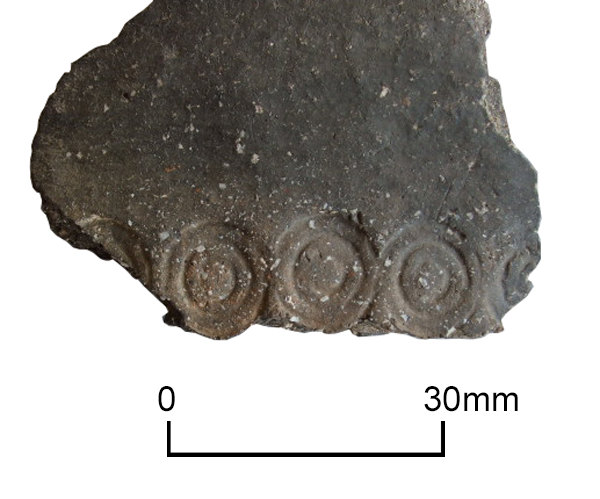
Today’s image is of a decorative motif on a piece of  pottery from the transitional period between the Middle and later Bronze Age.

The sherd from a vessel closely related to the one shown in Day 199, which contained the Birchington Bronze Hoard. Close inspection of the globular bowl from Birchington shows that it was decorated with a horizontal row of stamped rings, following the centre line of the body.

The sherd shown in the VM_365  image today is from another similar flint and grog tempered vessel, this time from Margate. The Margate pot is also likely to have been decorated with a single row of stamps from an object carved with a series of raised concentric circles. The stamping was added after the outer skin of the pot had been burnished to a smooth finish. On the current evidence – including the dating of the hoard from within the Birchington bowl the date of the vessel the sherd came from and other pots like this should be placed between c.1350-1150 BC.

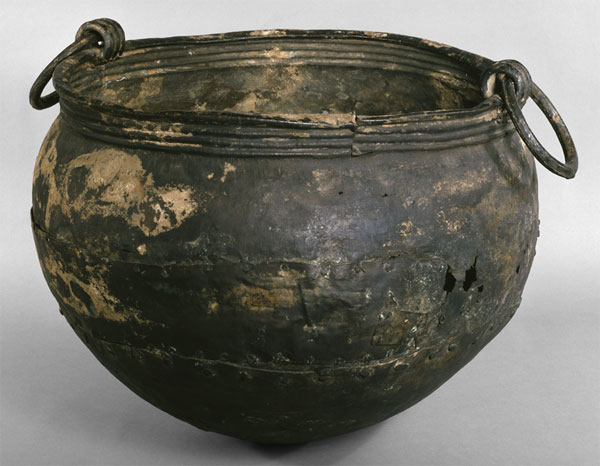
Like much of the decoration applied to Bronze Age pottery, the ring pattern is thought to be skeuomorphic,  each of the stamped rings emulating the rivets that would have joined two sections of a bronze bowl into a globular shape.

A bronze cauldron  that was found at Shipton on Cherwell in Oxfordshire which is now in the Ashmolean Museum, gives an idea of the riveting patterns on bronze vessels that may have inspired the ring stamp motif on the pots from Birchington and Margate.


VM_365 Day 199 The Birchington Bronze Hoard

VM 199

After Powell-Cotton et al 1924.

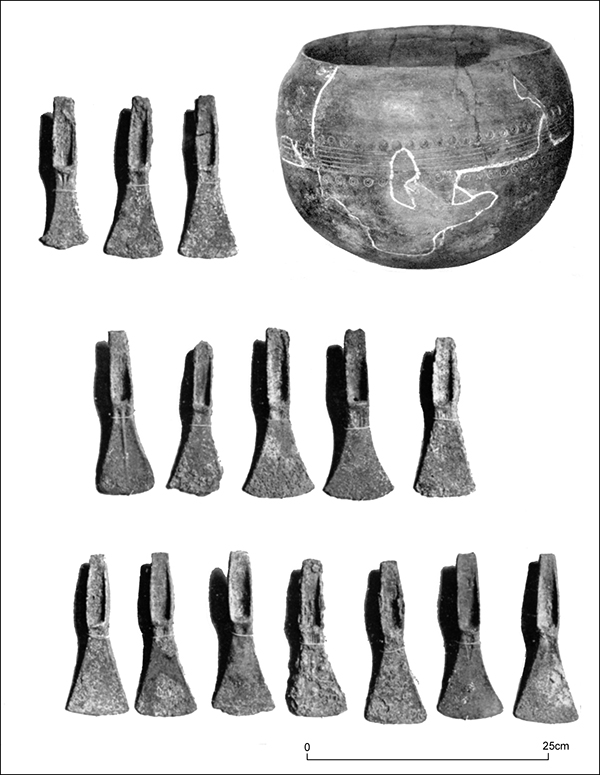
The image for Day 199 of the VM_365 project shows a Middle Bronze Age Bronze Hoard found in 1904 during brickearth extraction at Birchington.

The hoard comprised 14 palstave axes found in a globular fineware bowl of Deverel Rimbury type. Deposition within a pottery vessel is unusual and few other similar examples exist.

The vessel, which had been broken and the lower parts of which were missing, was stamped with two bands of concentric impressed rings above and below a band of scored horizontal lines. The vessel was restored in 1923.

References

Powell-Cotton, P. H. G. and Crawford, O. G. S. 1924. The Birchington Hoard. The Antiquaries Journal 4, 220-226.