VM_365 Day 96. Roman Enamelled Brooch from the Villa at Minster in Thanet

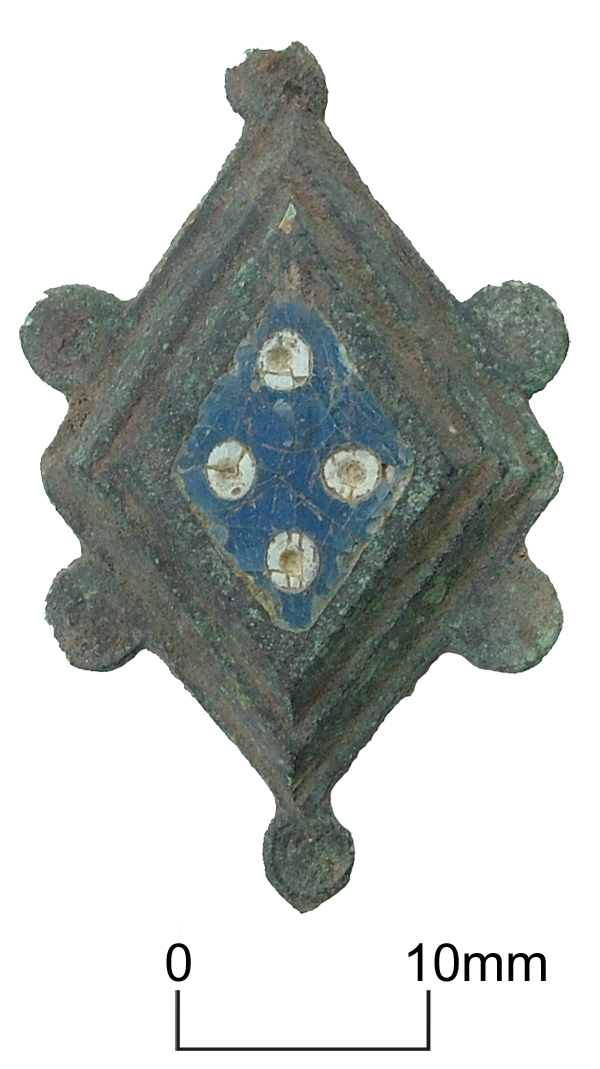
VM _96Our image today for VM_365 Day 96 is of another of the enamelled copper alloy brooches that were found at the excavations of the Roman Villa at Abbey Farm, Minster. Enamelled brooches like this were made in the later 2nd century AD.

The lozenge shaped, equal ended plate brooch, has two circular lugs at either end covering the catch plate and two equally spaced  circular lugs on either side. The brooch has been cast so  that the front rises in two stages to form a lozenge shaped cell in the central area, matching the shape of the outer edge. The cell  is filled with blue enamel with  white glass spots inset at each angle. The back of the plate is  a circular hollow between the two ends of the clasp.

The brooch was found during a metal detector survey over the plough soil of the field in 2004, while trenches were being excavated on another part of the site. A wider survey of an excavation site using methods like metal detecting or field walking can often reveal finds that have been moved from their original context, usually when cultivation of the ground has disturbed the archaeological features below. The Villa at Abbey Farm had been very heavily truncated by ploughing and general erosion, reducing most of the site below foundation level. Finds  from the wider area of the site where many of the artefacts like this brooch are dispersed can provide some information on the type and date of the archaeology that has been lost.

Other brooches from the same Roman Villa site have been shown in our posts on Day 90 , Day 89 and Day 88.
VM_365 Day 95. Artefacts waiting for their time to come

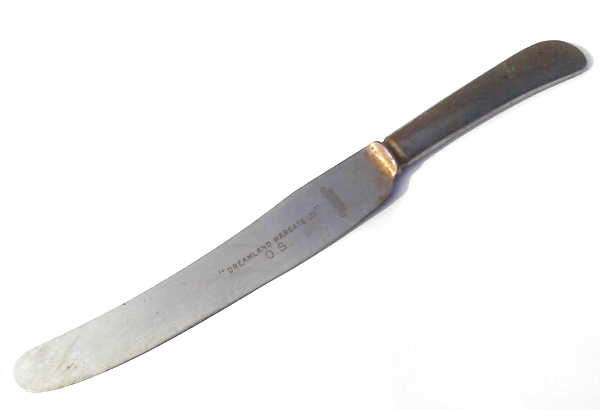
Image of a stainless steel dinner knife stamped Dreamland Margate Ltd
Dreamland lost and found

Today’s image is of a stainless steel dinner knife, unearthed a few years ago in the topsoil overburden of an archaeological excavation in Ramsgate. When it was discovered a few years ago, Margate’s regeneration was in its infancy and the Dreamland theme park on Margate’s sea front was just a faded and fire damaged memory of the past.

For many years it has migrated around our store, finding refuge in the oubliettes that hold the collection of objects from sites that are on the margins of being archaeological. It has languished in desk top pen holders and among the plastic toy characters and other objects that couldn’t escape the magpie tendencies of archaeologists.

The knife was unremarkable except for the stamped inscription on the blade which reads “Dreamland Margate Ltd.” O.S’, Guaranteed Stainless.

Times change and our attention has begun to focus on things that have been lost and we try to find ways to bring back a sense of their value. Margate’s  arts scene is having its moment in the spotlight, Vintage is the new Zeitgeist and Dreamland is returning to the Sea Front.

We are now interested in the minutiae of the recent past and suddenly our knife, which carries the memory of Margate’s former glories wakes from its slumber to become an object of interest: memorabilia, Vintage curio, exhibit?

VM_365 Day 94. Reconstructed Roman Rotary Quern

VM 94

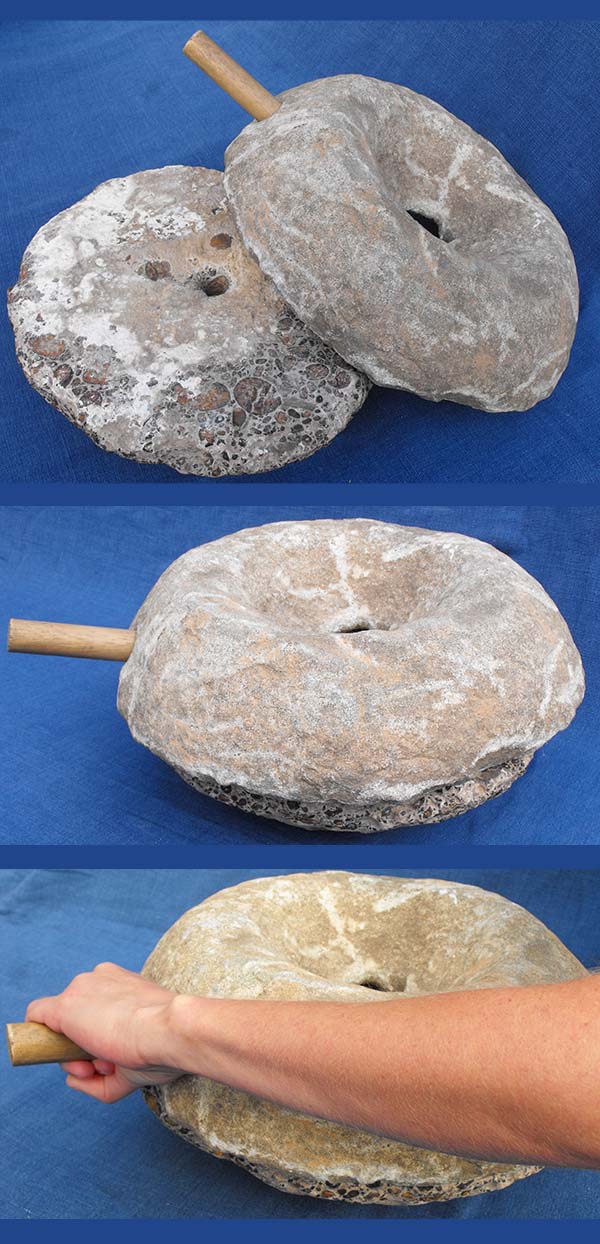
Today’s image is a reconstruction of a Roman Rotary quern. The quern stones were found on two separate sites, one from Broadstairs (bottom) and one from St. Nicholas at Wade (top).

The stone on the base is made of Hertfordshire Puddingstone, a natural conglomerate frequently used to make quern stones, the upper stone is Folkstone Greensand.

The base has a socket in the centre for a spindle to hold the two sections together. The top stone has a hole for a handle to allow the quern to be rotated backwards and forwards and a hole shaped to form a hopper where grain is poured in. The grain then passes between the grinding surfaces of the upper and lower stones, crushing them into meal or flour.


VM_365 Day 93. Decorated Samian sherd from Broadstairs

VM_91

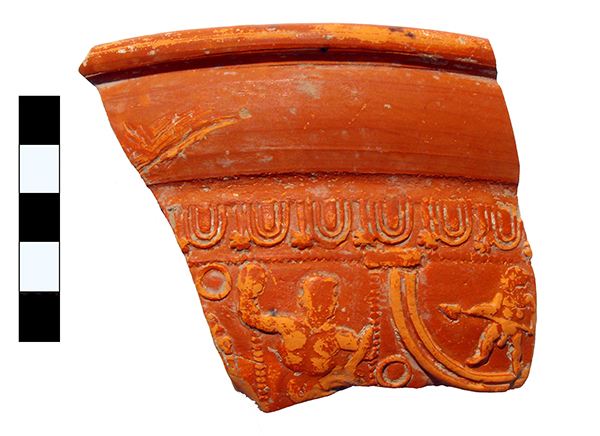
Today’s image shows a sherd of Roman samian pottery excavated from a small site near Bleak House, Broadstairs in 2009. This was one of 81 sherds of samian pottery recovered on the site representing 33 different vessels.

The piece shown is one of 11 from the same highly decorated bowl (a Dragendorf form 37) from Central Gaul, dated between 100-130 AD. The decoration is  arranged in panels divided by bead borders under an ovolo (egg shaped) border that surrounds the whole bowl.

The images on the vessel show part of a figure of the war god Mars and in a second panel in the upper half of a medallion, a nude pigmy warrior.

These motifs on samian bowls are common to Central Gaul where this bowl was manufactured.


VM_365 Day 92. Promoting Pride in a Prehistoric Presence

Images of Prehistoric Thanet
Images from Prehistoric Thanet

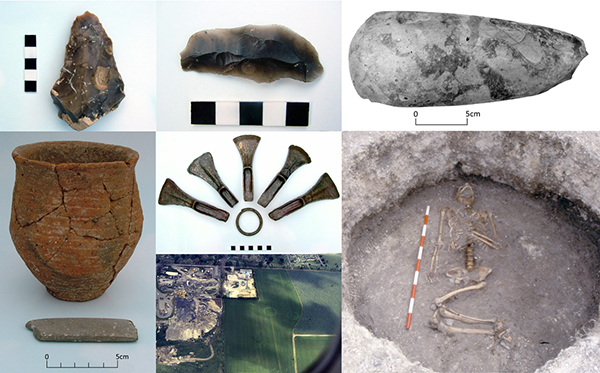
Today’s image for Day 91 of VM_365 is a reminder that Thanet’s past extends long into the prehistoric period. Our archaeological record has some of the most interesting and important evidence of the earliest periods of human settlement.

There is evidence from Thanet from the period of the earliest of our human ancestors, and from the first hunter gatherers who ranged over the landscape after the last Ice Age hundreds of thousands of years later.

There have been archaeological finds from all the periods recognised by prehistorians, from those Mesolithic hunters thorough the Neolithic, Beaker, Bronze Age and Iron Age.

Six thousand years of our human story are represented only by archaeological finds and sites and some of the most important have been discovered on the Isle of Thanet. Prehistory is now part of the school curriculum and it should be in the mind of anyone interested in the long story of the Isle of Thanet.


VM_365 Day 91. Underground Industrial Heritage Revealed

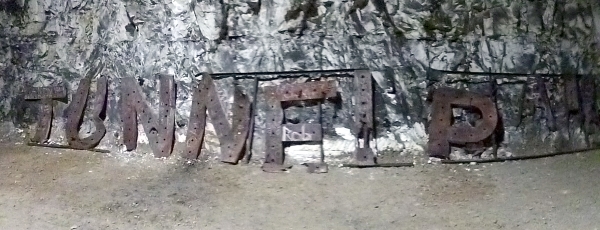
Tunnel Railway signOur post today for VM_365 Day 91 comes from an exciting weekend field trip by the Trust and friends to the Ramsgate Tunnels.

The letters arranged on the wall at the entrance to the chalk passage are from the sign for the Tunnel Railway, as the complex of railway lines and stations came to known.

The site combines a significant experience of the industrial archaeology heritage of the Ramsgate area, with a site associated with the defences of the coastal region in the First  and Second World War. A complex of passages, cut into the chalk to create air raid shelters for thousands of people, encircle the town of Ramsgate and the Ramsgate Tunnels experience allows a long section of the air raid shelters to be explored.

Within the tunnels is preserved the record of the many amateur urban explorers who explored the tunnels while they were closed to general public access. The names, slogans and dates scribbled and painted on the walls show how the Ramsgate tunnels remained in the consciousness of local people, their fascinating history waiting to be brought to life as a very popular public attraction.

VM_365 Day 90. Roman Equal-ended Brooch

VM_90

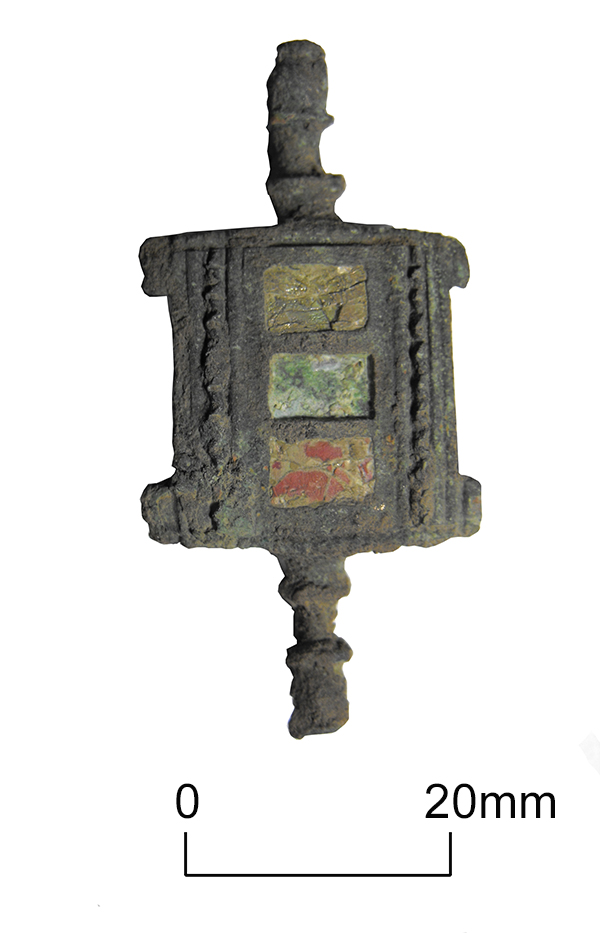
Today’s image for VM_365 Day 90 shows another brooch from Abbey Farm Villa, Minster. This equal ended brooch was found in the subsoil above buildings found on the southern side of the villa complex along with a small quantity of 2nd century pottery.
Over time this copper alloy brooch has become corroded but we can still see that it  has a rectangular plate with lugs. The centre has three equal sized rectangular cells filled with enamel; the bottom cell is coloured red, the middle cell is now empty and the top cell appears to have been green or yellow enamel. Either side of the enamelled cells is a side panel with a beaded rim and rectangular lugs at the corners. This type of brooch was widespread in the 2nd and early 3rd century.

VM_365 Day 89. 2nd Century Brooch from Minster, Thanet

VM_89

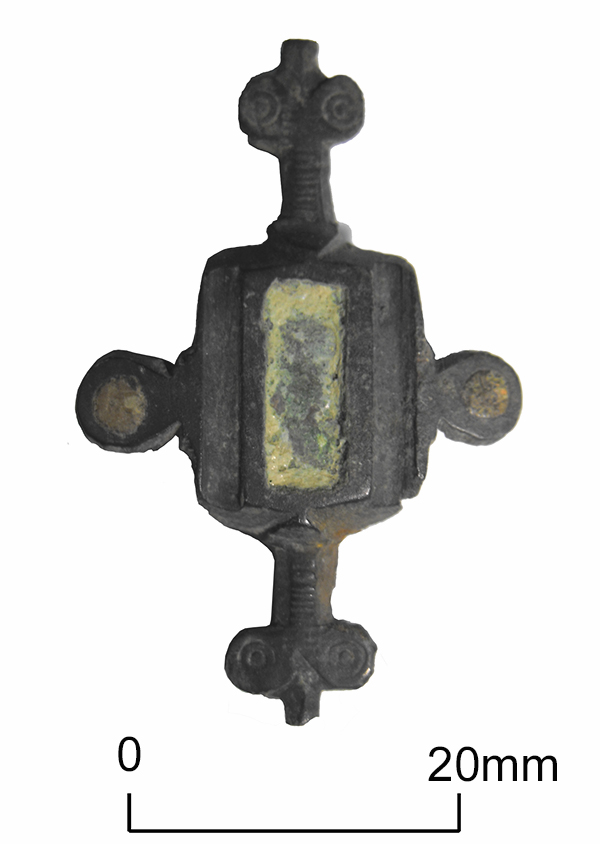
Today’s image is of a 2nd/early 3rd century brooch from Abbey Farm Roman Villa, Minster-in-Thanet. It was found in the upper fill of a well shaft which had been deliberately backfilled with large amounts of pottery and domestic rubbish. The pottery from the well shaft dates to the 2nd century with a few sherds as late as the early 3rd century.

The brooch is equal ended with a rectangular plate and two circular lugs. The projections are moulded and decorated with two sets of concentric circles and are broken at either end. In the centre of the brooch is a rectangular cell which was filled with enamel, now coloured yellow. The lugs are also decorated with two circular yellow enamelled cells.

References
Parfitt, K. 2007. The Roman Villa at Minster-in-Thanet. Part 4: The South-West Buildings, 6A and 6B. Archaeologia Cantiana CXXVII, 261-296.

VM_365 Day 88. Rosette brooch 1st Century AD

Thistle or rosette brooch of 1st century date from Minster in Thanet

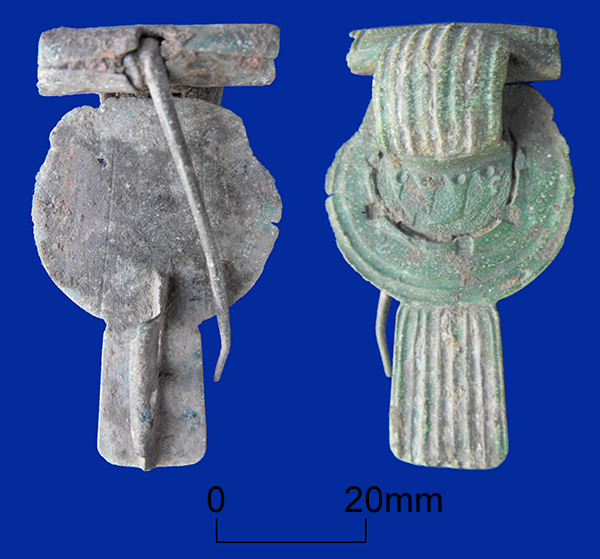
Today’s image for VM_365 Day 88  is of a brooch from the 1st century AD, which was found in the excavations at the Abbey Farm Villa at Minster in Thanet. This type of brooch has a cast thistle or rosette form with elaborate relief decoration. A cylindrical roll of metal covers the spring for the fastening pin at the back of the brooch.

This type of brooch was first made in the first half of the 1st century AD, before the Roman conquest of Britain. The rosette or thistle brooch was commonly used on the continent, particularly in Gaul and on the German frontier, as well as in southern Britain before the Roman invasion. This type of brooch is occasionally found on sites that date from shortly after the Roman Conquest and often accompanying burials of the early conquest period.

They may have lasted into the Roman period as family heirlooms, because of their particularly fine style and quality.

Reference

Bailey, J. and Butcher, S. 2004. Roman Brooches in Britain. Reports of the Research Committee of the Society of Antiquaries of London No. 68. London.

VM_365 Day 87. Local materials for local bakers.

Large flint nodule worked into a grinding surface

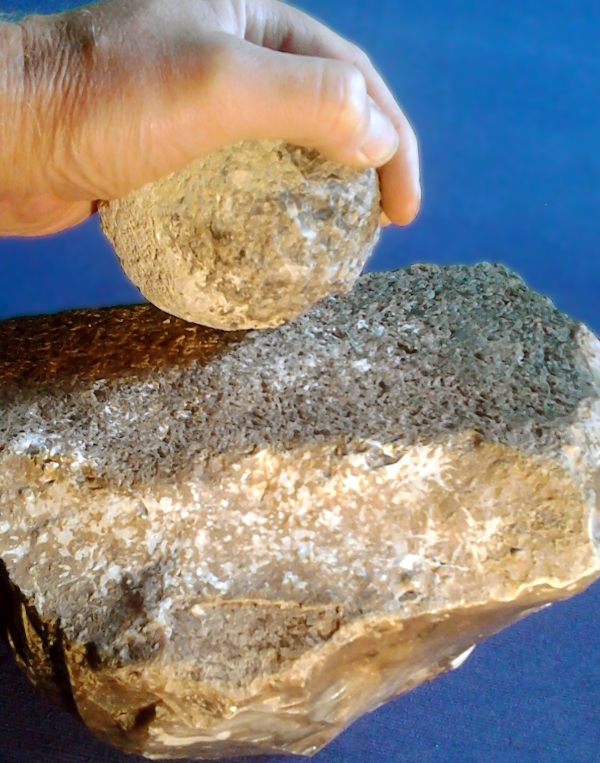
Today’s VM_365 image shows two artefacts from Iron Age sites in Thanet. One is a large stone with a flat grinding surface, found at a large Iron Age settlement site at South Dumpton Down near Broadstairs. The second object is a spherical rubbing or grinding stone, which fits comfortably into the hand, which comes from a contemporary site at North Foreland, Broadstairs.

The two objects demonstrate how local materials, in this case flints from seams within the chalk that underlies both sites, were adapted for tools associated with daily activities. Both objects were transformed by regular working into something quite different to their irregular natural state.

The surface of the larger flint was pecked and ground to a horizontal surface by the rubbing and grinding action that may have taken place every day. The smaller flint was chipped and ground into a sphere through a similar regular striking action, possibly while it was used as a rubbing stone used on a similar flattened surface. Rotating the object in the hand for comfort  probably created the spherical shape over time.

The combination of the two objects, under the power of a human hand, created an abrasive process, which was possibly used to rub grains between the stone to make flour, or to grind other foodstuff into powders or pastes.