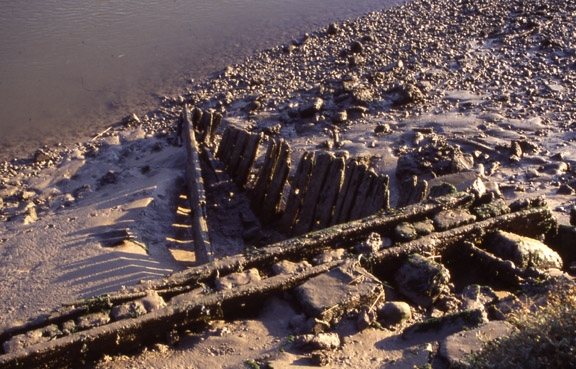
To commemorate the 100th anniversary of the start of the First World War, today’s image is of the timber structures at recorded at Stonar Cut, Richborough in 2005.
One of the least known structures of World War I is the Stonar Port, constructed between 1916-1918 to supply the Front Line in France and Belgium using the French canal network. Today only the upright timbers of the once extensive wharves survive to be seen in the water line along the River Stour.
Along with the structures that were added in the Second World War, this port and the many thousands of people who served their country in the two wars are not well known outside the military history field.
Find out more about our survey carried out in 2005 in the Virtual Museum.
Further reading:
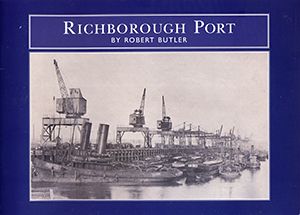
Butler, R. 1999. Richborough Port. Pfizer Ltd. Sandwich
We have a very limited amount of these publications for sale. If you wish to purchase a copy for £5.00 plus £2.00 p&p (UK only) leave a comment and we will get back to you to arrange payment.
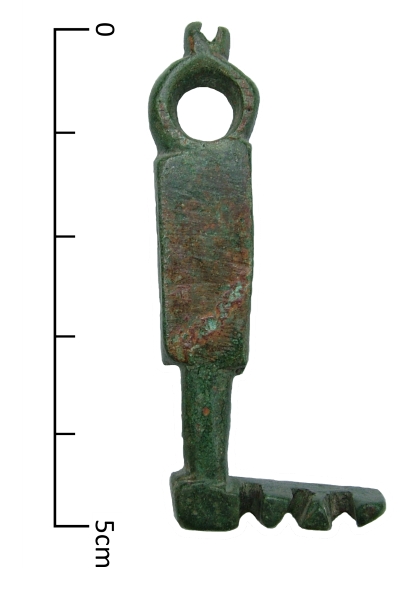
Today’s image is of a Bronze key once again from the Anglo Saxon cemetery at Sarre, also found in grave 286, like the glass beads shown yesterday.
The key is made of copper alloy or bronze and is beautifully preserved. It was found in association with a bronze handle and some sheet bronze fragments which may be the remnants of a casket with its key that were placed in the grave alongside the body.
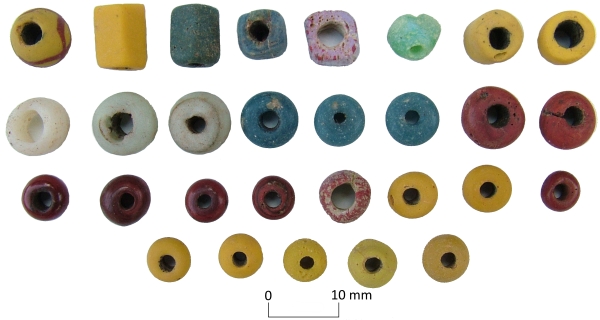
Following on from yesterday’s image of the gold thread in grave 285 from Sarre, today’s image is of 29 glass beads found in grave 286 from the same Anglo Saxon cemetery site.
The grave was large and well cut, most likely containing a female, based on the objects within it. Like grave 285 it had been disturbed in antiquity, skeletal material and objects left behind by the robbers were scattered throughout the grave fill.
Among the objects found within the grave were nine amber beads and thirty one glass beads. Twenty nine of the glass beads are shown in the picture above, all are coloured glass. The one at the top left hand corner is a multi coloured or polychrome bead, almost globular in shape and of yellow glass with brown crossing trails. The other beads range in shape from pentagonal cylinders, 4 sided cylinders, short cylinders, discs and one is pear shaped.
Find out more about the site by reading:
Brent, J. 1866. Account of the Societies Researches in the Saxon Cemetery at Sarr. Part 2 Archaeologia Cantiana VI, 157-85
Brent, J. 1863 . Account of the Societies Researches in the Saxon Cemetery at Sarr. Archaeologia Cantiana V, 305-22
Perkins, D. R. J. 1991. The Jutish Cemetery at Sarre Revisted: A Rescue Evaluation. Archaeologia Cantiana CIX, 139-162
Perkins, D. R. J. 1992. The Jutish Cemetery at Sarre Revisited; Part II. Archaeologia Cantiana CX, 83-120
For more on the clothing of the Anglo Saxon period read Penelope Walton Rogers’ excellently researched and illustrated book:
Walton Rogers, P. 2007. Cloth and Clothing in Early Anglo-Saxon England. CBA Research Report 145, Council for British Archaeology: York.
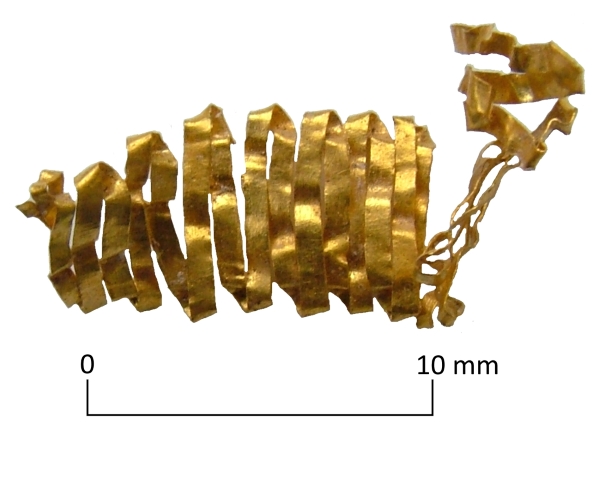
Today’s image is of a fragment of gold thread found in a mid to late sixth century grave at Sarre in 1990. The grave of an adult, probably a female, was disturbed in antiquity with the whole of the grave being emptied and backfilled.
The thread measures approximatley 20mm long and has been cut from a gold foil sheet that was 96.595% pure. The strip was folded and used in a brocaded pattern with textile threads, probably worn in a head band across the brow or decorating the edge of a coif or hood. The band was tablet woven and the pattern was inserted during weaving, not embroidered afterwards; the impressions of the textile threads can be clearly seen on the gold thread.
Similar gold threads have been found in Kentish graves of a similar date at Monkton, Bifrons, Lyminge and Faversham and are probably of continental origin.
Find out more about the site by reading:
Brent, J. 1866. Account of the Societies Researches in the Saxon Cemetery at Sarr. Part 2 Archaeologia Cantiana VI, 157-85
Brent, J. 1863 . Account of the Societies Researches in the Saxon Cemetery at Sarr. Archaeologia Cantiana V, 305-22
Perkins, D. R. J. 1991. The Jutish Cemetery at Sarre Revisted: A Rescue Evaluation. Archaeologia Cantiana CIX, 139-162
For more on the clothing of the Anglo Saxon period read Penelope Walton Rogers’ excellently researched and illustrated book:
Walton Rogers, P. 2007. Cloth and Clothing in Early Anglo-Saxon England. CBA Research Report 145, Council for British Archaeology: York.
Although Saturday 12th of July, the day of our fourth annual Archaeology for You event, was preceded by some impressive storms and rain, the wet weather held off for the day.
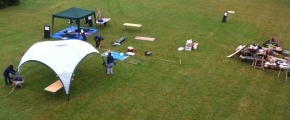
As in previous years we set up our eight Archaeology for You activity areas on the lawn in the gardens at the front of Quex House. With only some areas under shelters, our fingers were tightly crossed that the weather would stay calm over the day for the activities that were set up in the open air. The upper windows of Quex House provided a convenient vantage point for a photograph to be taken of our team of Trust Staff and volunteers setting up for the event.
Set up for Archaeology for you 2014, viewed from Quex House
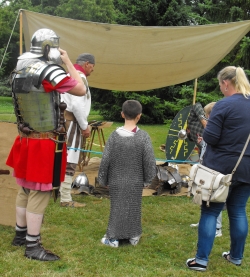
Iron Age and Early Roman re-enactment group De Bello Canzio joined us again this year bringing a sense of the real lives behind the objects from that era that we had on display and our activities were arranged in the form a large circle so that people could progress from experiencing the methods of investigation in the field, toward the interpretation of objects and their use in the Re-living Ancient Life activity area.
Romans from De Bello Canzio with a new recruit to the Legions
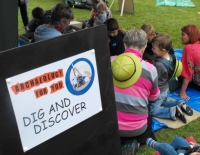
The new Archaeology for You logo we launched for the event this year was used on our display boards to guide people to each of the activities.
Our Logo in action on the activity signs
This year, each of the areas where methods of practical archaeological investigation were demonstrated was linked by the four corner posts of a 10 metre square, fitted with strings and tapes to demonstrate how grids form the backbone of archaeological research. This formed the arena for the demonstration of site surveying using Geophysical and Aerial Survey in Seeing Beneath the Soil and the hands on Dig and Discover boxes, in their new green livery. The grid took centre stage as the framework for Pictures, Plans and Paperwork, where people could learn about the recording process and for Evidence from Objects where finds could be processed and examined for clues about the past.
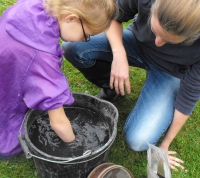
Our aim for Archaeology for You is to build a complete experience of the processes that archaeologists use to digs and the methods used to make records and understand the evidence of the past, which anyone can take part in. Many people took part in our Give it a Swirl
Giving an environmental sample a swirl
introduction to processing samples taken for environmental evidence and busy potters made pre-historic style vessels at Inspired by the Past. Great imagination was also used to create mosaics that reflected favourite themes from mythology and the modern world.
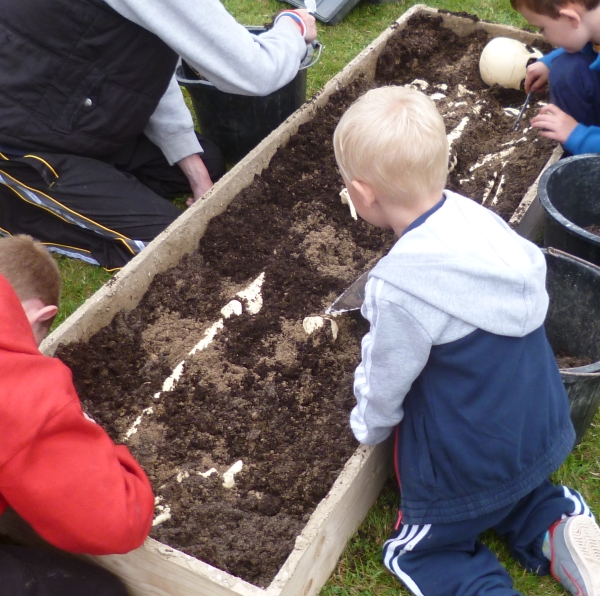
Every year we try to introduce a new element to the activities at Archaeology for You and in our Bones and Burials area this year we recreated a burial, which had to be carefully excavated and recorded over the day.
With the aid of our other teaching skeleton and books people taking part in activity can get a feel for the complicated digging and recording that is needed to get the most information from each burial that is investigated by archaeologists.
Excavating in the new skeleton activity
Archaeology for You is one of the education activities of the Trust for Thanet Archaeology that is supported by a grant from the Education Committee of the Kent Archaeological Society. The Powell-Cotton Museum is generous in allowing us access to their gardens for the event each year and the Director and staff of the Museum give a great deal of support to the event.
We would like to thank everyone who came along on the day and took part, we learn as much each year from the people who take part in Archaeology for You as they do taking part in our archaeological activities for all ages.
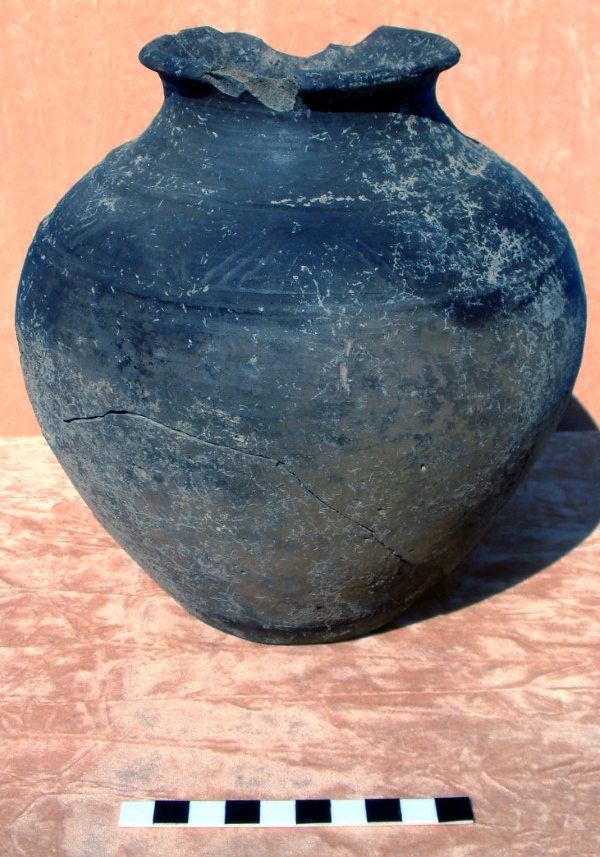
Locally made pottery Jar, encapsulating the transition from Iron Age to Roman culture
Today’s image for Day 32 of the VM 365 project is of a pottery vessel dating from an interesting period in history which is well represented in Thanet’s archaeological record, the later stages of the Roman conquest of Britain (50-75/100 AD).
Dating from a period when Late Iron Age pottery traditions were giving way to new Romanising production techniques, this near complete jar in a pottery fabric known as Thanet silty ware is decorated with raised beads and a chevron pattern around the upper part of the body. This particular vessel dates no later than 60-75 AD, a couple of decades after Britain was invaded and occupied by Roman forces.
The jar was recovered from the fill of a pit (cut 216) at an excavation at a site in Sea Parade, Birchington, it survived almost intact with only one large crack in the body of the jar and some damage to the rim. Characteristically for this type of vessel it has been deliberately made with three holes in the base, much like a modern flowerpot.
The many complete or near complete vessels of this period that have been recovered in excavations carried out at Minnis bay, particularly those of Antoinette Powell-Cotton in the 1950’s and 1960’s. The pottery sherds and vessels from these sites have been the foundation for classification and dating this important sequence of pottery, which spans a time of major cultural change.
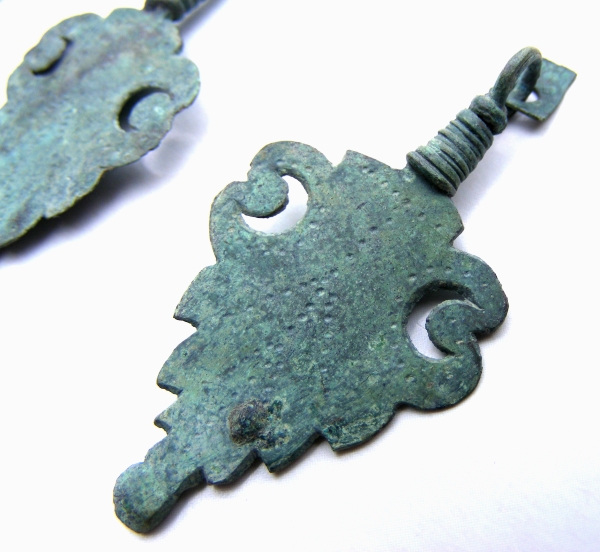
Ooops, this one needed updating to Day 31. Still checking our information on what these pendants might be – apron terminal pendants or horse harness pendants? Anybody have any parallels?
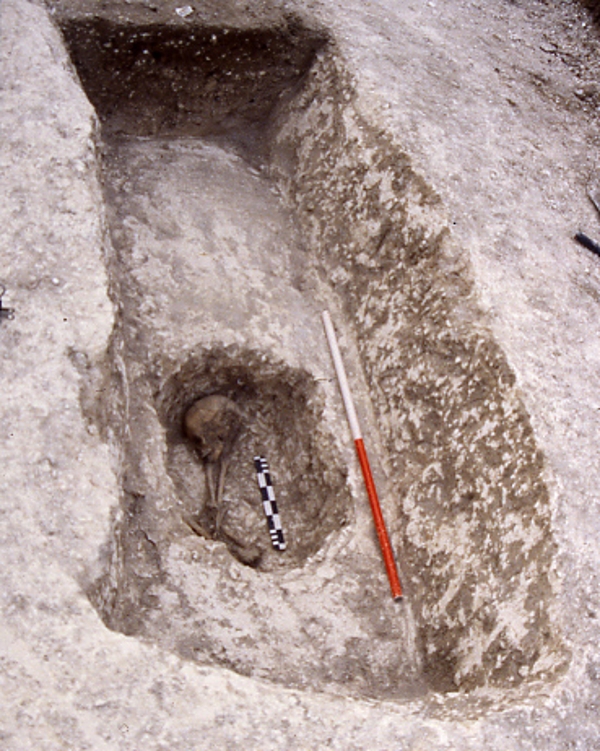
Can we find out who this person buried in the ditch of a round barrow was?
What drives our interest in following the trail of evidence from aerial photographs to the archaeology in ground that has been shown in the VM 365 images over the last few days?
The image for Day 30 of the VM 365 project shows a human skeleton, a young adult that was buried in a small grave that was excavated into the terminal of the round barrow that was shown in yesterday’s image. The grave fill overlying the skeleton was covered with a large fragment of whale rib.
Rather than focus on the excitement of the excavation process that revealed this burial, we should pay attention to the motivation for carrying out the investigation which is often overwhelmed by the excitement about the external character of the results.
The fundamental reason for developing the methods of archaeological investigation was, and remains, curiosity about the places we live in and about the people who have occupied the same places in the past. There are no written records describing the circumstances and experiences of life in periods such as the Bronze Age which are represented in such abundance in the Isle of Thanet. There is no evidence that emanates from their direct experience, which could be used to reconstruct their lives. The people under investigation in these circumstances are truly pre-historic, we lack any tools but archaeological methods to generate knowledge about them and to create narratives of the events that affected them.
Our interest in the universal set of questions, who, where, what, why, and when will not rest for lack of easy evidence and careful exploration and analysis can be used to describe the circumstances of discovery in ever greater detail. Once we understand as much as we can about the circumstances of discovery, and describe them with as much precision as possible, we can begin to interpret the meaning of the things we have discovered. Archaeological investigation must also be used to established the limits of our knowledge. If we take careful note of the present conditions of our discoveries we can begin to understand that many things that are lost from the image of the past we can generate.
Archaeology is about exploring the deliberate construction of messages by people in the past, the signal, as well as the inadvertent or deliberate destructive processes that can distort part of the message, the noise. To produce good and thoughtful interpretation; assumptions should be questioned; different perspectives adopted on the data and our ideas subjected to critical review.
There is always something new to said and new information that can be gathered from the evidence collected by archaeologists. In the case of this burial, its inclusion in a research programme investigating Isotopic data that can be extracted from the teeth will in due course add more to the constellation of knowledge that gathers around the physical remains we recover from excavations.
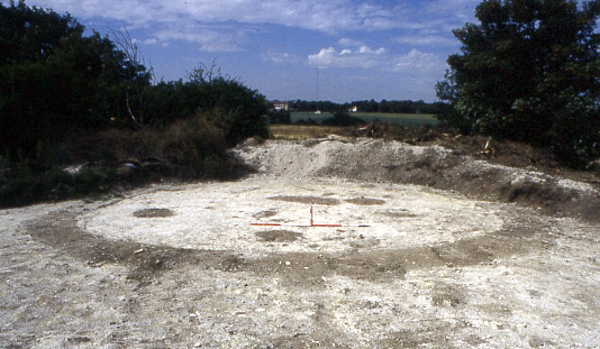
Circular ditch at North Foreland, Broadstairs showing in chalk geology after plough soil has been removed.
We know from the image in Day 28 of VM_365 that the locations of the prehistoric burial mounds of Neolithic and Bronze Age Thanet can still be traced from the influence they have on the growth of the crops in the fields that lie over them.
Today’s image, taken at a site at North Foreland near Broadstairs, shows what happens when the thin skim of plough soil that overlies the ditches is removed by archaeologists, using a combination of a carefully controlled mechanical excavator and a final clean up using hand tools.
Once the earth filled ditches and pits underlying the plough soil has been exposed, planning and recording can take place before any further excavation is carried out to examine how deep the surviving ditches may be, and to recover any finds that can help to give a date for the feature.
Careful attention is paid to the irregular patches of dark soil that are enclosed within the ditch because these may be contain the burials that were marked by the ring ditches and their associated mounds as enduring features in the landscape . Other burials were often inserted later, when the mound and ditch surrounding the burial had become a familiar feature in the landscape.
At this stage an archaeological site which was previously known only through images holds the potential to produce physical evidence for the past.
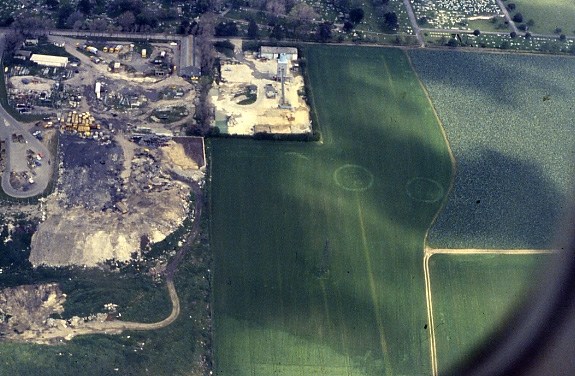
Another image today from our slide archive taken in the early 1990’s, showing how we know so much about the past of the Isle of Thanet without even touching the ground.
The image shows the cropmarks of two ring ditches, located in the fields behind Margate cemetery and council tip. These cropmarks undoubtedly represent the enclosures of unexplored Bronze Age burial mounds, just two of many hundreds of such features that are known to exist on the Isle of Thanet and have been identified in aerial photographs.
Many unsubstantiated ideas have accumulated around the huge number of these ring ditch cropmarks and the prestigious burials they represent, including a spurious association with Procopius’s ‘Island of the Dead‘ legend. However, their frequency and survival in the landscape undoubtedly contributed to the name that was given to Thanet as a territory in the early political divisions of Kent.
In the Domesday survey of the 11th century, the Isle of Thanet constituted a ‘Hundred’, a collection of a hundred smaller divisions of plough land called hydes. Known as the ‘Hundred of Ringslow’, the Hundred of ‘ring-mounds’, the name shows that the Bronze-Age past of the Isle had a lasting influence on the area.