VM_365 Day 136 Ramsgate Late Neolithic Grooved Ware sherd

Late Neolithic Grooved Ware sherd

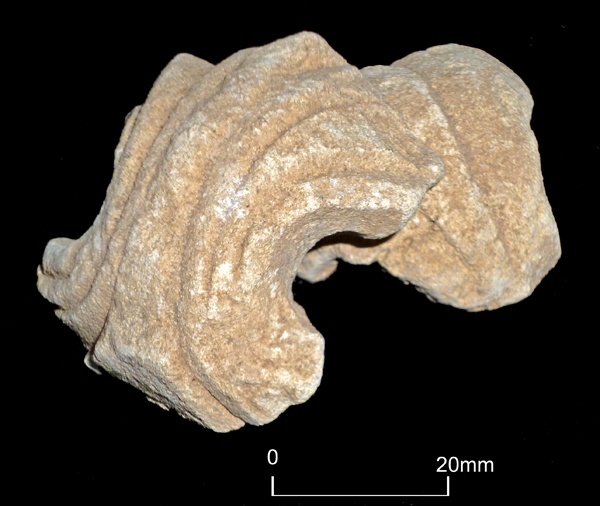
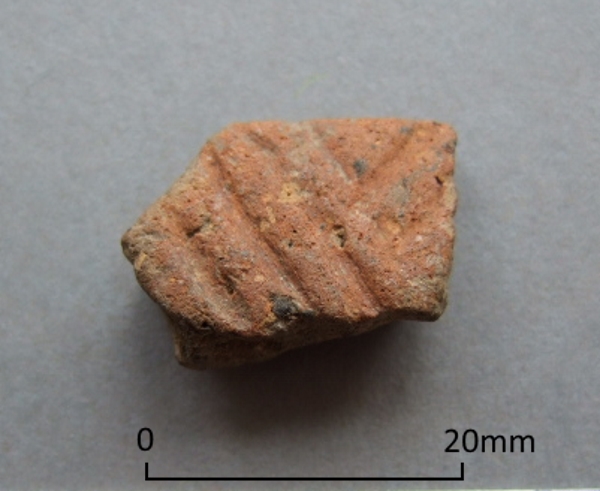
Today’s Image for VM_365 is of a small scrap of Late Neolithic pottery from 1976 excavation of the ring ditch of one of the ceremonial enclosures at Lord of the Manor, Ramsgate.

The sherd is a rim fragment from a tub-shaped vessel with a small-diameter. The exterior of the rim is decorated with incised grooves, the inner edge of the rim has a distinctive bevel, similar to the rims of other examples of this type of pottery. The typical decoration of the sherd with a pattern of grooves in the surface, provides the name that has been given to this ceramic tradition; Grooved Ware.

Before flat based grooved ware vessels began to manufactured, all Early and Middle Neolithic pottery in this country was made with round bases. Grooved Ware is believed to have been first used in the Orkneys, spreading southward across Britain and seems to represent the only truly ‘homegrown’ tradition in the entire history of British ceramics.

The style of decoration on this sherd, coupled with the beveled rim,  places the sherd into the Durrington Walls style, which was current during the main building phases at Stonehenge and is dated to c.2800-2300 BC

To date the tiny sherd pictured here seems to the best example of Grooved Ware archaeologists have recovered on the Isle of Thanet. Although it is small, the sherd  is a valuable hint that there may be more evidence of this important period of settlement to discover in the future.

The image and information for today’s VM_365 post were kindly provided by a guest curator, ceramic specialist Mr Nigel Macpherson-Grant

In 2007 a group of potters experimented with manufacturing Grooved Ware vessels, follow this link to the Prehistoric Ceramics Research Group website article on the process.
VM_365 Day 135 How to carve a spindle whorl.

VM 135-a

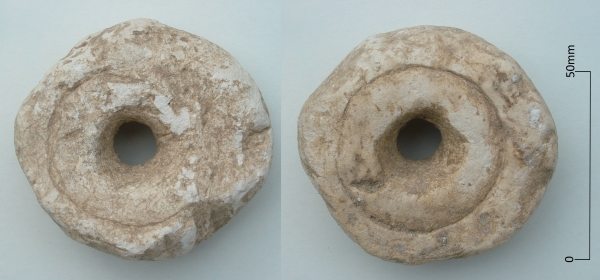
Day 135’s  VM 365 image shows the two sides of an unfinished spindle whorl of Late Iron Age or Early Roman date, which was found at in 2005 at Dumpton Gap, Broadstairs .

This particular object is  interesting because it shows the different stages that the maker went through to carve the spindle whorl from Chalk. The first stage would have been the selection of a suitable sized piece of hard chalk, probably picked up from the beach nearby, and carve it roughly into shape.  It seems likely that the outline was then scored in the chalk using a pair of compasses, marking the location of the central hole at the same time. The central hole would then have been drilled through the chalk and the finished object was shaped and finished more carefully using the scored circles as a guide.

We do not know why this object was abandoned part way through the manufacturing process, it may have been because the fragment was damaged, a large chip that had been removed from one side (left image) may have been the cause.

Although many of the objects archaeologists examine have been broken after use, it is rare to see one that gives such an insight into the manufacturing methods, because it has been abandoned while it was being made.

VM_365 Day 134 Flint butcher’s knife from Lord of the Manor, Ramsgate

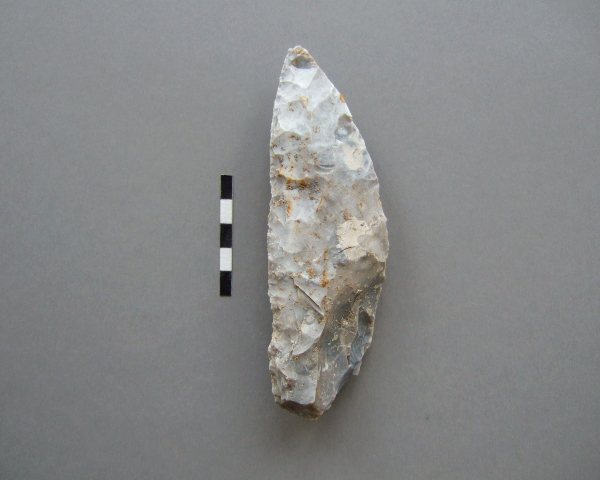
Flint knife of Late Neolithic to  Early Bronze Age date
Flint knife of Late Neolithic to Early Bronze Age date, suited for butchering animal carcasses.

Day 134’s  VM_365 image is of a flint knife, a prehistoric flint tool, that had been re-deposited in the fill of a chalk quarry pit dating to the medieval period and sectioned in excavations carried out in 2013.

The knife  has been carefully flaked on both sides, it is slightly thinner and curved on the cutting edge. It is comfortable to hold in the hand and could have been used without being set in a wooden or bone handle or haft.  The manufacture and use of this type of flint tool spans the  Late Neolithic to Early Bronze Age c.2800-1700 BC.

The knife would have been used for everyday meat processing tasks, although it is definitely not a skinning knife, which are usually thin and often polished for the careful task of smoothly separating hide from flesh. Because it is a thick and heavy tool,  it would have been ideal for butchering tasks; cutting joints; separating limbs and other heavy tasks.

VM_365 Day 133 Decorative Stone from lost Medieval Parish Church of All Saints, Shuart

VM 133

VM 365 Day 133’s image shows two fragments of decorative stone from the lost medieval parish church of All Saint’s, Shuart, which was excavated between 1978 and 1979 by the Isle of Thanet Archaeological Unit.

The image shows the fragments of delicately carved Caen stone dating from the 12th century. The carvings represent fragments of a piece of carved foliage, used to decorate the interior of the church. The pieces were found along with other contemporary fragments of decorative stone in deposits associated with the much later demolition of the church building.


VM_365 Day 132 Roman glass from Minster Villa

Roman window and vessel glass

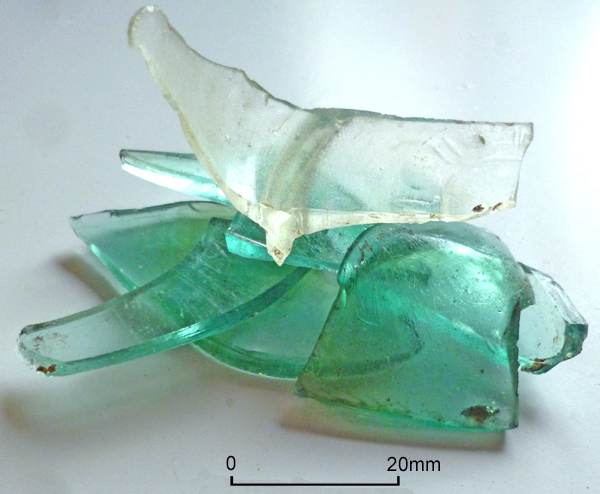
The image for day 132 of VM_365 is a selection of the fine glass fragments that were found in the excavations at the Roman Villa at Minster in Thanet.

No complete vessels were recovered from the site, but the fragments of sheet glass and the small pieces of vessel glass, including body sherds bases and rims, tell us that glass was as common on this site as it was on any other Roman building, where glass is sometimes better represented more completely in the archaeological record.

The glass sherds are in a range of colours, most commonly blues, greens and clear. One rare sherd is made from canes of glass in different colours welded into a muti-coloured pattern on the body of a vessel.

Typically for glass of this period the sherds are hard and clear, demonstrating the Roman’s mastery of glass making and the frequency with which glassware was used on the table and windows were used in their buildings.

Large sheets of glass were difficult to make and the windows in a building like the Minster Villa would have been composite structures with the glass held in place with a metal framework, like the one from the Tivoli Villa which was shown in VM_365 Day 78.

The small sample of glass vessel sherds shown here represent one of the most important pieces of evidence of the Roman way of life in Thanet from the 1st to the 3rd century AD.

VM_365 Day 131 Roman water Pipe

Second century AD Roman water pipe

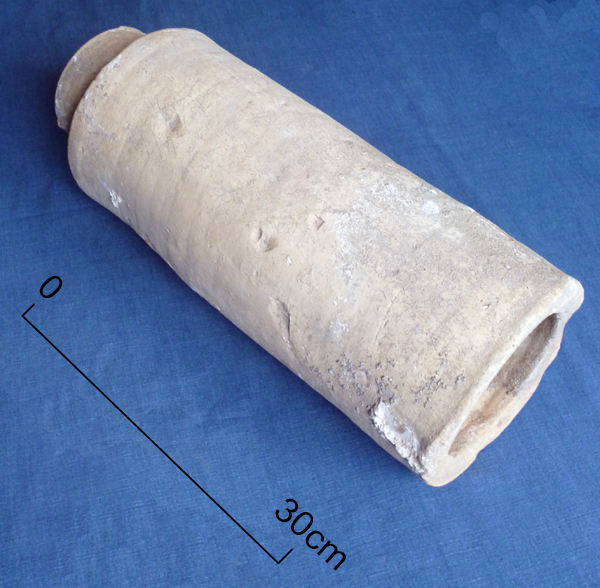
The  image for Day 131 of VM_365  is of a Roman ceramic water pipe dating to the second century. Like the perforated lead drain cover that was shown in Day 130, the pipe was excavated  from the area near a bath house at the Roman Villa at Minster.

Ceramic pipes like this one were manufactured to have an extended collar formed at one end, which would fit into the opening of another pipe, forming an interlocking series that could be made as long as was needed. The joints may have been mortared to prevent leaking. Water would flow through the pipes under gravity. Similar systems of pipes were even used by the Romans to lift water across valleys and even to raise water from one level to a higher elevation.

The pipe at Abbey Farm was found on its own, used in part of the drain leading from the lowest of a series of rooms of the bath house (Room 41 of Building 6A), which conducted the water that was discharged from the bath house into a drainage ditch.

Room 41 had originally been a cold plunge bath (room 41a) but it  was later adapted to become a hot plunge bath through the construction of a hypocaust  below the floor. A new tile lined drain measuring 2.65 metres long was assembled to discharge the  water into the  ditch. It was  later extended using more tiles and this ceramic pipe which may previously have been  used in another part of the site.

The ceramic water pipe is one example of the distinctive,  mass produced and specialised building materials that the Romans introduced to Britain.


VM_365 Day 130 Roman perforated Lead drain cover from Villa at Minster, Thanet

Perforated lead drain cover from Roman villa at Minster

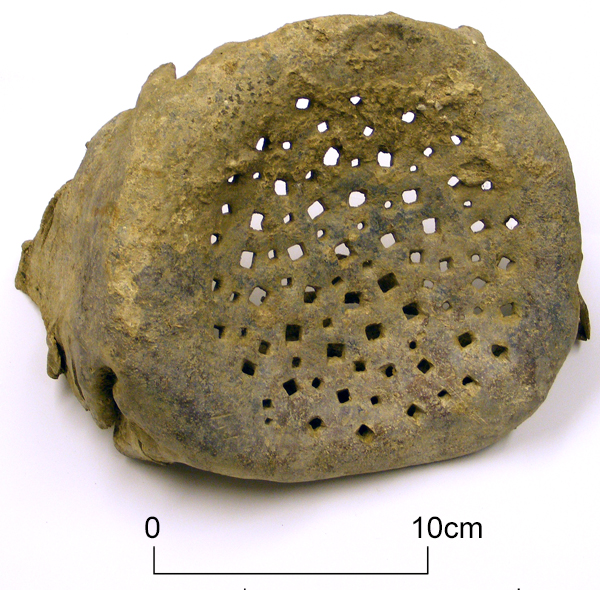
The image for VM_365  Day 130 is of an unusual  perforated lead drain cover dating to the 2nd century AD, which was found at the Abbey Farm Roman Villa site at Minster in 2004.

The object was made by bending a thick lead sheet  over the end of a pipe which is no longer present, forming the strange folded look of the outer flange. Using a square object, the pattern of small holes were punched into the surface of the lead that would have covered the opening of the drain pipe. It appears that the lead covering was intended to create a vent to distribute the flow of water, or perhaps a filter to prevent larger material from passing through the drain. Ceramic drain pipes were found on the site and the cover may have been fitted to one of these.

The lead cover was found in a ditch at the Villa  adjacent to a detached Bath House located by the south west corner of the boundary wall of the main villa complex (Building 6A).  The ditch was located outside a small sunken room at the south western corner of the bath house (Room 42), which was later used as a stoking chamber for the hypocaust systems under the floors of two adjacent rooms.

Before it was converted into a stoking chamber this room  may have been a sunken bath,  with the external ditch acting as a drain. The lead cover was found at the base of the ditch and although it was not found in place it seems likely to have been part of the system of drainage  for the sunken bath in this room.

References

Parfitt, K. 2007. The Roman Villa at Minster-in-Thanet. Part 4. the South West buildings, 6A and 6B. Archaeologia Cantiana Volume 127, 261-296.


VM_365 Day 129 Roman disc brooch from Villa at Minster

Roman disc brooch from Minster in Thanet

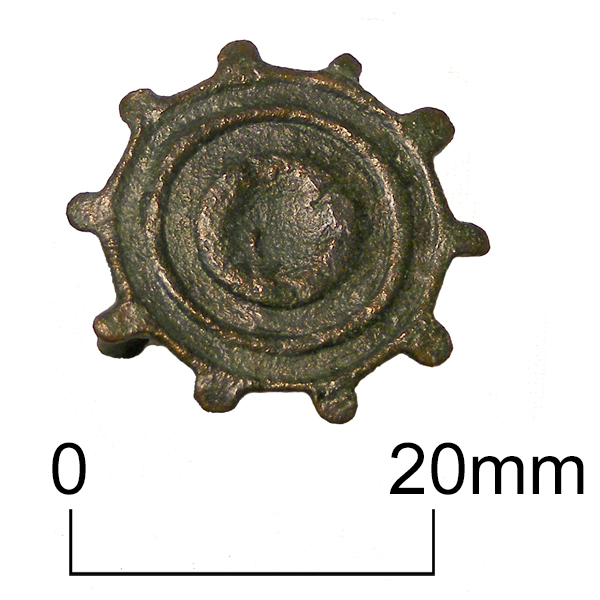
The small disc brooch shown here for Day 129 of the VM_365 project was recovered from the plough soil above the site of the Roman Villa at Minster in Thanet in the 1996 excavation season.

The circular brooch has ten small lugs radiating from the outer circumference and has a raised circular bead surrounding an indented central area.

The raised bead creates two fields which were probably originally filled with coloured enamel, although the decoration seems to have worn off over time in the soil conditions.

At the back of the brooch the shaft of the pin in the sprung clasp mechanism which held the brooch on has broken off , but the raised clip that retained the pin and the two lugs to hold the spring mechanism are still attached to the flat back.

VM_365 Day 127 Viking period polished and perforated shale disc

Kimmeridge shale perforated disc, later Saxon or Viking period.

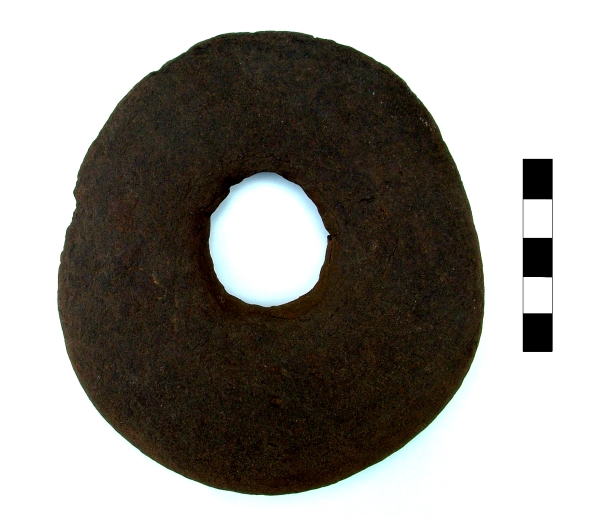
Our image for Day 127 of VM_365 is of this disc of Kimmeridge shale, found at Cliffsend, Ramsgate near the former shore of the Wantsum channel.

Kimmeridge oil shale is easily worked and the black surface of the material could be polished to a glossy sheen, making it attractive throughout history for manufacturing decorative objects and ornaments. In this case the ground conditions in the deposit where the disc was found have caused the surface to become pitted and rough. The disc may have been a personal ornament or been combined with other materials into a decorative or practical object.

The disc was found in a plough truncated ditch and the pottery and rubbish found in association with it suggest it probably dates to the 8th or 9th century, one of the rare finds from this Later Anglo-Saxon or Viking period in Thanet’s archaeological record.