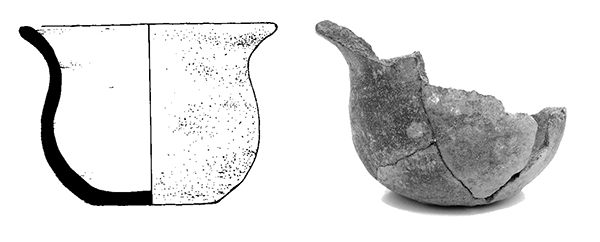
The image for VM_365 Day 146 shows a mid Saxon handmade jar and its illustration from a site near St Mildred’s Bay, Westgate which was excavated in 2006.
The small handmade jar has an everted-rim and is made in a rough patchy grey/black fabric with a hard ‘gooseflesh’ finish. It is encrusted internally with lime. The external rim diameter measures 100mm. It is an example of an ‘Ipswich’ type ware, characteristic of c.AD.750/75-850 dated assemblages from East Kent.
The jar was found in the same pit as the large fragments of daub shown in Day 145’s article.
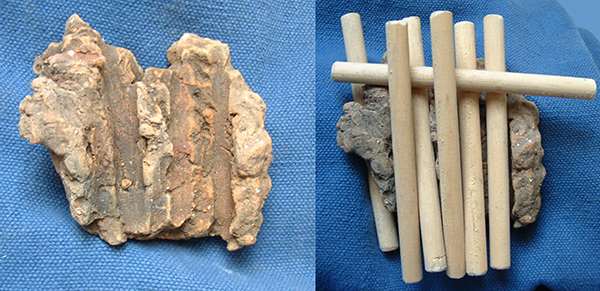
Today’s image for Day 145 of VM_365 shows one of the large fragments of daub which was excavated from a mid Saxon site near St Mildred’s Bay, Westgate in 2006.
The picture on the left shows a fragment of daub measuring approximately 15 cm high and you can clearly see the impressions left in the daub from the wooden rods and sails which formed the structure that it covered. The picture on the right is a reconstruction of where the rods and sails would have been placed, using similar diameter pieces of wooden dowel.
These fragments of daub were redeposited in a pit and mixed with a dark grey sooty soil, there was no evidence for an in situ structure. This deposit of daub appears to be from a demolished structure used to fill this pit, possibly used as packing to create a post pad or platform. Other finds from this pit included burnt chalk, burnt flint, animal bone and five sherds of pottery from the same small handmade jar.
We do not know what the original structure would have been but it could have been part of an oven or kiln.
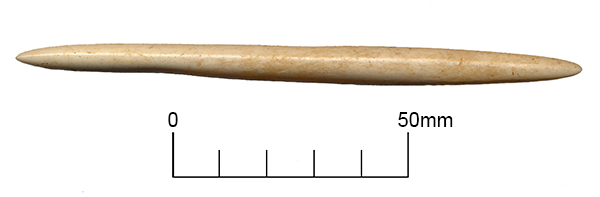
The image for Day 144 of VM_365 is of a bone double ended pin beater found in the fill of a pit at a small middle Saxon site excavated near St Mildred’s Bay, Westgate in 2006.
Pin beaters were used to beat down threads while using a warp weighted loom.
The pin beater is made of bone or ivory and measures 121 mm long, 3mm at its narrowest point at the end and 8mm at its widest point at the centre. It has an ovoid, slightly flattened profile and has been polished through use to a very smooth and glossy finish. Both ends have been carved to form a point.
This pin beater was found in the fill of a rectangular pit along with fragments of burnt daub, animal bone and marine shell, as well as a single pottery sherd from a jar dating between 450-700 AD.
Other finds from the same site included large fragments of burnt daub with rod and sail impressions and an iron lock mechanism possibly from a chest or casket.
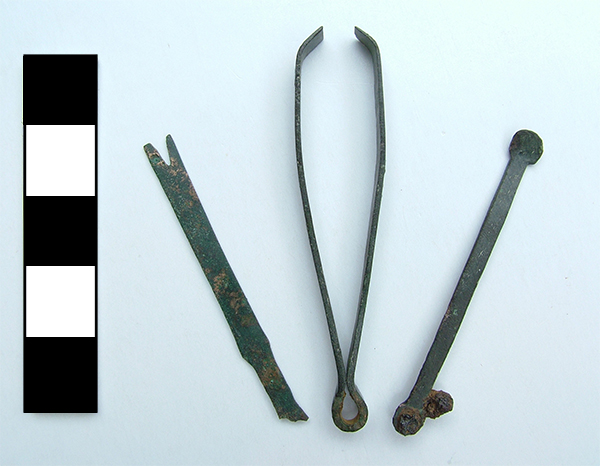
For Day 143 of VM_365we have an image of a Roman personal grooming set excavated from the villa at Minster in 1997.
This set, all made from copper alloy, comprises (left to right) an instrument for cleaning fingernails, tweezers and an ear scoop or cosmetic spoon. The three items would have been suspended together with an iron loop, traces of which you can see adhering to the end of the ear scoop and inside the end of the tweezers. The end of the nail cleaner has broken but you can just make out the curve where the hole for the ring was.
Personal grooming sets such as these would probably have been used by both men and women and are commonly found on both settlement sites and within graves.
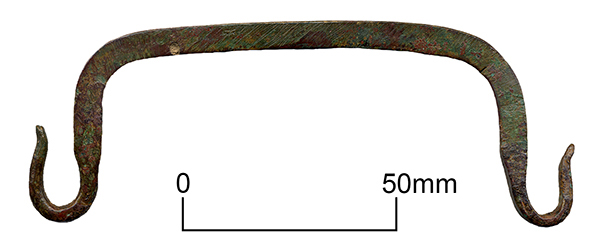
Bronze casket handle from Anglo-Saxon grave at Sarre
The image for Day 142 of VM_365 is of a bronze handle, which may have been attached to a casket placed in a grave at the Anglo-Saxon cemetery at Sarre. The small amount of intact bone that remained in the grave (G. 286) suggested that it contained an adult. Other finds associated with the burial were small muticoloured glass beads in a range of sizes that probably once formed a necklace.
The handle shown in the image is made from a bar which is rectangular in section along most of its length, but at either end has been bent, beaten and filed to form hooks with a more rounded section. The hooks terminate with blunt points at the end of each of the sinuous loops. The hooked ends would have passed under two loops fixed to whatever object it was attached to, allowing it to be carried by the main bar of the handle.
The handle was found along with Iron objects and other copper alloy items including the bronze key that was shown in VM_365 Day 35, leading the excavator Dr. David Perkins to suggest that the various objects might have been fittings associated with a casket. The handle would have been mounted on the top, with a lock plate like the one shown in VM_365 Day 51 mounted on the side, perhaps operated with the key that was in the grave.
The image below shows a reproduction of a Viking Era casket which may be similar to the one in the grave at Sarre:
Reproduction (Viking era) casket with similar handle structure. Source: https://jorvikingi.files.wordpress.com/2014/08/dsc_0021.jpg
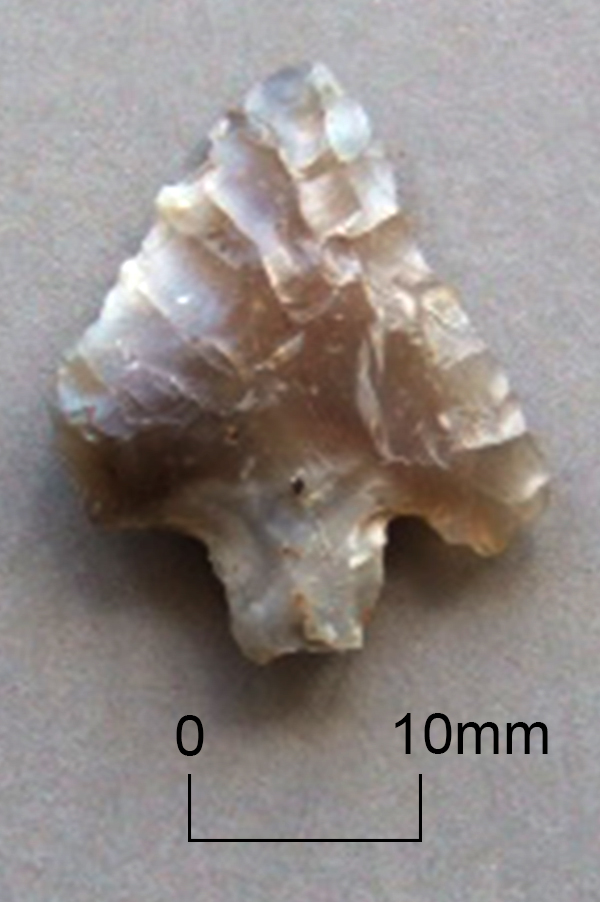
Today’s VM-365 Day 141 image is of an Early Bronze Age, flint, barbed and tanged arrowhead found during excavations by Thanet Archaeological Society at Lord of the Manor, Ramsgate in 2012.
This example is almost as pristine as the day it was made, is unpatinated and has a date range of c. 2300-1600 BC. It is missing its left hand barb which may have been broken whilst it was being made.
The arrowhead was found within the topsoil while cleaning the stripped surface of the site prior to excavation.
With thanks to Nigel Macpherson-Grant for supplying the information and photo.
Iron clench bolts and roves from a structure covering an Anglo-Saxon grave
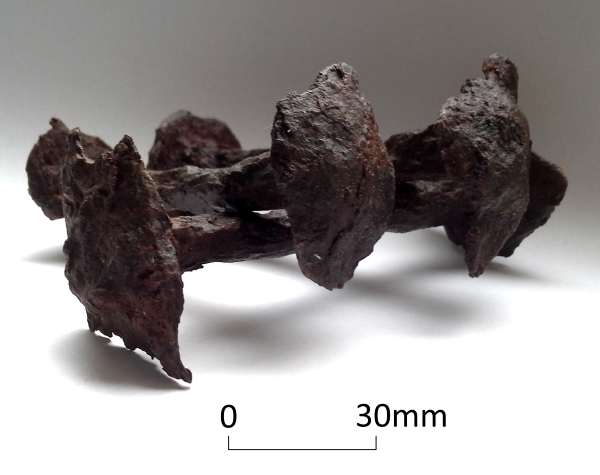
The image for Day 140 of VM_365 is of a group of iron clench bolts, found in the excavation of an Anglo Saxon grave near Thorne Farm, Minster between 1983 and 1984. Each bolt has a domed head at one end and at the other end the shank passes through a flat lozenge shaped plate, called a rove. The plate held in place by bending and flattening the shank to cover the hole, preventing it from sliding off the shank. Bolts of this type were used as fixings in early planked ships of clinker construction where the covering boards overlap. Perhaps the most important and well known archaeological discovery of an Anglo-Saxon ship built in this way is the Sutton Hoo ship. The bolt and rove act as a clamping rivet, holding two overlapping planks tightly between the domed head and the tightly clamped plate. Eighteen bolts of this type were distributed throughout the fill of the grave and in the soil in the wider area around the grave.
The gaps between the bolt heads and the roves from the grave measure approximately 60mm and appear to have been used to fasten wooden planks together in some form of structure that was used to cover the grave, impressions of wood were visible in the corroding iron of the bolts.
It is difficult to reconstruct what form the grave covering took, whatever covered the grave was bigger than the cut containing the burial. It has been suggested that because these bolts were commonly used in shipbuilding, the covering structure could possibly have been a small wooden boat, or a piece of a larger boat. Another possibility is that a sort of sea-chest, which a sailor may have kept his personal equipment in, might have been constructed with clench bolts in the same way as ships were. Perhaps old sailors were finally laid to rest with under the weathered and worn fragments of shipwrecks, small boats and even the sea-chests that would have formed such an important part of their lives.
Reference
Perkins, D. R. J. 1985. TheMonkton Gas Pipeline: Phases III and IV, 1983-84. Archaeologia Cantiana Volume CII, 43-69.
Brookes S. 2007. Boat-rivets in Graves in pre-Viking Kent: Reassessing Anglo-Saxon Boat-burial Traditions, Medieval Archaeology, 51
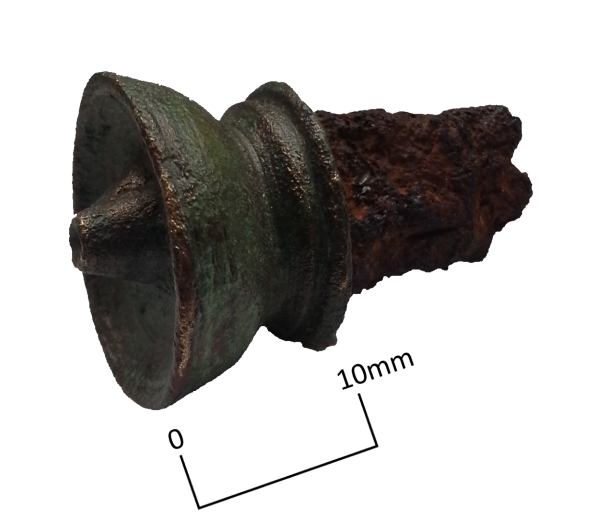
Day 139’s VM_365 image shows a Roman lock fastener from the villa at Minster.
This lock fastener is made of copper alloy, cast around an iron shank and was used to hold the lock plate to the front of a chest or door. A number of these decorative lock fasteners would have been used around the edges of the lock plate to hold it to the wood.
The cast bronze knob was visible on the front of the lock and was probably highly polished, while the iron shank passed through the lock plate and the wooden casket or door and was held in place at the rear by a pin inserted through the hole in the shank at the end. In our example the shank has broken across the hole that the pin would have passed through.
Our example was probably used to hold the lockplate to a chest as the measurement between the knob and the hole in the shank suggests a total depth of lockplate and wood to be 15mm, too shallow for a door.
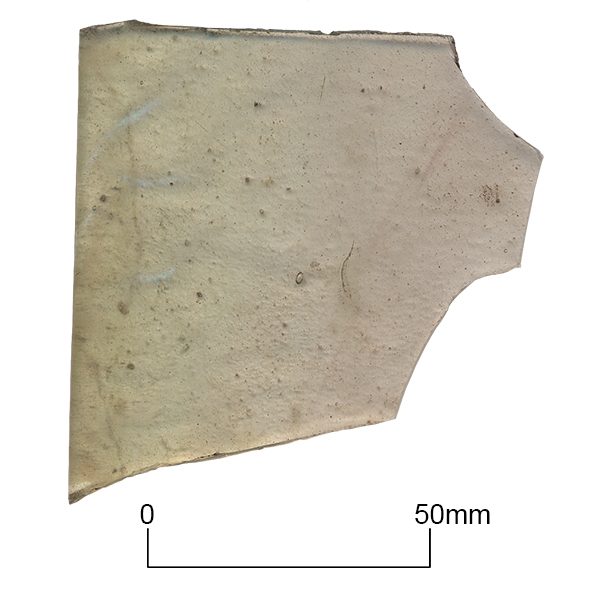
Today’s Day 138 VM 365 image shows our largest fragment of Roman window glass from the villa at Minster dating to around the 1st to 2nd century.
This fragment of clear glass is a pale olive brown, growing pinkish in colour toward the broken edge. You can see many tiny air bubbles throughout the fragment. The glass appears to have been poured as a single sheet into a mould, onto a flat, slightly rough surface, possibly compacted sand, as the underside is also slightly rough in texture. The upper side is shiny and wavy rather like the surface of poured toffee and is thicker along the rounded edge which would have been formed against the edge of the mould.
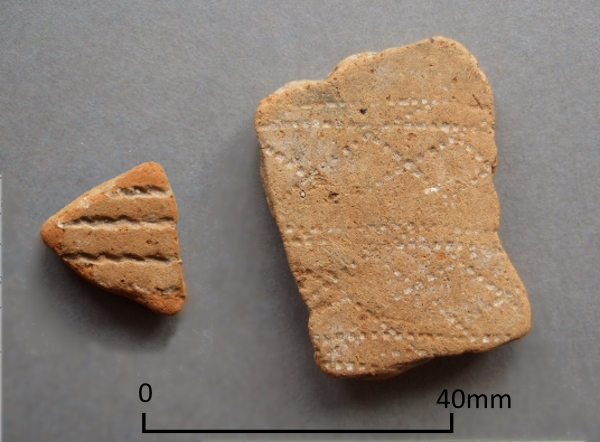
Two Beaker sherds from Lord of the Manor, Ramsgate.
Toady’s image for VM_365 Day 137 is of two admittedly small, but important pottery sherds of Beaker vessels, like the Grooved Ware sherd from Day 136, the two Beaker sherds were found together in the 1976 excavations at Lord of the Manor, Ramsgate.
The sherds are from Phase 2 of the development of the Lord of the Manor 1 monument, a period of Early Bronze Age activity associated with the re-use of the earliest ring ditched enclosure as a burial site. In this phase a burial was placed within a smaller ring-ditch that was cut inside the circuit of the earlier large causewayed enclosure ditch, to create a round barrow.
The smaller sherd on the left of the image is decorated with a cord impression, which would have extended over the whole body of the vessel. The second sherd on the right is decorated with a pattern in zones, created with impressions from the teeth of a comb.
The first cord impressed style is the earliest, dating between c.2300-200 BC. The second comb decorated sherd is marginally later, around 2100-1900 BC. Both sherds are made of an identical fine oxidised fabric, with a fine silty fabric matrix and fine crushed pot grog tempering. Both have a similar neat, finely executed decoration and so can reasonably be thought of as contemporary vessels.
Both sherds were found in a small pit, located outside the ditch enclosing the central burial. The two sherds indicate a date between c.2100-2000 BC for the feature, although this has not yet been confirmed by Carbon14 dating.
Once again today’s VM_365 image and information on the pottery has been provided by ceramic specialist Nigel Macpherson-Grant.

 Day 139’s VM_365 image shows a Roman lock fastener from the villa at Minster.