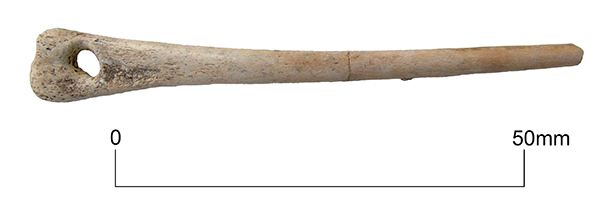
VM_365 Day 156 Iron Age Bone Pin from Broadstairs

VM 156

Today’s VM_365 image is of an Iron Age bone pin  excavated from a pit at Dumpton Gap, Broadstairs in 1994.

The pit had been used for the disposal of domestic refuse which included animal bone, quern stone fragments and sherds of pottery dating to the Early Iron Age before being used to bury a single adult individual in a similar way to the burial at North Foreland.

The bone pin, possibly used to fasten a cloak, was found at  the left shoulder of the skeleton, fragments of an Iron buckle were found at the right shoulder.

VM_365 Day 155 Ghosts of other things preserved in Bronze Age pottery decoration

Bronze Age pottery with skeumorphic decoration, possibly emulating stitching in leather.
Bronze Age pottery with skeuomorphic decoration, possibly emulating stitching in leather.
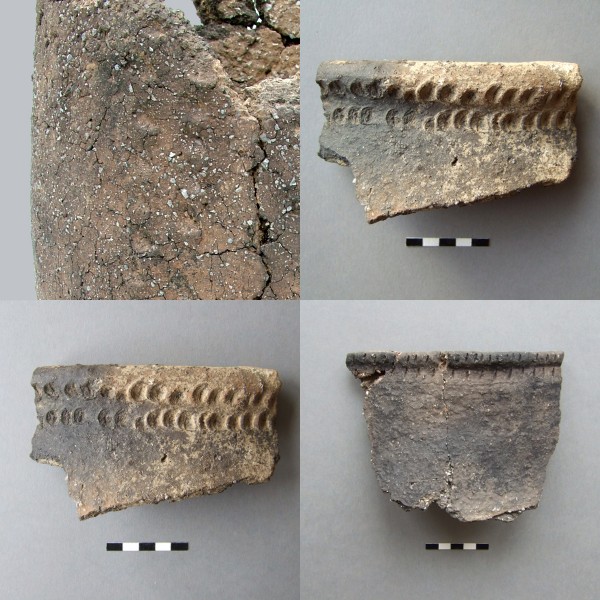
The image for Day 155 is of a nearly complete body and three rim sherds from four  pottery vessels, all from excavations in Thanet and dating from the Middle Bronze Age, in the date range of c.1550-1350 BC.
The vessel on the top left is a Middle Bronze Age vessel from a cremation group in Ramsgate, which is decorated along its side with a single vertical row of marks from a finger tip.  The three other rim sherds have a regular repeated pattern of decoration around the rim, made with a finger tip and finger nail. What inspired the potters who made these vessels to adopt this scheme of decoration?
Perhaps they used a model from some other part of their experience of the materials that were in common use in their community to generate a scheme of decoration which would be familiar to them and give prompts about what the appropriate functions of the vessels were and what uses they could be put to. The term skeuomorph is used to describe such decorative schemes that retain residual, but often completely redundant, elements from some other source. Even in our digital world we continue to make one thing look like another so that an object retains a familiarity and usability and helps us understand how the function of an object relates to what we know.
The decorative scheme on these contemporary Middle Bronze vessels may be skeuomorphs of the stitching that would have been required to create vessels from hard leather or perhaps another material that was less durable than pottery like the birch bark bucket found with the Egtved Girl who died in southern Jutland, Denmark and was buried in an oak log coffin, dated by dendrochronology to 1370 BC. The bucket held an alcoholic drink, probably a form of ale.
http://media-cache-ec0.pinimg.com/736x/07/0f/29/070f293b5ec3a4e638f9cbacfd535151.jpg
Birch bark bucket found in the Oak log grave of Egtved Girl.
The various locations of the schemes around the rims and up the side of the Bronze Age pottery vessels from Thanet could be emulating the vertical join in soft material, like a  hard leather tube or birch bark and the stitching that created a usable rim. The survival of a more varied range of material in more favourable archaeological contexts should help us understand how echoes of their familiar forms were preserved in the material that does survive in the more limited range of archaeological materials that can be recovered from Thanet’s dry chalk soils.


VM_365 Day 154 Roman Box Seal lid from Minster

VM 154

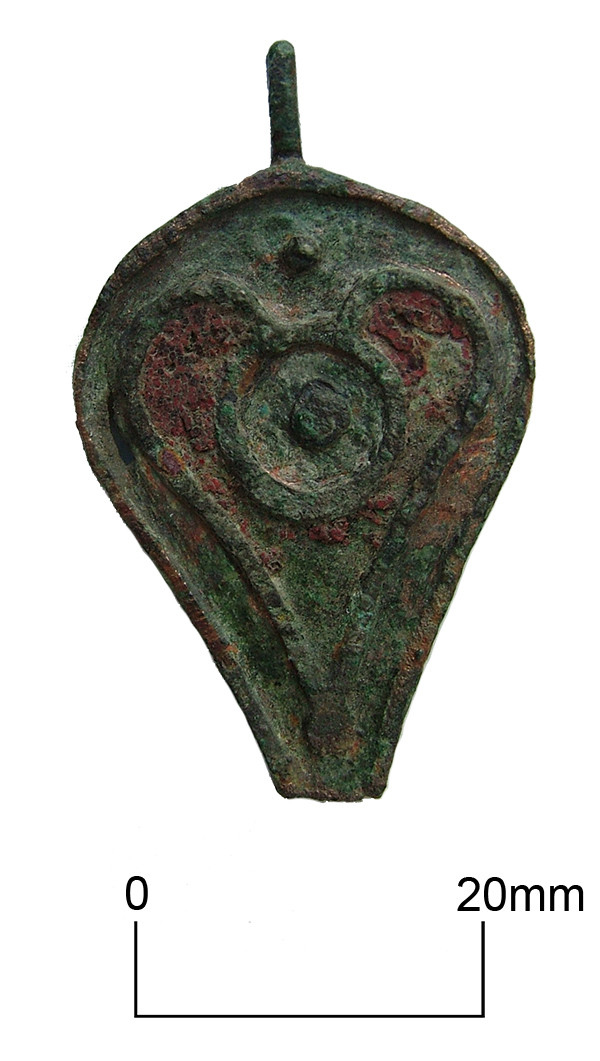
The image for Day  154 of the VM_365 project shows a 2nd to 3rd century Roman seal-box lid, found in the excavation of the Roman villa at Minster.

Seal-boxes were small bronze containers, used to seal the openings of documents and parcels. The box protected inside an impression made in a piece of wax from an intaglio seal, a carved image on a hard stone which was perhaps mounted on a signet ring.  The wax seal impressions from an intaglio served as private or public signatures, guaranteeing that the contents of the sealed document or parcel were authentic.

To secure a parcel,  a cord was passed through a central hole in the base of the seal-box forming a loop. The two ends of the cord were  wrapped around the parcel and through two additional holes on the underside of the box. The loose ends were passed through the central loop and pulled tight, through two notches either side of the base. The cords were held in place with beeswax and the personal seal iwas pressed into the wax, protected in transit by closing the lid of the seal box over it.

Our example is a leaf shaped seal box lid in  bronze, with an enamelled heart shaped design on the lid.

Further reading

Holmes, S. 1995. Seal-boxes from Roman London. London Archaeologist 7.15, 392-395.

VM_365 Day 153 Anglo Saxon bottle vase from Sarre

VM 153

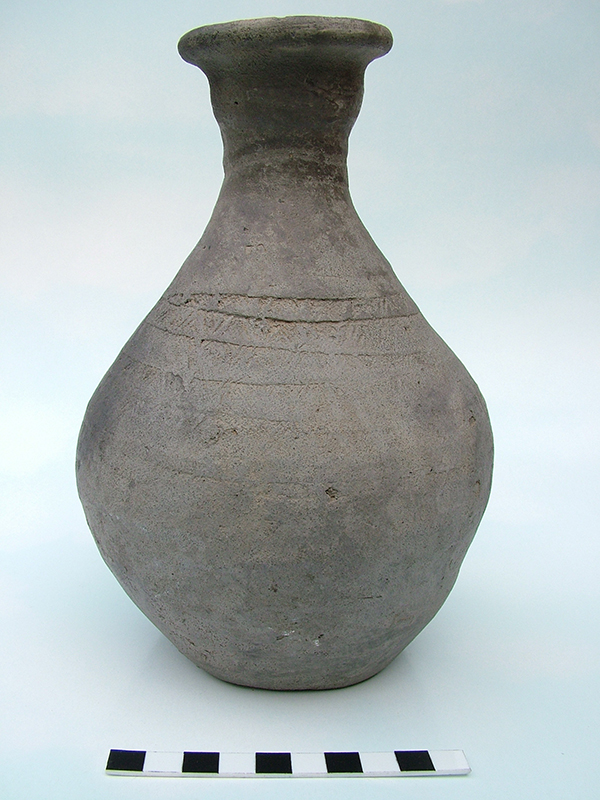
For Day 153 of the VM_365 project our image shows an Anglo Saxon ceramic bottle vase, excavated in 1990 from Grave 277 at the Anglo-Saxon cemetery at Sarre, the iron châtelaine ring and keys shown in yesterday’s post came from the same grave.

The bottle vase shown here is wheel turned in a smooth grey fabric and has been decorated with a lightly impressed rouletted chevron design. Fourteen similar vessels were excavated from graves in the same cemetery by John Brent in 1862.

Vessels of this type were manufactured on the continent by the people of the Frankish Kingdom, who also used them as grave goods. Examples from east Kent; other cemeteries in Thanet and graves from the Sarre cemetery are known to have been continental imports, considered by archaeologists to be luxury items. The decoration on the vessel from Sarre shown here is similar to, although slightly more complex, than an example found in grave 156 at Buckland Anglo-Saxon cemetery near Dover.

The vessel shown today has been carelessly cut from the potters wheel with wire so that it does not stand straight. It has been considered unlikely that a ‘second’  like this would  have been included in a shipment of luxury goods from the continent.

It has been suggested that because of the inferior execution of the manufacture of the vessel, it may have been the product of a less able local Anglo-Saxon potter rather than  a continental Frankish import. This idea perhaps underestimates several aspects of human nature that may have been at play in production, trade and consumption in Anglo-Saxon society.


VM_365 Day 152 Chatelaine and keys from Sarre

VM 152

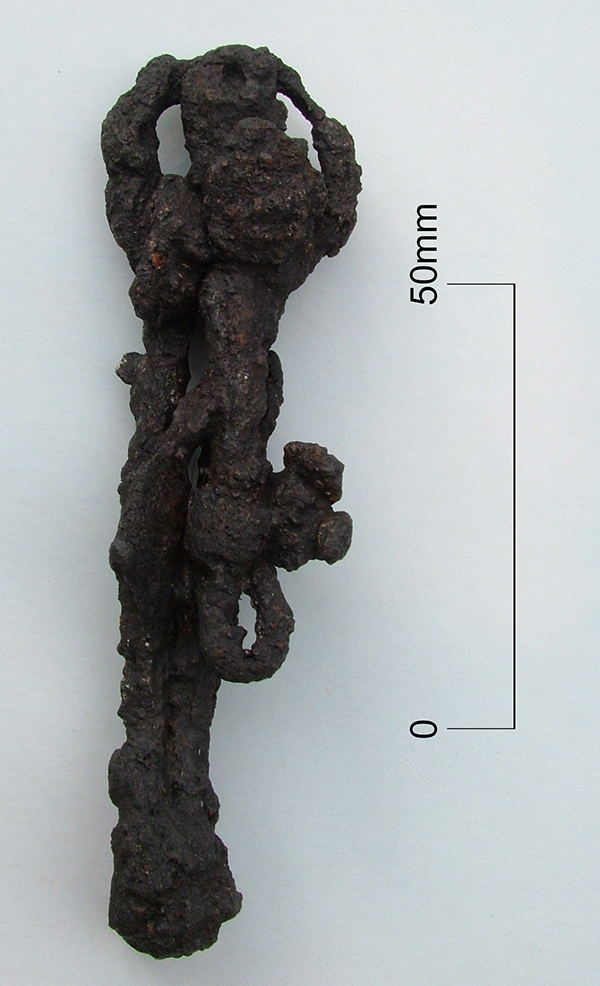
Today’s image for VM_365 Day 152 shows a heavily corroded iron châtelaine ring holding two iron keys or latchlifters which were excavated from grave 277 at Sarre in 1990.

This grave was undisturbed. Because of its small size and the lack of survival of much of the bone. was interpreted as the grave of a child, probably female.  Along with the châtelaine and keys, a bottle vase and an iron knife were also found accompanying the individual in the grave.

The two keys or latchlifters were suspended from the iron ring and were accompanied by a hook ended object with a sliding fitting on its shaft, which may be a keeper designed to hold the  châtelaine fast to a girdle when it was worn around the waist.

VM_365 Day 151 Anglo Saxon Iron Knife from Sarre

VM 151

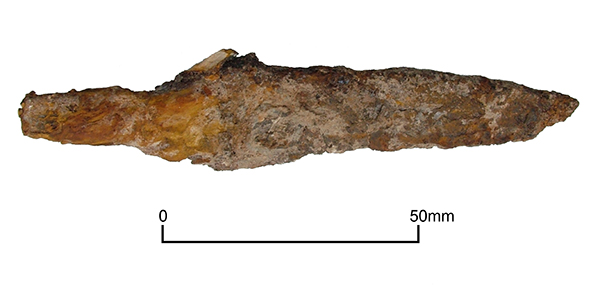
Our image for VM_365 Day 151 shows one of the most common artefacts excavated within Anglo Saxon graves; an iron knife.

Iron knives are often found in both male and female graves and come in many different types. This example was found in grave 279 at Sarre excavated in 1990. The grave it was found in had been heavily disturbed, probably through contemporary grave robbing. Skeletal material of four individuals was found scattered throughout the grave fill suggesting that the grave may originally have held multiple occupants.

Although this knife is heavily corroded you can clearly identify the tang and the blade. This knife originally had a wooden handle into which the tang fitted.  Iron knives from Anglo Saxon graves have been classified according to their size and shape by Vera Evison. This knife is of a late 6th to 7th century type and conforms to Evison’s type 1 classification.


VM_365 Day 150 Gold looped pendant from Sarre

VM 150-1

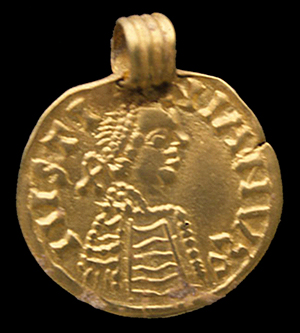
Today’s VM_365 Day 150 image shows a gold pendant excavated from an Anglo Saxon grave  at Sarre in 1990. The pendant is no longer in our possession and the image above was taken at the time of the excavation.

The large, well cut grave (grave 286) had been disturbed by grave robbing in antiquity and skeletal material, objects and fragments were scattered throughout the fill.  The skeletal material that could be identified indicated that the skeleton was of an adult and the grave goods suggest that it is likely to be an adult female. Objects found within the grave included a silver and glass keystone pendant, an iron key, iron knife, amber and glass beads, a bronze casket handle  and a Bronze key.

The pendant, weighing 1.63 grammes, is a made from a gold tremissis; a 6th century Merovingian coin that has had a  hanging loop added. The coin was minted in Austria or Burgundy in the name of Justinian I (527-565 AD) and its composition  has been measured using X-ray fluorescence spectrometry comprising 85.6% gold, 11.9% silver and 2.35% copper.

Reference

Perkins, D. R. J. 1991. The Jutish Cemetery at Sarre Revisited: A Rescue Evaluation. Archaeologia Cantiana CIX pp139-166


VM_365 Day 149 Silver Square Headed Brooch from Sarre

VM 149

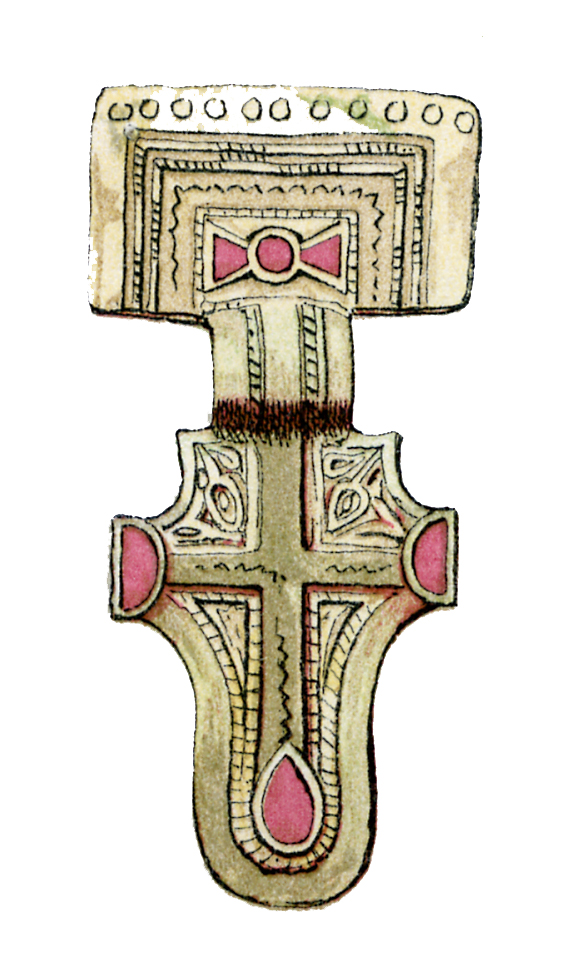
Today’s VM_365 image for Day 149 is of an illustration of a late sixth century,  silver, small square-headed brooch found in Grave 4 at Sarre by John Brent in 1863. This coloured illustration was published in 1863 in an account of the Kent Archaeological Society’s researches of the cemetery at Sarre.

The brooch is very similar to the example found in 1982 during the excavation of the Monkton Gas Pipeline which we posted for Day 147.

It is suggested that both brooches, as well as an example from Bifrons, Howletts all came from the same workshop and although very similar, they vary in slight details and do not come from exactly the same mould.

This brooch was found in the grave of a female along with a Great Square Headed brooch, a bell beaker, weaving baton, crystal ball and spoon, gold braid and other smaller items.

References

Brent, J. 1863. Account of the Society’s Researches in the Saxon Cemetery at Sarr, Part 1. Archaeologia Cantiana V, 305-22.

Perkins, D. R. J. and Hawkes, S. C. 1984. The Thanet Gas Pipeline Phases I and II (Monkton Parish), 1982. Archaeologia Cantiana CI, 83-114.


VM_365 Day 148. Medieval Jug from Margate

VM 148

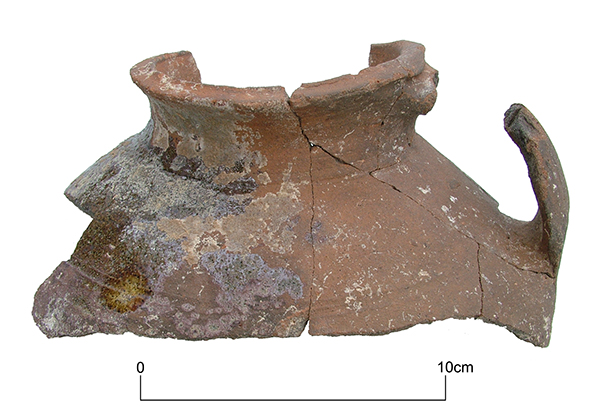
Today’s Day 148 VM_365 image shows part of a medieval jug excavated from a pit at East Northdown, Margate in 2003.
The upper part of this later 14th century globular bodied jug was found in 17 pieces within the fill of a pit, much of it is missing, including part of the handle, but enough was present to reconstruct the upper part of its profile. The jug was manufactured in Canterbury and is made of Canterbury Tyler Hill sandyware with a date range of c.1350-1400/1425 AD.

VM_365 Day 147 Silver Square Headed Brooch from Minster

VM 147

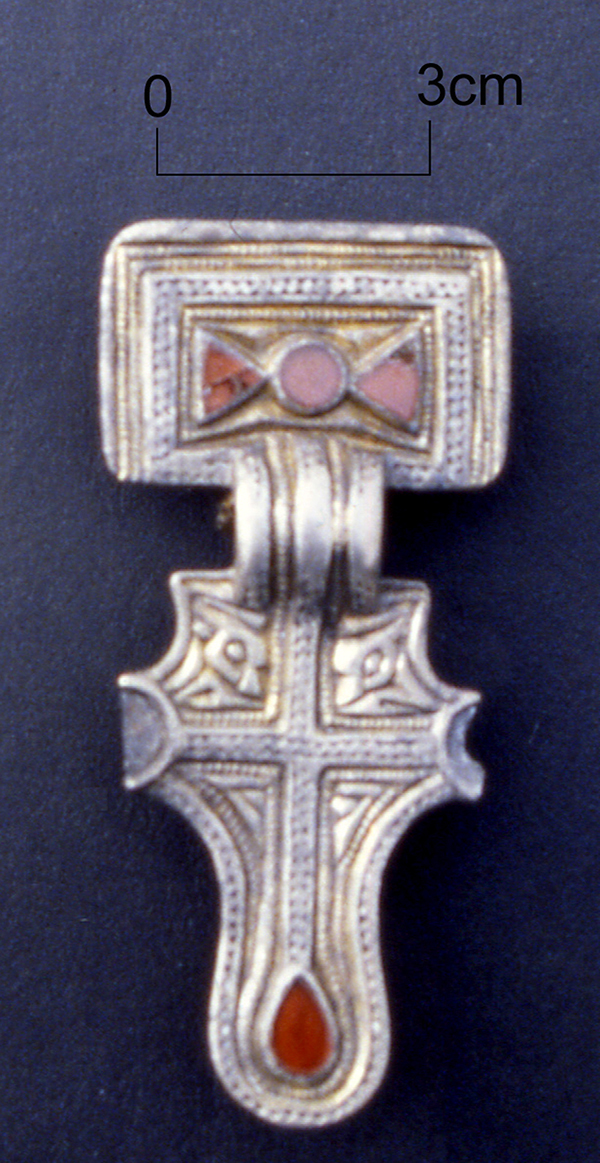
Today’s image for VM_365 Day 147 is a small silver square headed brooch excavated from an Anglo Saxon grave at Monkton near Minster in 1982. The brooch is no longer in our possession and the above photograph was taken in 1982.

The brooch was found in the grave of a female buried in the second third of the sixth century. Remains of gold threads similar to those found at Sarre were found on the skull and other finds included a bronze ring for a purse or bag at her waist, a bronze buckle and amber beads over her upper body.  The brooch was found on her left shoulder.

The brooch is made of silver with gilding applied by mercury amalgam. It is a Kentish type with similar brooches found at  the cemeteries at Sarre and Bifrons and may have been worn alone as a cloak fastener.