Category Archives: Archaeology

VM_365 Day 41 Dumpton Gap

41

Yesterday we introduced you to Howard Hurd, Thanet’s first scientific archaeologist. Today we show you some of the archaeological work carried out by Hurd at Dumpton Gap and South Cliff Parade, Broadstairs.

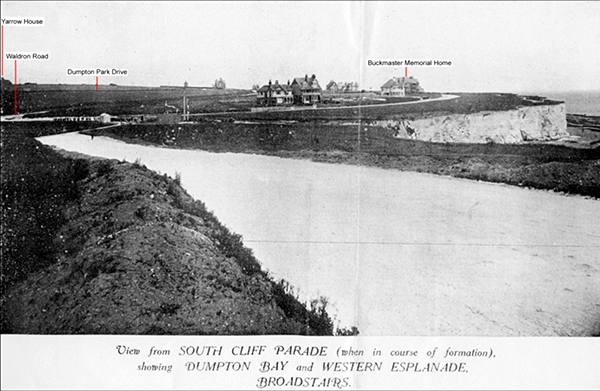
The image above, taken c. 1907  for a land auction catalogue, shows what Dumpton Gap looked like as the new estate was being laid out along the cliff top between Dumpton Gap and Broadstairs. The view is taken from South Cliff Parade, near where the entrance to Seacroft Road is now.

In the background the buildings that were already constructed are marked; Buckmaster Memorial Home, along the Western Esplanade and Yarrow House (now East Kent College) on the edge of the picture. The beginning of Waldron Road and Dumpton Park Drive are visible in the background. At the top of the cutting leading down to Dumpton Bay you can see the buildings associated with the entrance to a submarine telegraph.
41.2

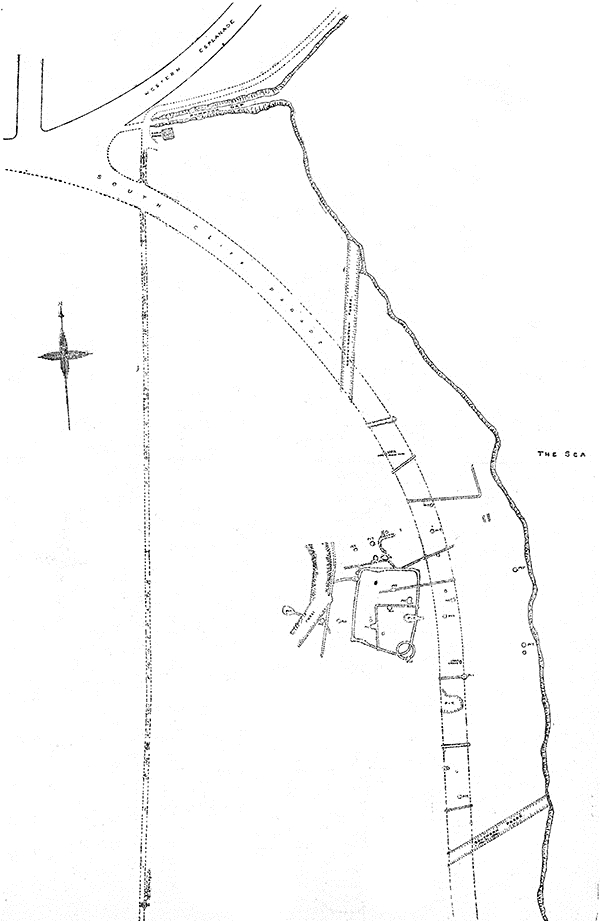
In his capacity as Town Surveyor and Engineer, Hurd recorded the archaeological features that were exposed during the work and published reports on them. You can see from the meticulous plans that he published in 1913, that  many archaeological features were revealed when the roadway was stripped. The features include a small prehistoric round barrow, pits, ditches and the settlement enclosures which he referred to as a Late Celtic Village.
41.3

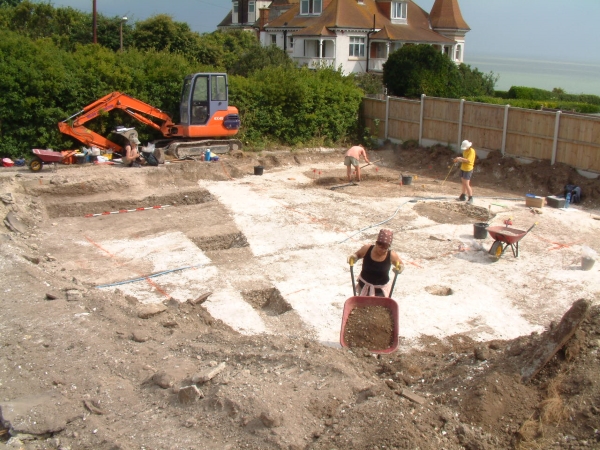
Excavations carried out at Seacroft Road by the Trust for Thanet Archaeology in 2006 allowed us to revisit a small part of the area that Hurd recorded. Our plans of the site overlaid almost perfectly with his and our excavations were able to establish that occupation on the Late Iron Age site, which Hurd referred to as ‘Late Celtic’,  continued into the Roman period. Roof tiles, stone and pottery of Roman date suggest that a building was located in the area, perhaps the one described by the Reverend John Lewis in his History of the Isle of Thanet, written in 1736, as being present in this area.

Further reading:

Hurd, H. 1909.  On a Late-Celtic Village near Dumpton Gap, Broadstairs. Archaeologia (Second Series) Volume 61 Issue 02, pp 427-438

Moody, G. A. 2008. The Isle of Thanet from Prehistory to the Norman Conquest. The History Press: Gloucester.
 

VM_365 Day 40 Howard Hurd: Thanet’s First Scientific Archaeologist

40

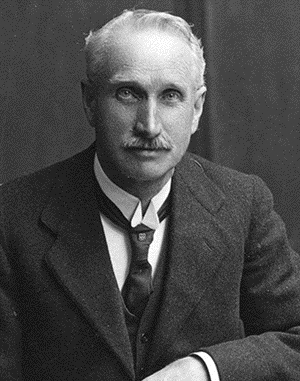
Howard Hurd was Thanet’s first scientific archaeologist. In 1897, at the age of 32, he was  appointed Surveyor and Water Engineer to the Urban District Council of Broadstairs and St Peters in charge of the water supply and other services. His work on the new estates being constructed as the town expanded brought him into contact with many archaeological discoveries. The local construction workers were aware of his interest and brought things they had found to his attention.

Hurd produced comprehensive reports of his discoveries with accurate plans, illustrations and photographs. He recorded archaeological discoveries of Bronze Age Barrows at King Edward Avenue, Valletta House and Dumpton Gap; Roman cremation urns at Rumfields Road and the Anglo Saxon cemetery at  Valletta House, now Bradstow School. In 1911 he was one of the founder members of the Broadstairs and St Peter’s Archaeological Society along with Miss Bartrum, the owner of Valletta House.

His work was the first accurate, scientific archaeological recording carried out on Thanet that still stands the test of time today.

Find out more by reading:

Moody, G. 2008. The Isle of Thanet from Prehistory to the Norman Conquest. The History Press: Gloucester. 19-20.
Hurd, H. 1913. Some notes on recent Archaeological Discoveries at Broadstairs. Broadstairs and St Peter’s Archaeological Society


VM_365 Day 39 Needles and pins in bone and ivory from a Roman Villa

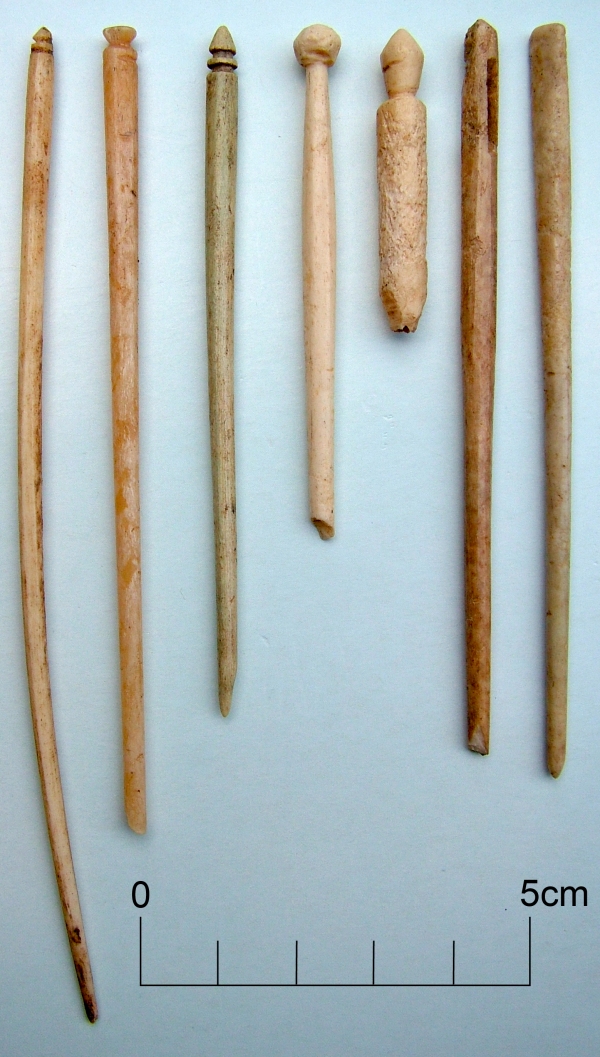
Bone and ivory pins, personal items from a Roman Villa

While some of these bone and ivory pins are undoubtedly personal objects, used as hair pins and possibly for fastening clothes, these fragile objects from the Roman Villa at Minster in Thanet may also reflect the enormous variety of crafts and industries that were carried out in and around the Villa.

Some pins and broken fragments of pins which have eyes through in the upper part of the shaft, are probably large needles. Being made of such a brittle material  they were perhaps used to stitch together soft woollen cloth, perhaps in a process associated with weaving, or perhaps they may have been used to make and mend nets.

Similar straight wood and ivory  pins with their carefully carved terminals can be found among the bobbins of lacemaker’s  tool kits in the present day, although there seems to be no direct evidence of Roman lacemaking.

VM_365 Day 38 Medieval Floor Tiles

VM_38

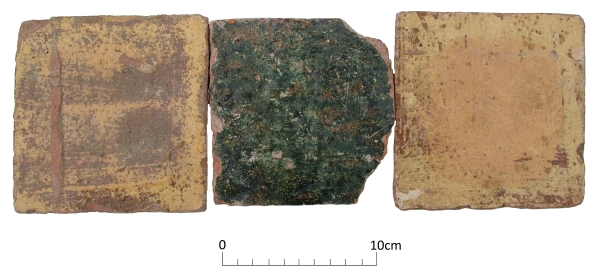
Today’s image shows three nearly complete floor tiles from the site of one of the lost medieval parish churches of Thanet;  All Saints, Shuart. The site was excavated by the Isle of Thanet Archaeological Unit in 1978 under the direction of Frank Jenkins, assisted by Dave Perkins and site assistants from the Manpower Services Commission.

These plain glazed floor tiles were found in the demolition rubble of the latest phase of the church and are of Flemish manufacture dating to the late 14th to 15th centuries.

The Church  was originally established in the 10th century, along with St Nicholas at Wade, as dependent chapels of the Church at Reculver. All Saints was altered and expanded in the 10th-11th centuries,  12th century and again in the 13th century. By the mid 15th century the church was in ruins and it was eventually demolished by about 1630.

The reason for its decline may be that the parishes of St Nicholas at Wade and All Saints were combined in the early 14th century and it later became too much of a financial burden for the parish to support two churches;  All Saints was neglected in favour of St Nicholas at Wade.

Further reading:

Jenkins, F. 1981. The Church of All Saints, Shuart. In Detsicas, A. 1981. Collectanea Historica: Essays in Memory of Stuart Rigold. Kent Archaeological Society; Maidstone. 147-154.


VM_365 Day 37 Entrance to First World War Air Raid Shelter, Ramsgate

VM_37

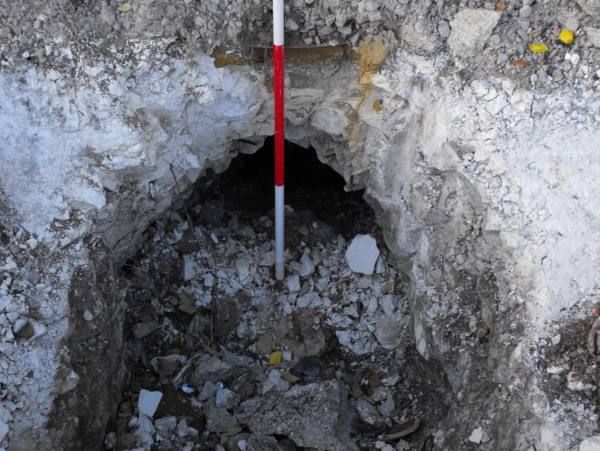
This intriguing picture shows the entrance to a First World War air raid shelter which was exposed in 2011 when a new supermarket at Chatham Street, Ramsgate was being constructed.

Bombing raids from Zeppelins and cross channel shelling had affected Thanet, but it wasn’t until 1917 that the Island was targeted by German Gotha bombers. Many of the air raid shelters on the Isle were dug into the chalk bedrock at this time.

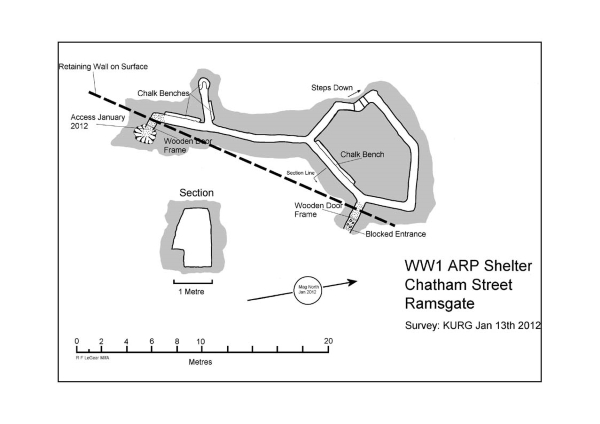
The Chatham Street shelter was surveyed by Rod LeGear, assisted by other members of Kent Underground Research Group in January 2012. The survey, shown below, revealed that the tunnel included benches cut into the chalk and had been lit by simple candles some still remaining as stubs in niches in the wall.

An Ice factory occupied the site from around 1907 and this shelter was probably dug as a refuge for its employees in 1917 in response to the Gotha bombing raids.

VM_365 37.2

Further Reading:

LeGear, R. 2012. Underground Thanet. Trust for Thanet Archaeology: Birchington.

VM_365 Day 36 First World War Structures at Stonar


VM_36

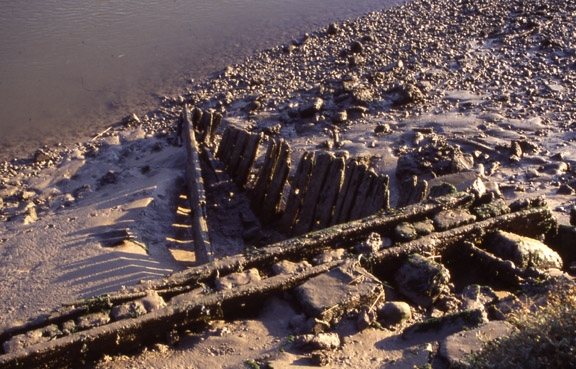
To commemorate the 100th anniversary of the start of the First World War, today’s image is of the timber structures at recorded at Stonar Cut, Richborough in 2005.

One of the least known structures of World War I is the Stonar Port, constructed between 1916-1918 to supply the Front Line in France and Belgium using the French canal network. Today only the upright timbers of the once extensive wharves survive to be seen in the water line along the River Stour.

Along with the structures that were added in the Second World War, this port  and the many thousands of people who served their country in the two wars are not well known outside the military history field.

Find out more about our survey carried out in 2005 in the Virtual Museum.

Further reading:

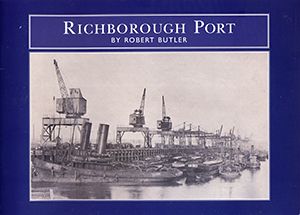
Butler, R. 1999. Richborough Port. Pfizer Ltd. Sandwich

r-port_book

We have a very limited amount of these publications for sale. If you wish to purchase a copy for £5.00 plus £2.00 p&p (UK only) leave a comment and we will get back to you to arrange payment.

Update: You can now order this book from our Publications page


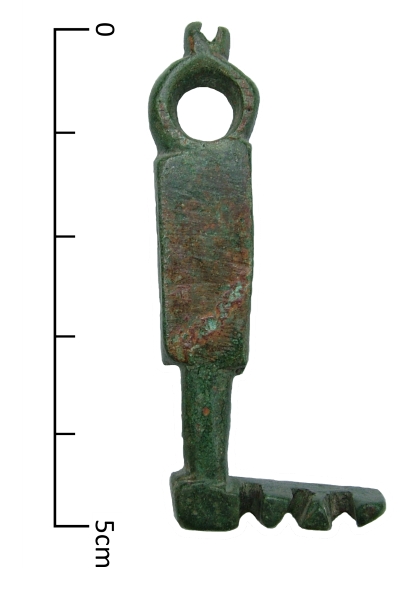
VM_365 Day 35 Anglo Saxon Bronze Key

VM 35

Today’s image is of a Bronze key once again from the Anglo Saxon cemetery at Sarre, also found in grave 286, like the glass beads shown yesterday.

The key is made of copper alloy or bronze and is beautifully preserved. It was found in association with a bronze handle and some sheet bronze fragments which may be the remnants of a casket with its key that were placed in the grave alongside the body.


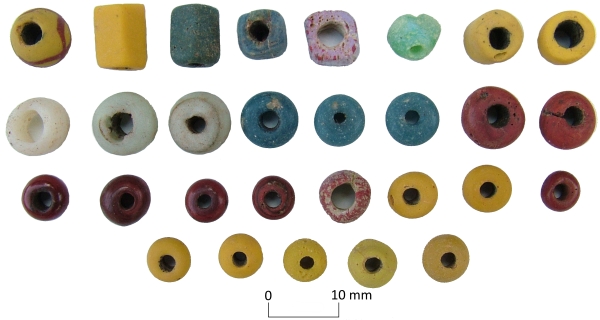
VM_365 Day 34 Anglo Saxon Glass Beads

Following on from yesterday’s image of the gold thread  in grave 285 from Sarre, today’s image is of 29 glass beads found in grave 286 from the same Anglo Saxon cemetery site.


VM 34

The grave was large  and well cut, most likely containing a female, based on the objects within it. Like grave 285 it had been disturbed in antiquity, skeletal material and objects  left behind by the robbers were scattered throughout the grave fill.

Among the objects found within the grave were nine amber beads and thirty one glass beads. Twenty nine of the glass beads are shown in the picture above, all are coloured glass. The one at the top left hand corner is a multi coloured or polychrome bead, almost globular in shape and of yellow glass with brown crossing trails. The other beads range in shape from pentagonal cylinders, 4 sided cylinders, short cylinders, discs and one is pear shaped.

Find out more about the site by reading:

Brent, J. 1866. Account of the Societies Researches in the Saxon Cemetery at Sarr. Part 2 Archaeologia Cantiana VI, 157-85

Brent, J. 1863 . Account of the Societies Researches in the Saxon Cemetery at Sarr. Archaeologia Cantiana V, 305-22

Perkins, D. R. J. 1991. The Jutish Cemetery at Sarre Revisted: A Rescue Evaluation.  Archaeologia Cantiana CIX, 139-162

Perkins, D. R. J. 1992. The Jutish Cemetery at Sarre Revisited; Part II. Archaeologia Cantiana CX, 83-120

For more on the clothing of the Anglo Saxon period read Penelope Walton Rogers’ excellently researched and illustrated book:

Walton Rogers, P.  2007. Cloth and Clothing in Early Anglo-Saxon England. CBA Research Report 145, Council for British Archaeology: York.

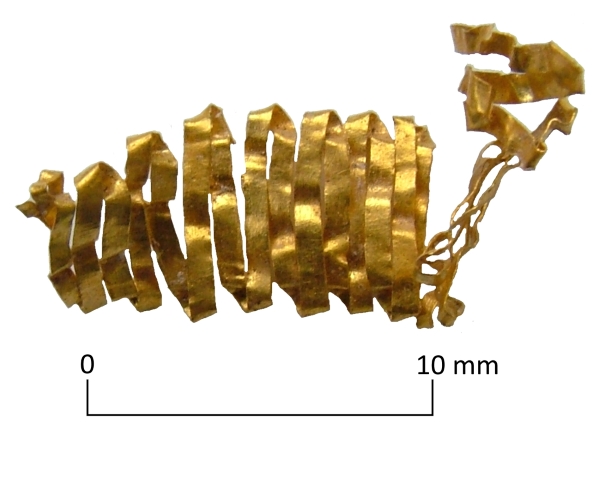
VM_365 Day 33 Gold threads

Today’s image is of a fragment of gold thread found in a mid to late sixth century grave at Sarre in 1990. The grave of an adult, probably a female, was disturbed in antiquity with the whole of the grave being emptied and backfilled.

VM_33
The  thread measures approximatley 20mm long and has been cut from a gold foil sheet that was 96.595% pure. The strip was folded and used in a brocaded pattern with textile threads, probably worn in a head band across the brow or decorating the edge of a coif or hood. The band was tablet woven and the pattern was inserted during weaving, not embroidered afterwards; the impressions of the textile threads can be clearly seen on the gold thread.
Similar gold threads have been found in Kentish graves of a similar date at Monkton, Bifrons, Lyminge and Faversham and are probably of continental origin.

Find out more about the site by reading:

Brent, J. 1866. Account of the Societies Researches in the Saxon Cemetery at Sarr. Part 2 Archaeologia Cantiana VI, 157-85

Brent, J. 1863 . Account of the Societies Researches in the Saxon Cemetery at Sarr. Archaeologia Cantiana V, 305-22

Perkins, D. R. J. 1991. The Jutish Cemetery at Sarre Revisted: A Rescue Evaluation.  Archaeologia Cantiana CIX, 139-162

For more on the clothing of the Anglo Saxon period read Penelope Walton Rogers’ excellently researched and illustrated book:

Walton Rogers, P.  2007. Cloth and Clothing in Early Anglo-Saxon England. CBA Research Report 145, Council for British Archaeology: York.


Archaeology for You 2014, celebrating the National Festival of Archaeology

Although Saturday 12th of July, the day of our fourth annual Archaeology for You event, was preceded by some impressive storms and rain, the wet weather held off for the day.

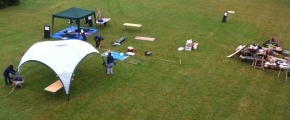
As in previous years we set up our eight Archaeology for You activity areas on the lawn in the gardens at the front of Quex House. With only some areas under shelters, our fingers were tightly crossed that the weather would stay calm over the day for the activities that were set up in the open air. The upper windows of Quex House provided a convenient vantage point for a photograph to be taken of our team of Trust Staff and volunteers setting up for the event.

Setting up for Archaeology for you 2014
Set up for Archaeology for you 2014, viewed from Quex House

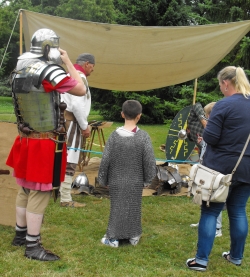
Iron Age and Early Roman re-enactment group De Bello Canzio joined us again this year bringing a sense of the real lives behind the objects from that era that we had on display and our activities were arranged in the form a large circle so that people could progress from experiencing the methods of investigation in the field, toward the interpretation of objects and their use in the Re-living Ancient Life activity area.

Romans from De Bello Canzio with a new recruit to the Legions

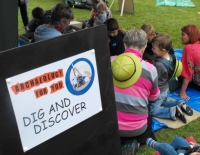
The new Archaeology for You logo we launched for the event this year was used on our display boards to guide people to each of the activities.

Our Logo in action on the activity signs

This year, each of the areas where methods of practical archaeological investigation were demonstrated was linked by the four corner posts of a 10 metre square, fitted with strings and tapes to demonstrate how grids form the backbone of archaeological research. This formed the arena for the demonstration of site surveying using Geophysical and Aerial Survey in Seeing Beneath the Soil and the hands on Dig and Discover boxes, in their new green livery. The grid took centre stage as the framework for Pictures, Plans and Paperwork, where people could learn about the recording process and for Evidence from Objects where finds could be processed and examined for clues about the past.

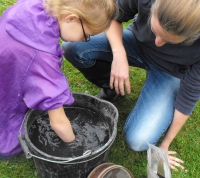
Our aim for Archaeology for You is to build a complete experience of the processes that archaeologists use to digs and the methods used to make records and understand the evidence of the past, which anyone can take part in. Many people took part in our Give it a Swirl

Giving an environmental sample a swirl

introduction to processing samples taken for environmental evidence and busy potters made pre-historic style vessels at Inspired by the Past. Great imagination was also used to create mosaics that reflected favourite themes from mythology and the modern world.

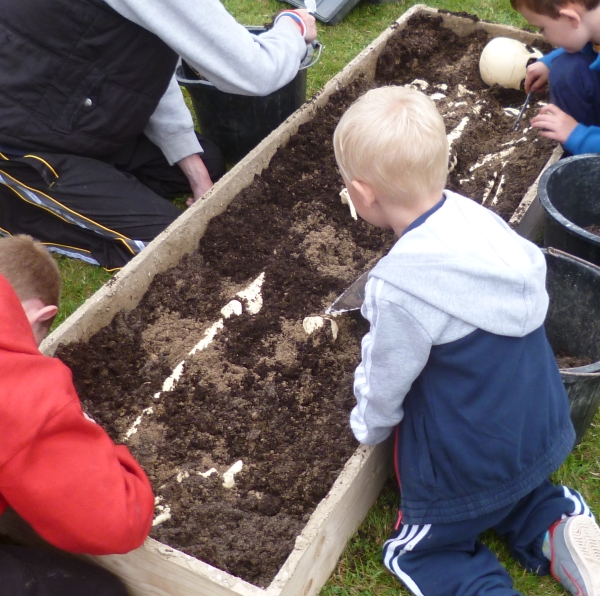
Every year we try to introduce a new element to the activities at Archaeology for You and in our Bones and Burials area this year we recreated a burial, which had to be carefully excavated and recorded over the day.

With the aid of our other teaching skeleton and books people taking part in activity can get a feel for the complicated digging and recording that is needed to get the most information from each burial that is investigated by archaeologists.

Excavating in the Trust for Thanet Archaeology new skeleton activity
Excavating in the new skeleton activity

Archaeology for You is one of the education activities of the Trust for Thanet Archaeology that is supported by a grant from the Education Committee of the Kent Archaeological Society. The Powell-Cotton Museum is generous in allowing us access to their gardens for the event each year and the Director and staff of the Museum give a great deal of support to the event.

We would like to thank everyone who came along on the day and took part, we learn as much each year from the people who take part in Archaeology for You as they do taking part in our archaeological activities for all ages.

Logo for Archaeology for You