Category Archives: From the Archives

VM_365 Day 230 Roman cremation burial from Minster, Thanet

VM 230

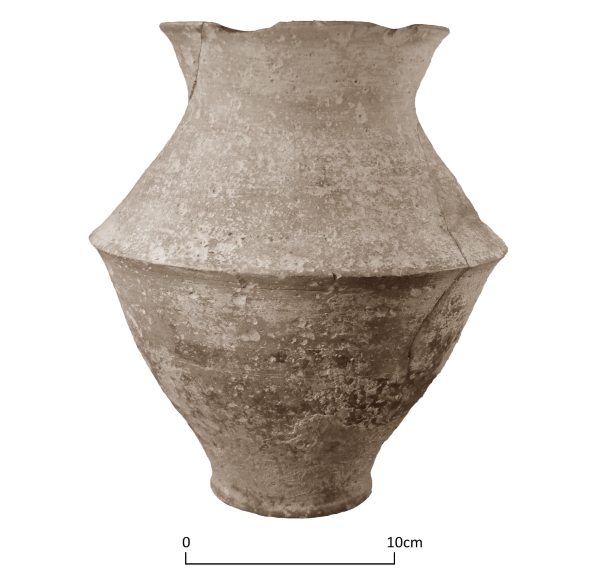
Today’s image for Day 230 of VM_365 shows a Roman vessel which was found during grave digging at the modern cemetery at Tothill Street, Minster in the 1920’s.

This greyware  biconical urn with a carinated rim was found in association with three other vessels, presumably all from the same cremation group.  The group also included a carinated beaker in grey ware with black spots measuring approximatley 10 cm high, a grey ware bowl or platter about 18cm in diameter and a flagon in red fabric measuring approximatley 17.5 cm high. This cremation group dates to the late first to early second century AD.

The biconical urn contained fragments of burnt human bone representing the cremated remains of the individual buried in the pit.  The other vessels are likely to be ancillary vessels deposited in the grave pit alongside the urn, possibly containing food and other offerings for the afterlife.

These vessels were reported in the Antiquaries Journal in 1924 by Mr W. Whiting, an early Roman ceramics specialist who also later worked on the pottery from the early excavations at Richborough Roman Fort in the 1930’s.

VM_365 Day 227 Anglo Saxon pottery from Sarre

VM 227

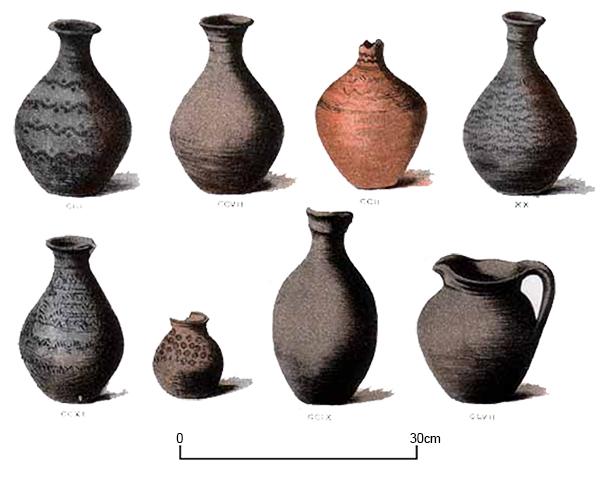
The image for Day 227 of the VM_365 project is taken from the illustrations of pottery vessels excavated at the Anglo Saxon cemetery at Sarre in the mid 19th century which were published in Archaeologia Cantiana by John Brent in 1868. The Sarre cemetery was not investigated again until over 100 years later in 1990 when a number of graves were excavated before a pipeline was laid across the site.

The  range of pottery vessels shown above, described by Brent as Anglo Saxon narrow necked pottery, include wheel turned bottle vases and a jug. One of the graves from the 1990 excavation contained a wheel thrown bottle vase similar to those above which was shown on Day 153 of the VM_365 project.

References

Brent, J. 1868. Account of the Society’s Researches in the Saxon Cemetery at Sarr. Part 3. Archaeologia Cantiana 7. 307-321


VM_365 Day 226 La Tène style pottery from Margate

VM 226

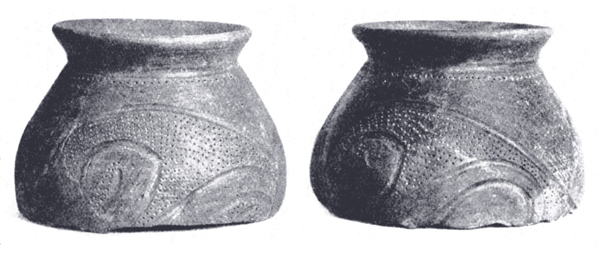
Today’s image for Day 226 of the VM_365 project shows two different views of the upper part of a Middle Iron Age pot decorated with geometric patterns in the distinctive continental La Tène style.

La Tène was a culture with its own distinctive decorative style which developed in Europe during the Iron Age and is named after the Swiss site where evidence of it  was first discovered  in 1857. The La Tène culture flourished in the area north of the Alps around Belgium, Eastern France, Switzerland, Austria, Southern Germany, the Czech republic, Poland, Hungary and Romania. Artefacts influenced by this style are found in Britain and parts of Ireland.

The vessel was found in excavations by Dr Arthur Rowe in 1924 at Tivoli, Margate and was  probably made locally,  influenced by the continental style. Other continentally influenced vessels have been found at Margate, with the pattern picked out in red paint, found at Fort Hill on the eastern side of Margate during excavations in the 2000’s.

VM_365 Day 225 An Antiquarian Illustration of an Anglo Saxon grave

VM 225

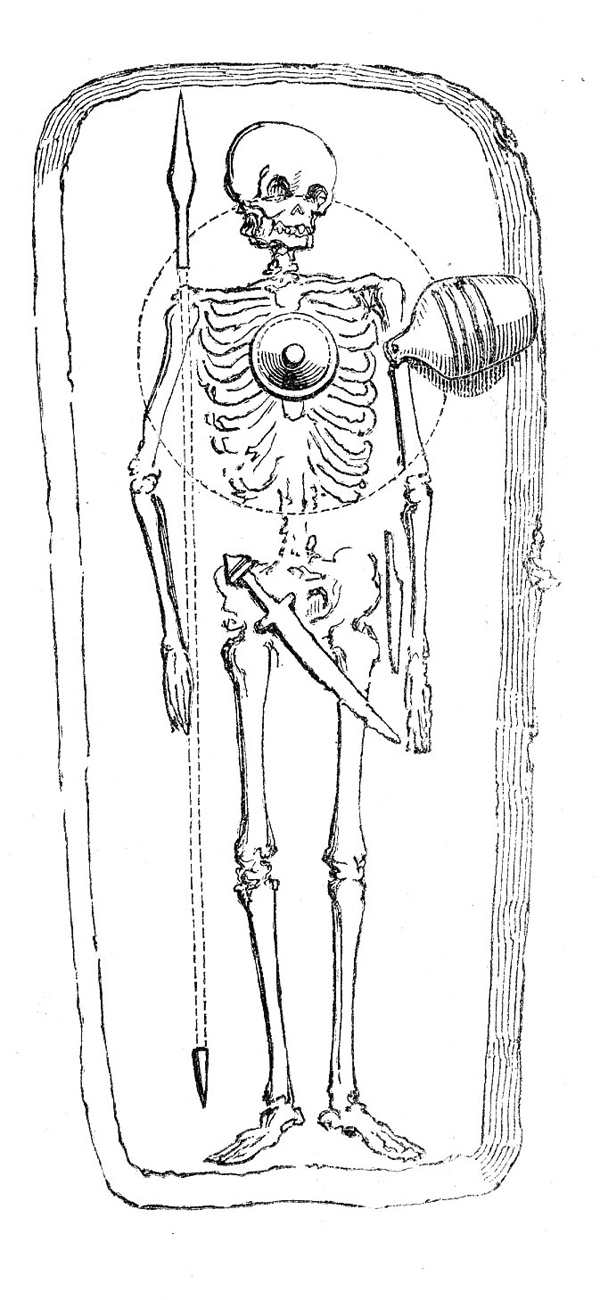
The image for Day 225 of the VM_365 project is an illustration of one of the Anglo-Saxon graves from Ozengell, Ramsgate drawn by F. W. Fairholt in the mid 19th century.

The Anglo Saxon cemetery at Ozengell was discovered in 1846. While workmen were digging a cutting for the new South Eastern Railway line from Ashford to Margate a large number of graves were dug through in fields near an Inn on the road to Canterbury from Ramsgate called Lord of the Manor. Many of the graves within the route of the cutting were destroyed and their artefacts sold off by the workmen before any record of them could be made.

However, William Rolfe, a Sandwich Antiquarian, managed to secure a number of the artefacts from the cemetery for recording and was able to arrange for around thirteen undisturbed graves to be opened for investigation by a group of antiquarians including Charles Roach Smith, Thomas Wright and the illustrator,  F. W. Fairholt who drew many archaeological finds of the period.

Fairholt drew this image during his visit and it is an excellent representation of the layout of the one of the graves. The illustration shows the skeleton of a male, with the remains of a shield on his chest,  a spear on his left side, an iron knife at his right hip, a short sword across his pelvis and a pottery vessel at his right shoulder.

The cemetery was not investigated again until over 100 years later, during the 1960’s, 1970’s and early 1980’s and most recently in 2013.  Artefacts from graves investigated during the 1980’s have featured on Day 204, Day 206, Day 209 and Day 211 of the VM_365 project.

Fairholt’s meticulous attention to detail means that his contemporary grave plan gives a level of information comparable with those made over 100 years later.


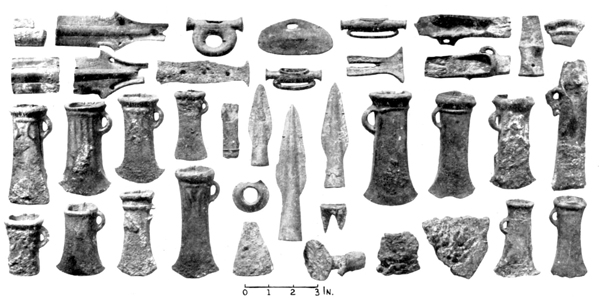
VM_365 Day 220 The Ebbsfleet I Late Bronze Age hoard


The Ebbsfleet I Hoard after Jessup
The Ebbsfleet I Hoard after R. Jessup

Today’s  image for Day 220 of the VM_365 project shows another of the Bronze Age hoards from Thanet, consisting of 181 pieces, weighing approximately 27.21 kg (60lbs).

A description of the Hoard was  given by George Payne in Archaeologia Cantiana after it was passed to him by Mr W.H. Hills of Ramsgate. The hoard was found on a farm at Ebbsfleet near Minster sometime before 1895.

The objects include socketed axes, spear-heads, parts of swords and axes, belt fasteners or ‘bugle’ fittings, portions of a dagger, a knife, and a quantity of ingots.

George Payne suggested that ‘These objects formed the stock in trade of a bronze founder, who went about from one settlement to another casting implements on the spot and taking old worn and broken ones as payment for new’.

This interpretation persisted in the classification of hoards like this containing a mix of complete and broken objects as well as ingots of bronze as a Founders Hoard.

Several of these Founders Hoards have been found on Thanet, some previously featured in VM_365 including nr. Manston (Day 194, Day 196 and Day 197), The Beck Hoard and Birchington III hoard.

Reference

Payne, G. 1895, Researches and discoveries in Kent. Archaeologia Cantiana 21, xlvii-lvi

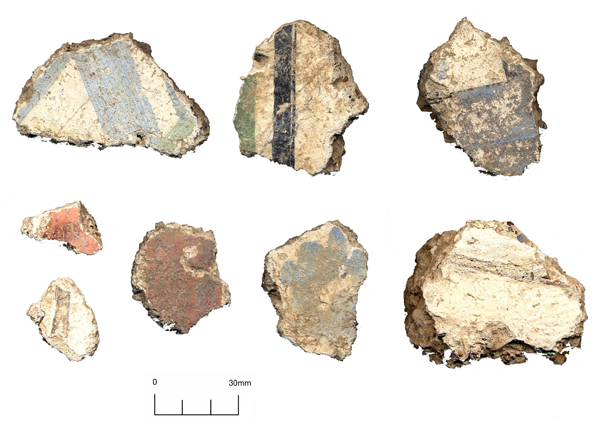
VM_365 Day 218 Roman Painted Plaster from Broadstairs

VM 218

Today’s image for Day 218 of the VM_365 project shows a selection of the painted plaster fragments from the Roman building at Stone Road, Broadstairs which was excavated in 2004.

A total of 49 fragments of painted plaster were found in an extensive demolition deposit concentrated in the north west corner of the building, suggesting that the structure was a high status house.

Painted plaster in an extensive range of colours and styles has been excavated at the Villa site at Minster in Thanet,  with some of the fragments featuring in a series of previous VM_365 posts on Day 178, Day 182, Day 185, Day 188 and Day 191.

Although there are fewer fragments from Stone Road, and are generally much smaller than those at Minster,  they show a wide range of panel designs painted in hues of blue and green as well as  black. Some have suggestions of natural designs, with the third fragment from the left in the bottom row possibly representing a flower painted with blue pigment.

The excavated part of the building also contained a Bakers oven suggesting that the painted rooms were in another part of the range of buildings. Other artefacts recovered from the Stone Road Roman building  have featured as posts on VM_365, including part of a Roman spoon and a Military style belt buckle.


VM_365 Day 217 Art and Anglo-Saxon archaeology

VM 217

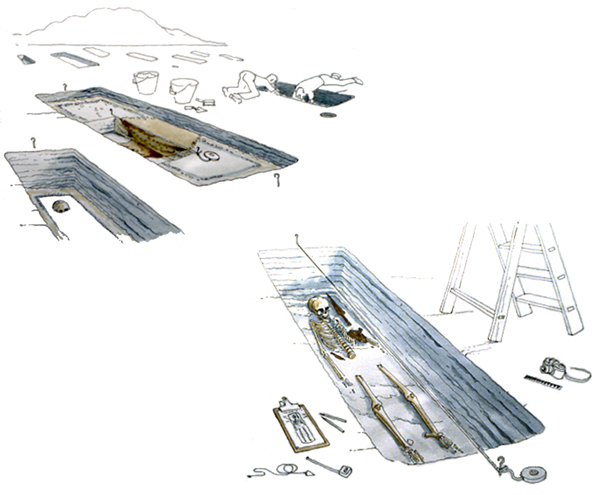
The image for Day 217 of the VM_365 project continues yesterday’s series of images showing artistic interpretations by Len Jay of the archaeological investigation of Anglo-Saxon archaeology in Thanet .

The picture in the top left shows a series of Anglo-Saxon graves under excavation. Two archaeologists are shown in the top right, in the familiar but somewhat undignified posture that is often adopted to excavate a grave with care, without standing on a significant find or on the skeleton itself.  Anglo-Saxon cemeteries usually contain many graves, laid in groups or rows. In the Ozengell Anglo-Saxon cemetery which inspired the drawings, the graves were cut into the chalk geology and had been disturbed by many centuries of ploughing over the fields.

The grave in the centre of the image is the one shown in the previous set of pictures, which was robbed soon after it was created by the excavation of a pit through the middle of the mound.  In the centre of the grave the stratigraphy of the later cutting through the grave is demonstrated, with the brown soil of the later robber cut shown sectioned within the lighter grey fill of the earlier grave fill deposit. It is through this careful unravelling of the sequence of events represented by changes in soil colour that allows us to tell the story of the robbing of the Anglo-Saxon graves.

The lower right image shows the grave after the original fill has been removed, with the skeleton lying on the base. The clothes and weapons shown in the first image from yesterday’s post having been laid with the person who was buried, now only exist as corroded metal objects which have to be carefully excavated and conserved. The excavation is recorded in detail in plans and written descriptions and photographs are taken of the objects in place. Overhead shots of the whole grave are taken from the vantage point of the step ladder shown on the right.

The skeleton in the excavated grave is incomplete, the pelvis, lower spine and upper legs have been cut away by the robbers digging their pit into the middle of the mound. By carefully recording the location of the robber pits and comparing their position with the typical grave goods found in complete burials, it is possible to explore the targets of the grave robbers and the types of artefacts they may have been looking for.

The four reconstructions drawn by Len Jay describe all the processes that have occurred to give us one of our most valuable sources of evidence for the lives and habits of the Anglo-Saxon period. The first set of drawings trace the creation of the graves, their alteration by the intervention of other people  and the effect of the natural processes of decay. The second set of image shows how methods of archaeological investigation can explore all these previous events and processes and generate knowledge about life and death in the Anglo-Saxon period.

Like his colleague and friend Dr Dave Perkins, Len Jay wanted to convey to ordinary people how archaeologists carried out their work and to reconstruct the events that their discoveries were revealing. Both Dave and Len achieved this through their considerable artistic abilities.

Further reading:

The subject of grave robbing in Anglo-Saxon cemeteries in Kent is explored in detail by Dr. Alison Klevnäs in her theses titled ‘Whodunnit? Grave-robbery in early medieval northern and western Europe’ which can be downloaded as a PDF from the University of Cambridge website.  The important records of excavations in Thanet contributed evidence for this work.


VM_365 Day 216 Art and Anglo-Saxon archaeology

VM 216

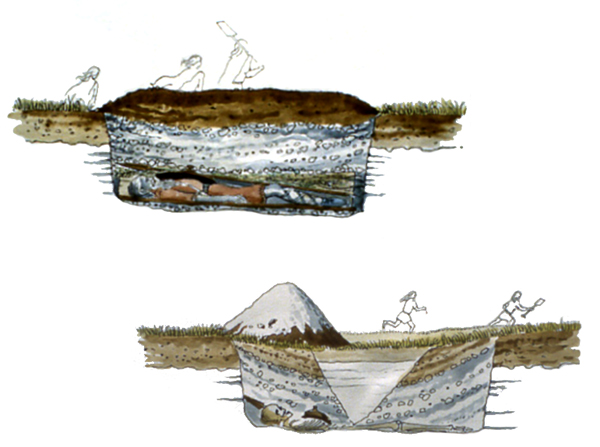
The image for Day 216 of the VM_365 project is drawn from our slide collection, with reproductions of a series of sketches illustrating aspects of the archaeology of the Anglo-Saxon cemeteries that are such a significant part of Thanet’s archaeological landscape.

Thanet has been lucky to have had several talented illustrators among its archaeological community.  A drawing by the Trust’s first Director Dave Perkins featured on Day 111 of the VM_365 project. Today’s images were drawn by Len Jay, a founding member of the Isle of Thanet Archaeological Unit, the predecessor of the Trust for Thanet Archaeology and the Isle of Thanet Archaeological Society. Len Jay was a trained artist and used his abilities to create imaginative illustrations of some of the significant aspects of the archaeology that the Thanet Unit became involved in.

The images in today’s post illustrate a common phenomenon encountered during the investigation of Early Anglo-Saxon cemeteries where archaeologists began to discover that they were not always the first to have dug into the graves furnished with valuable  goods such as weapons, items of jewellery, clothing and vessels in pottery and glass. It is now recognised that many early Anglo-Saxon graves that were were robbed not long after they had been created.

The upper part of the image in today’s post shows a section through a recently created grave, with its occupant dressed in typical costume and accompanied with a shield, sword and knife. In the distance the family are leaving the graveside. In the lower image, two grave robbers have excavated a pit into the centre of the mound that marks the site of the grave, piling the spoil in a heap. They too are seen making a hasty exit with the objects they have recovered.

Grave robbing at an early period has been recognised in many of the large early medieval cemeteries of northern Europe and the phenomenon extends to the cemeteries of East Kent. Although initially it may seem that the motives are relatively simple, recent study has started to consider whether the practise has more complex meanings, perhaps associated with the growth of Christianity and the ambiguous relationship of the converted population with the pagan graves of the pre-Christian era.

Len Jay used his talents as an artist to visualise the processes that were being observed in excavations and explored their meaning through his visual representation, which complemented the body of written material that was also being generated.


VM_365 Day 213 Manston Beaker before Restoration

VM 213

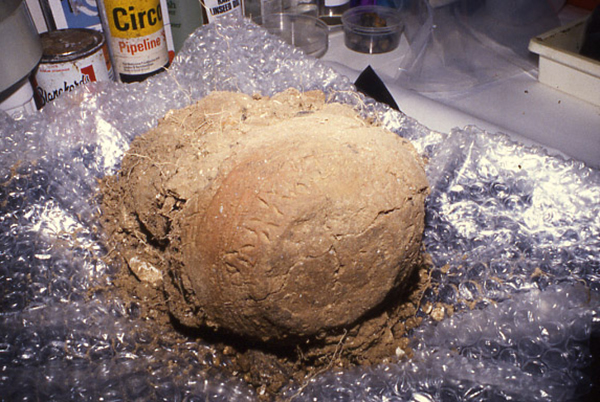
The image for Day 213 of the VM_365 project is one of our pictures from the slide archive collection. Taken in 1987, it shows the Manston Beaker prior to its restoration.

The Beaker, previously featured on Day 161,  was found resting on its side and was lifted on site in a block of soil, tightly wrapped in bubble wrap, before being transported back to the laboratory where it was excavated from its soil block.

This picture shows the base of the beaker during cleaning. We often forget when we see an object cleaned up and on display how many stages it may have gone through to get to that condition. In the case of this Manston Beaker it involved the heavy restoration of its missing parts and decorative pattern.

VM_365 Day 208 Three glass vessels from Margate with a tale to tell

VM 208

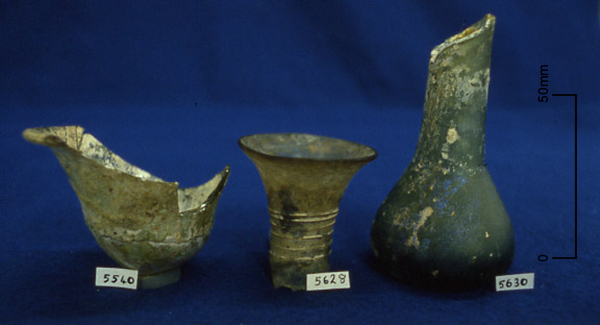
Today’s VM_365 image for Day 208 of the project shows three glass vessels which were part of the Rowe Bequest, a collection donated to the people of Margate by Dr Arthur Rowe.

In 1986, David Perkins, the first Director of the Trust for Thanet Archaeology, was involved in cataloguing the artefacts belonging to the Rowe Bequest which had been housed in the Old Margate Museum prior to the Second World War. A number of the artefacts in the Rowe Bequest were associated with the Anglo Saxon cemetery at Half Mile Ride, Margate. Using  Rowe’s notes and modern archaeological research, Perkins was able to publish a reappraisal of the cemetery in the county journal.

While cataloguing the items, Dave Perkins identified the three glass vessels, pictured above, which had been packed along with the artefacts from the Half Mile Ride collection but were not been mentioned in the museum records.

The first of the vessels (on the left) is a green glass Base Cup dating to around the 7th century. A stand obscures the pointed base of the vessel in the photograph; it was originally manufactured so that the contents of the vessel had to be fully consumed before it could be put down on its rim. Perkins confirmed that the Base Cup was from one of the graves of the Half Mile Ride cemetery.

Despite being from two seperate vessels of different dates, the two other fragments shown in the centre and on the right, had been reconstructed incorrectly to form a ‘single’ vessel and had been described in the old catalogue as Roman, suggesting they were probably from the Twenties Brickfield approximatley 300 metres to the north west of the Half Mile Ride graves. Dave Perkins was able to show that this catalogue entry was not right.

The body and base on the right are from the lower part of a flask of thick blue green glass dating to the Roman period. The rim and neck in the centre are actually from a clear glass pouch bottle with glass thread decoration around the neck,  actually of Anglo Saxon date. The pouch bottle also dates to around the 7th century. Perkins was able to confirm that it also came from the Half Mile Ride cemetery.

References

Perkins, D. R. J. 2000. Jutish Glass Production in Kent: And the Problem of the Base Cups. Archaeologia Cantiana CXX, 297-310.

Perkins, D. R. J. 1987. The Jutish Cemetery at Half Mile Ride, Margate: A Re-appraisal. Archaeologia Cantiana CIV, 219-236.