Category Archives: Places

VM_365 Day 133 Decorative Stone from lost Medieval Parish Church of All Saints, Shuart

VM 133

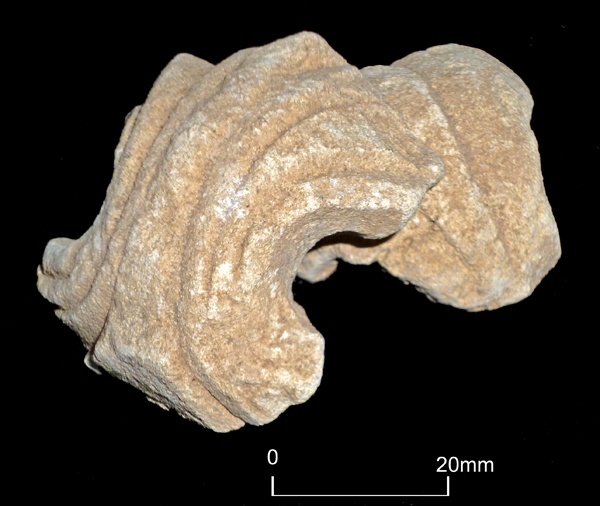
VM 365 Day 133’s image shows two fragments of decorative stone from the lost medieval parish church of All Saint’s, Shuart, which was excavated between 1978 and 1979 by the Isle of Thanet Archaeological Unit.

The image shows the fragments of delicately carved Caen stone dating from the 12th century. The carvings represent fragments of a piece of carved foliage, used to decorate the interior of the church. The pieces were found along with other contemporary fragments of decorative stone in deposits associated with the much later demolition of the church building.


VM_365 Day 126. Late Iron Age Bridle Bits from North Foreland

VM 126

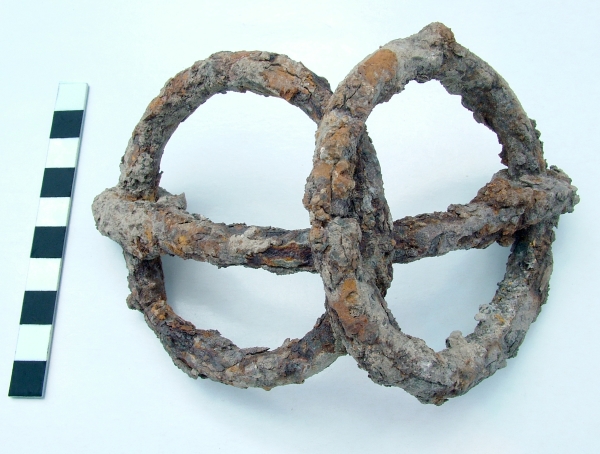
VM 365 Day 126, today’s image shows one of the two sets of what are thought to be Horse bridle bits, both consist of a pair of iron rings linked by loops at either end of a curved iron bar. They were found during the excavation of a pit at the Iron Age settlement at North Foreland, Broadstairs.

Both of the bit sets were found in the fills of the same pit dated by the associated pottery to the Late Iron Age around 150-50 BC. X-Ray images showed that each of the rings had a break in it, possibly to allow the bar to be attached to the rings which could then be hammered shut.

Bronze Bridle bits of this type, with a single plain bit, are more commonly found but these sets are unusual for Iron bits because they are made of a single curved piece of iron, rather than the more typical two or three piece iron examples.

Perhaps the two sets of bits were used together for a specialised purpose. It is possible they have a different function altogether and the similarity with horse bridle parts is a deceptive coincidence.

VM_365 Day 125. Iron Age Worked bone object from North Foreland

VM-125

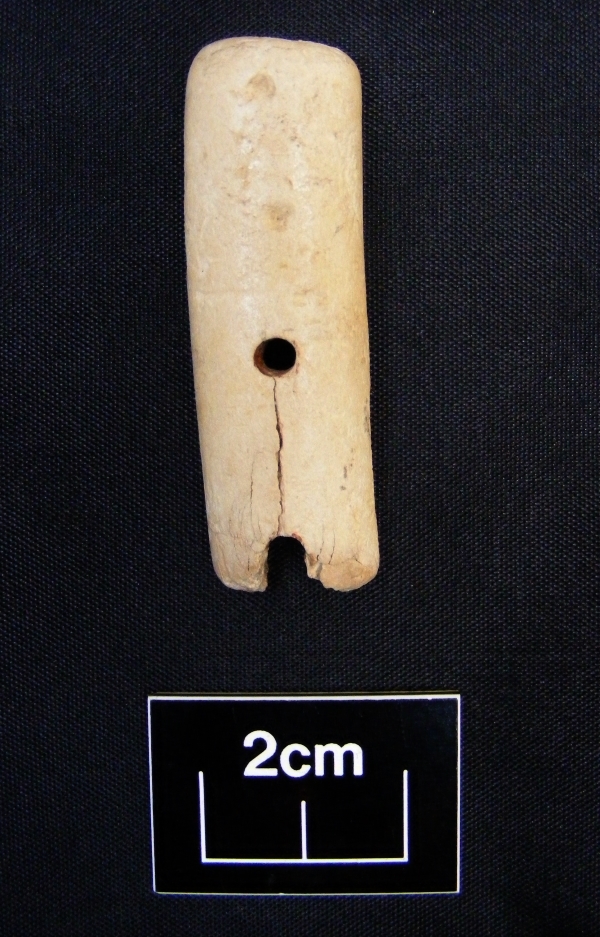
Today’s VM 365 Day 125 image is a fragment of worked bone found during excavations at North Foreland in 2001.

The worked bone was found in a large pit dated to the late Iron Age by the pottery contained within its fill.  Also found, at the base of the pit, were two sets of iron bridle bits.

This fragment of worked bone measures 52mm by 16mm and has been worked to form a relatively uniform convex curve along its length. It is probably a knife handle,  there is iron staining on the back and it is pierced by two holes, presumably for rivets to join the handle to the iron blade and its matching bone piece on the other side of the knife.  If you look carefully at the top of the piece you can see two shallow circular depressions where two false starts have been made for the rivet holes.

VM_365 Day 124 Iron Age chalk loom weights from North Foreland.

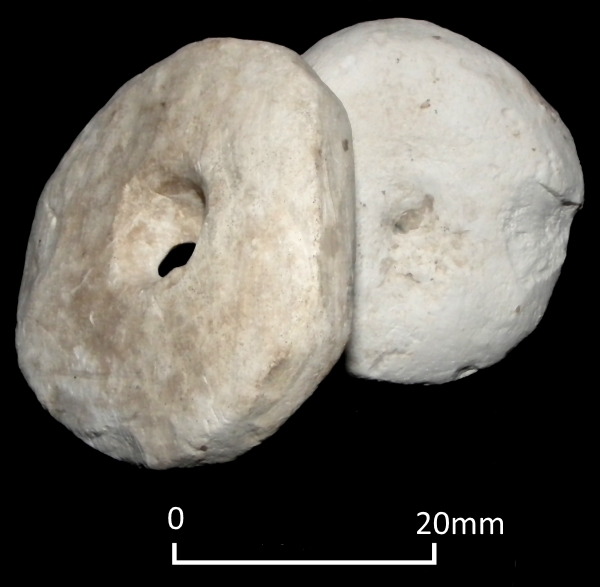
Today’s VM 365  image for Day 124 is of two loomweights that were found among the soil and rubbish used to backfill an abandoned grain storage pit at North Foreland, Broadstairs, one of two similar  pits that were found near to each other. The other pit had been used later to bury a woman in the upper part of the cut.

Two Iron Age chalk loomweights from North Foreland, Broadstairs.
Two chalk loomweights from the Iron Age settlement at North Foreland, Broadstairs.

The loom weights were found in the upper fills of  the pit, among pottery dating to the middle Iron Age.  Other domestic waste in the pit fill included animal bone, marine shells, flint, daub, charcoal, and burnt and charred grain and chaff from species such as oats, barley, wheat and spelt.

The loomweights were carved from chalk, which may have been picked up from the coast nearby. The weights may not have been used before they were dumped in the pit with the other rubbish. One weight was certainly unfinished as the hole in the centre did not penetrate all the way through the chalk and must have abandoned while it was still being worked on.

VM_365 Day 123 Decorated bone or ivory pin from Iron Age burial at North Foreland, Broadstairs.

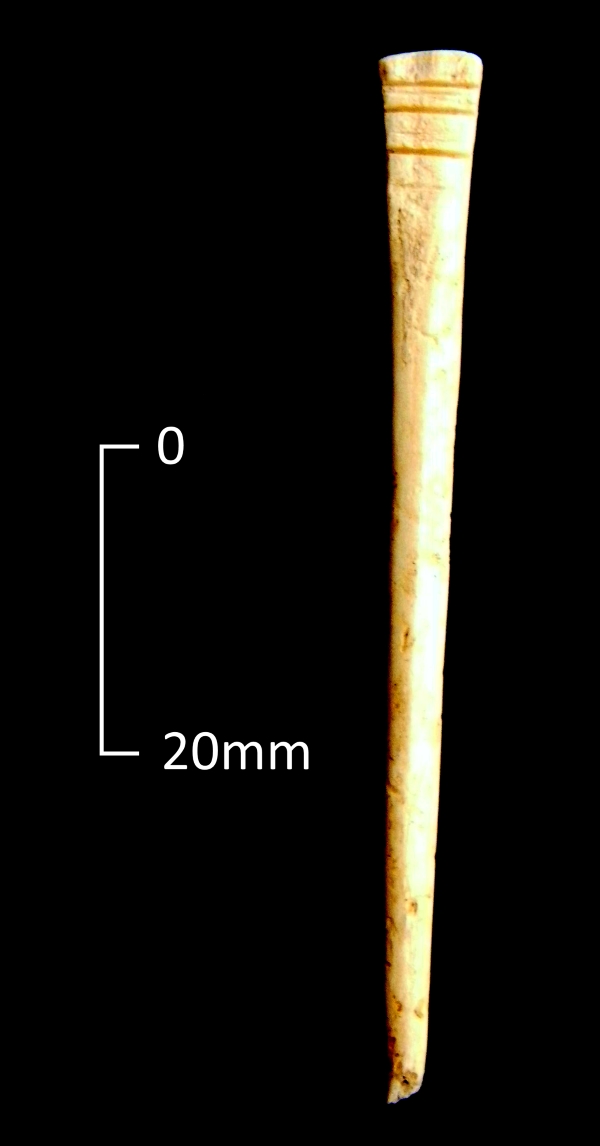
Bone pin with incised decoration from Iron Age Burial, North Foreland Broadstairs.

For Day 123 of VM_365 we have an image of a small decorated pin that was found in association with the Iron Age woman who was buried in the grain storage pit at North Foreland, Broadstairs.

The blue glass beads that were near the neck of the burial have been shown in a previous post for VM_365, along with the complicated story of the pit’s primary use and of the things that had later been used to fill it.

At first glance the pin, which was also found in close association with the skeleton, appears to be a much simpler object than the exotic glass beads, but it has a more complex story to tell.

The pin is carved from a piece of dense bone, or possibly ivory. The shaft has been carved to taper toward a point, which has unfortunately broken off.  Close examination of the surface of the shaft reveals fine facets along the length. The whole surface of the pin was polished to a smooth sheen.  At one end the pin was  flattened to form a head and on the side shown in the image the head was decorated with three incised lines.

This object could possibly have been a dress fitting or even a hair pin, another indicator that the woman buried had some status and was not simply thrown in the pit with other unwanted debris.


VM_365 Day 122 Ghosts of Iron Age timber preserved in plaster

VM 122

The image for VM 365 Day 122 shows in greater detail the Iron Age chalk plaster blocks found in at the base of an abandoned grain storage pit at North Foreland, shown yesterday under excavation. The scales in the images above are all 10 centimetres long.

A chalk paste had been used to make a form of plaster which had been spread over a timber structure, much like the clay daub that was often used in other places. Although the timber itself had rotted away, some of the blocks still had distinct voids and impressions that had been formed by the rods and sails of the supporting framework of wooden stakes.

An impression of a possible timber structure identified near the mouth of the pit suggests that these blocks may have formed part of a lining for the pit, or alternatively part of a superstructure built around the upper opening to the pit.  The blocks were tipped into the pit in pieces and covered with rubbish once it it was no longer used as a grain store.

Each of the blocks in the image above preserves a ghost of a timber stake in the voids left in the plaster that was spread around it. The dry chalky conditions of Thanet’s soils do not often preserve organic materials and finding a piece of timber that was two thousand years old would be a remarkable discovery. The closest we are likely to get are the negative ghost timbers that were preserved in these blocks of structural material at North Foreland.


VM_365 Day 121 Evidence for Iron Age structures at North Foreland

VM 121

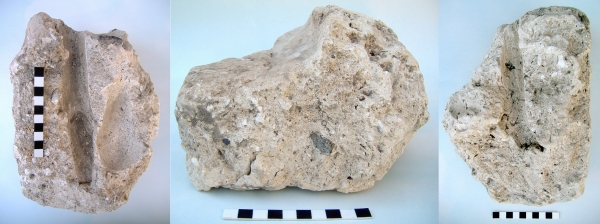
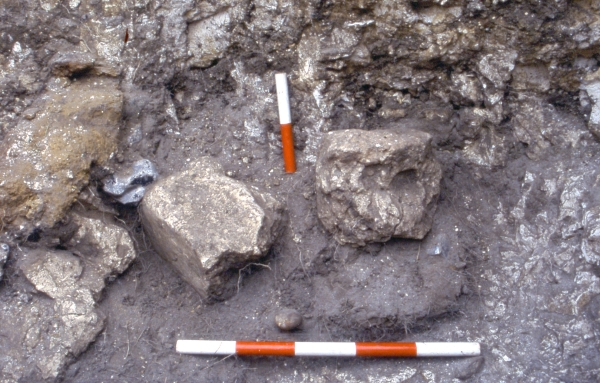
Today’s image for VM 365 Day 121 shows a number of large blocks of moulded chalk paste at the base of an early to middle Iron Age pit at North Foreland, Broadstairs, under excavation in 2003.

The pit was 1.38 metres deep, with a bell shaped profile. The diameter at the surface measured 1.66 metres,  widening to 1.9 metres at the base.  The pit was originally dug to store grain,  the earliest fills containing large quantities of burnt and charred seeds, chaff, and grain of species including barley, spelt, emmer and oat.

Sealed between two of the earliest fills were the blocks of moulded chalk paste, used as a form of lime plaster to cover a structure. After the blocks had been dumped in the base, the pit was  used as a rubbish pit, with artefacts including pottery, animal bone, marine shell and fragments of quern stone being tipped in until it was completely filled.

Later a woman was buried in the upper section of the pit, probably after it had been partly cleared of the dumped debris. The grave was covered over with more material derived from the surrounding settlement.

The chalk blocks are important as they represent some of the only evidence we have for what the structures in the surrounding settlement that created this storage pit might have been made of.  All other traces of the above ground Iron Age structures were eroded away over time, leaving only the below ground elements of pits, ditches and post holes to be excavated by the archaeologists.
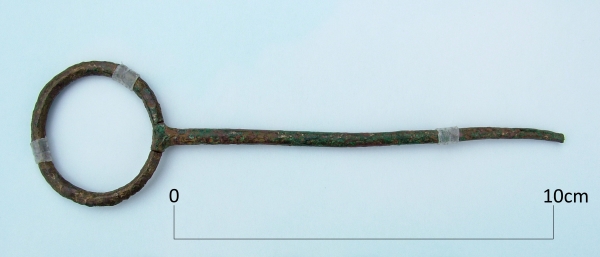
 

VM_365 Day 120 Anglo-Saxon Decorated Strap ends from Sarre

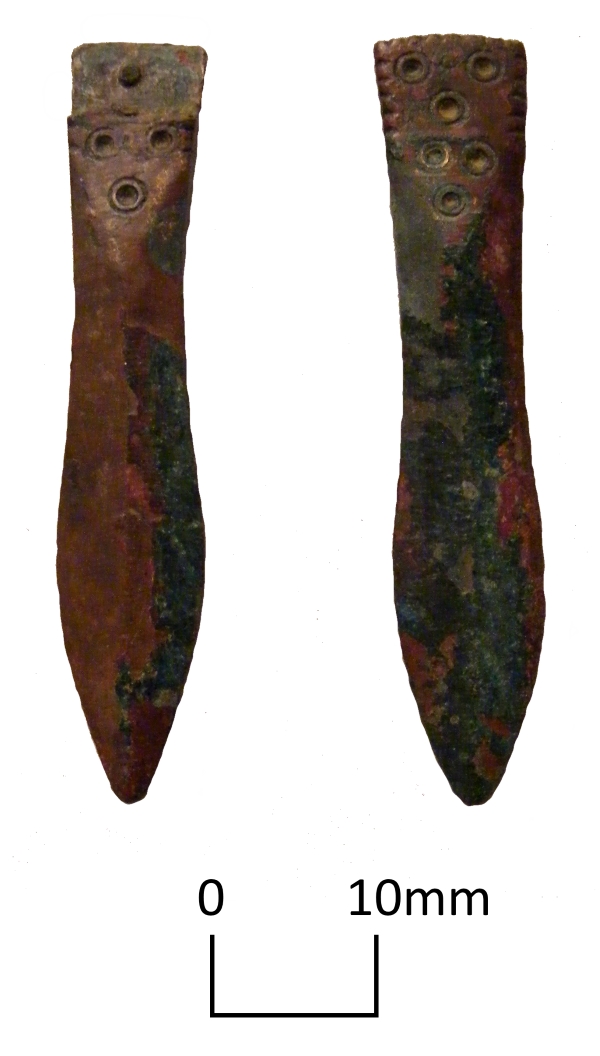
VM 120Today’s image for VM 365 Day 120 shows two decorated strap ends found in grave 276 at Sarre in 1990.
These were the only objects found in the grave that had been heavily disturbed, probably in the Anglo Saxon period. All the skeletal remains were piled at one end and it was not possible to determine the sex or age of the individual from the bones that survived.

These bronze strap ends are a matching pair and have been beautifully decorated with a ring and dot motif. Similar strap ends have been found in grave 98 at the Bucklands cemetery at Dover although the Sarre examples are more ornate.


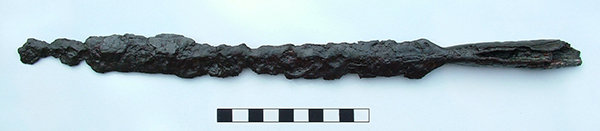
VM_365 Day 119 Anglo Saxon Spearhead from Sarre

VM 119

Day 119’s image shows the remains of an Anglo Saxon spearhead from grave 283 at Sarre.

The grave was very shallow, measuring only 0.24 metres deep and had been disturbed or robbed in antiquity probably in the Anglo Saxon period. Only a few of the bones of the skeleton of an adult male aged over 30 years old remained in situ.

The original position of the spearhead in the grave is unknown and it was later dislodged from the grave fill when it was cleared by the mechanical excavator before hand excavation. The spearhead would most likely have originally been located near the skull along one side of the grave edge as is common with other undisturbed graves.

The part where the spearhead was attached to the wooden shaft, the ferrule, is relativley well preserved and wood impressions of the shaft are visible on the inside of the corroded metal. The spearhead is of 6th century date, conforming to Swanton’s E4 type. Five others were found when graves from the same cemetery were excavated in the 19th century by John Brent.

References

Perkins, D. R. J. 1992. The Jutish Cemetery at Sarre Revisited: Part II. Archaeologia Cantiana Volume CX, 83-120.

Swanton, M. J. 1974. A Corpus of Anglo-Saxon Spear Types. British Archaeological Reports 4.