Category Archives: Places

VM_365 Day 245 Minster Villa detached Bath house

VM 245b

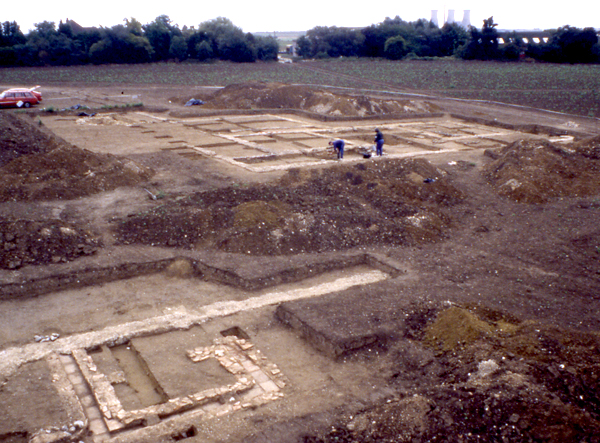
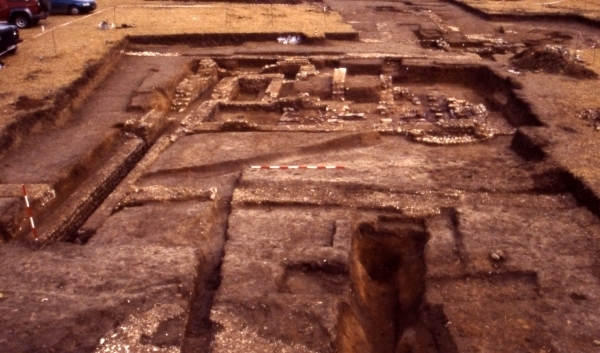
The image for Day 245 of the VM_365 project shows an overview, from the west side facing east, of the detached bath house building (Building 3 )that stood to the west of the main range of buildings of the Minster villa. The bath house was located within the walled compound of the building, adjacent to the west wing of the villa which was shown in the post for VM_365 Day_242. The bath house lay under the spoil and unexcavated area in the centre right of that image. The Minster villa had a number of bath houses in operation at various times in its period of use.

The bath house was formed of a series of cold, warm and hot rooms as well as cold and heated pools arranged in a tight rectangle around a furnace, which heated the raised hypocaust floors. Building materials recovered from the structure indicated that the floors were formed of concrete and lime plaster, but there was no evidence for mosaic floors. In common with the rest of the building, no structure above foundation level survived, but some of the deeper elements of the structure associated with the furnaces and hypocausts were relatively well preserved.

The main ranges of the Minster villa had been constructed on the plateau and crest of an elongated hill, flanked by dry valleys, which overlooked the flood plain of the Wanstum valley below. The bath house had been located on the edge of the plateau at the point where the land began to fall  toward the western valley.

The bath house builders took advantage of the natural slope to feed water diverted from a natural source, probably a spring,  through the various processes within the bathhouse structure.   It is not clear where the water source used by the bathhouse was, but the western valley has a small spring fed stream in the present day and the source may have been located further up the valley in the Roman period.

Although much of the infrastructure had been destroyed, probably within the Roman period, remnants of the piping and channels that controlled the flow through the building were recovered.  In the foreground of the image one of the drainage ditches from the western side of the building, traced for some of its length in the excavation, can be seen.  On the right of the picture  two parallel walls mark the route of a deep mortared flint channel that also served as a main drainage outlet for the building.

The position of the bath house reflects a clever approach to water engineering which was a characteristic of architecture in the Roman period. With the main occupants, administrative staff, servants and labourers a buildings like the Minster villa would have represented one of the densest concentrations of people within a confined space that could be found in the Roman period. The post for Day 131 of the VM_365 project showed one of the high pressure water pipes that had been used for the external drain of another bath house. located at the southern end of the  western wing of the villa.

Wherever a large population gathered, the supply of clean water and systems for disposing of waste would have been essential.  The provision of steady flow of water through the building would have served more than just the provision of luxury bathing facilities but also to keep the location and its occupants clean and healthy.
 

VM_365 Day 244 Minster Roman villa heated apse

VM 244

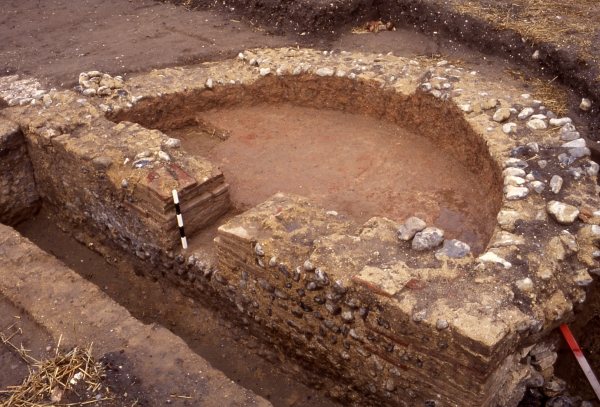
The image for VM_365 Day 244 shows part of an apse which was located in the centre on the north side of the east west range of rooms of the Minster villa.

This structure is one of the better preserved elements of the villa’s underground heating system, which as previous posts have noted, survived damage from cultivation because they had been cut below the foundation level of the main structure. The apse is formed by flint and brick walls set in firm mortar forming a ‘D’ shape that extended out from the northern end of the middle room in the central range with the sub floor surfaced in hard, pink concrete made using crushed tile. The apse may have formed a heated niche at the northern end of a rectangular room.

In the foreground of the picture a deep ‘L’ shaped channel gave access from the exterior of the building on the east side into a furnace chamber. The hot air from the furnace entered the apse through a small arch in the southern wall,  passing under the floor of the curved chamber and out through flue tiles in the wall, although none were preserved. The southern retaining wall of the stoke chamber was built of an unusual combination of mud-brick and mortar.

The floor of the apsidal room above was probably surfaced with mosaic as large fragments of patterned mosaic had been retained in the chamber after demolition of the building giving us our best evidence that the villa building was originally extensively covered with tesselated floors.


VM_365 Day 243 Robbed Roman Remains

VM 243

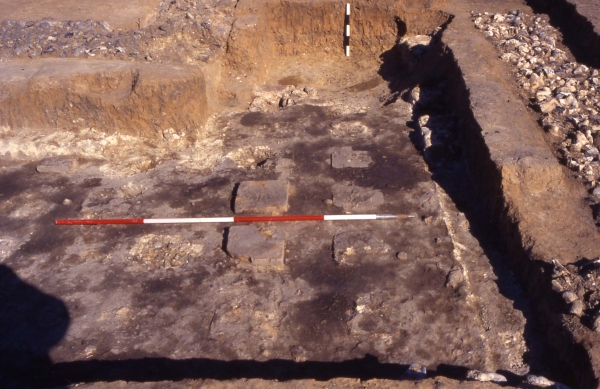
Today’s image for VM_365 Day 243 shows the remains of a hypocaust underfloor heating system from Building 4 of the Abbey Farm Roman villa complex at Minster, Thanet. The remains of the hypocaust structure survive to a depth of only around 0.5 metres below the base of the plough soil.

Building 4 was a two roomed corridor house seperate from the main villa building. The corridor house had a  small heated room in one corner. Like most of the buildings in the villa complex, this structure had been heavily robbed in the Roman period and later for reuseable building materials, including the large flint cobbles that were used in the building foundations.  In the case of the heated room in Building 4 the tiles that had been used to build the pilae stacks that supported the hypocaust floor had all been taken to be used elsewhere.

In the picture above the wall foundations around the edge of the hypocaust have been robbed leaving the raised lip of the  mortar floor and a few cobbles to suggest where the walls had been. Only the tiles that were bonded to the floor with mortar and were too difficult to remove remain in place, leaving scars in the mortar and parts of broken tiles to show where the stacks had been.

VM_365 Day 242 The Roman villa at Minster Part 1.

VM 242

Today the image for VM_365 Day 241 is a view of the excavation of the west wing of the Roman Villa at Abbey Farm, Minster in Thanet. The villa is the largest Roman building to have been excavated in Thanet and it was exposed over several seasons of excavation when it was adopted by the Kent Archaeological Society for a training excavation.

The picture is taken from the west side, facing south east toward Richborough. The Villa’s boundary wall is in the foreground, with a stone and tile structure attached to it. In the upper middle of the picture the foundations of the main east west range of the villa and its western wing are exposed, following the removal of the thin layer of topsoil that covered it. The curved apse from the central hall in the main range can be seen in the top left limit of the building foundations.

Like much of the archaeology found on Thanet, heavy ploughing has reduced the walls of the villa almost to the base of their original foundation trenches, leaving only one or two courses of stone to mark out the floor plan. Only the deep chambers for the hypocaust systems for heated rooms that were originally constructed below ground survived in the main villa structure. Occasionally, deep cut channels like the tile lined structure in the foreground also survived.

Previous VM_365 posts have explored some of the diverse range of artefacts recovered in the excavation of the Villa, including personal items such as brooches, tweezers and needles and pins on Days 88, 89, 90, 96, 112, 129139, 143, 154 and 39. Evidence of the different decoration schemes using painted plaster has featured on Days 178, 182, 185, 188 and 191, and evidence for how they managed their water supply has featured on Day 130 and 131.

VM_365 Day 241 Accessory vessel from burial at Thorne, discovered in Gas pipeline

VM 241

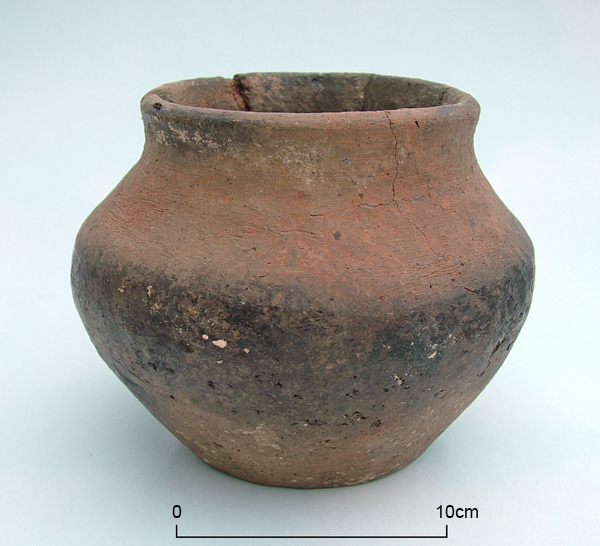
The image for Day 241 of the VM_365 project is of a pottery vessel placed with a skeleton in a Roman grave discovered on a gas pipeline project at Thorne, near Cliffsend. Vessels from a cremation group from the same area, discovered in the same pipeline project, were shown in the post for VM_365 Day 239.

The north south orientated grave contained the skeleton of an adult around 25 years old. The small pottery beaker or jar was found along with a flagon near the head of the individual.

The pot is made in a grog tempered fabric,  where fragments of crushed ceramic has been added to the clay paste. Occasional stone grits are also visible where they protrude from small faults in the surface. The outer surface of the pot has been lightly burnished.

The range of vessels that were recovered from this small cemetery illustrates the market for a wide range of styles of pottery and probably the diverse products that were shipped in the pots, which existed in Thanet in the Roman period. Each grave is  a snapshot of the pottery that lay to hand as the accessory vessels for a burial or cremation were assembled. The surviving vessels from grave groups, as well as those from remarkable survivals like the dump of Roman kitchenware discovered at Broadstairs, allow archaeologists to reconstruct the suites of pottery that were available to settlements in Thanet.


VM_365 Day 240 Reconstruction of Roman cremation burial at Thorne

Reconstruction of 1st century Roman cremation at Thorne

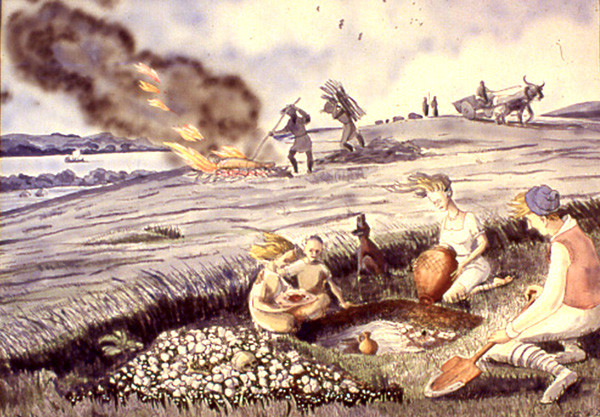
The image for Day 240 of the VM_365 project is of an artists reconstruction of the child’s grave, containing cremated remains and accessory vessels, based on one (Grave 5) excavated on a gas pipeline near Thorne, near Minster in Thanet, which was shown on Day 239. The painting is by Len Jay whose work reconstructing images from the Anglo-Saxon archaeology of Thanet, which he helped to discover, have featured in previous VM_365 posts on Day 216 and Day 217.

The image shows the rectangular pit being prepared to receive the pot containing the cremation, with the accessory vessels already in place. The grave has been excavated with a wooden shovel, strengthened by an iron blade added to the tip. On the left of the pit there is a heap of chalk from the geology that has been exposed below a thin covering of soil.   Human bones are present in the chalk, reflecting the many thousands of years that the landscape was used to create funerary monuments and the fact that successive generations often disturbed the remains of those that came before them, accidentally or deliberately.

On the left of the group of figures  surrounding the grave, a child is about to add a plate of food to accompany the vessels. Organic remains like food are something which we can not now detect through archaeology except in the rarest of circumstances, but the vessels imply that such perishable things were placed with the remains. The girl is comforted by a boy to her right and a dog howls into the air.

The burial of the cremated remains takes place on the crest of the ridge which forms the backbone of Thanet’s chalk landscape,  in the top right a sailing vessel is shown in the Wantsum channel  which is overlooked by the ridge. In the top right small figures tend a flock of sheep on the crest of the ridge. The prevailing wind that swept the open downland ridge, blowing the hair of the group to the left is still notable in the present day.

A cremation burial is simply the gathered ashes of a burnt body, that was arranged with vessels and other objects according to prevailing beliefs and sealed below a covering of soil, forming a lasting memorial to the person buried. The burning of a body is taking place in the background of this image on the crest of the ridge, using the wind to accelerate the wood fuelled fire so it could reach the temperatures that were necessary to reduce the body to ashes.

The landscape in this picture is recognisable to anyone who knows Thanet well, although it has changed considerably in recent years. However the details of the scene may reflect accurate archaeological data, it is still evocative of a distant time and of the human stories behind the objects that we recover as archaeological artefacts.

VM_365 Day 239 Grave 5, Thorne Roman cemetery

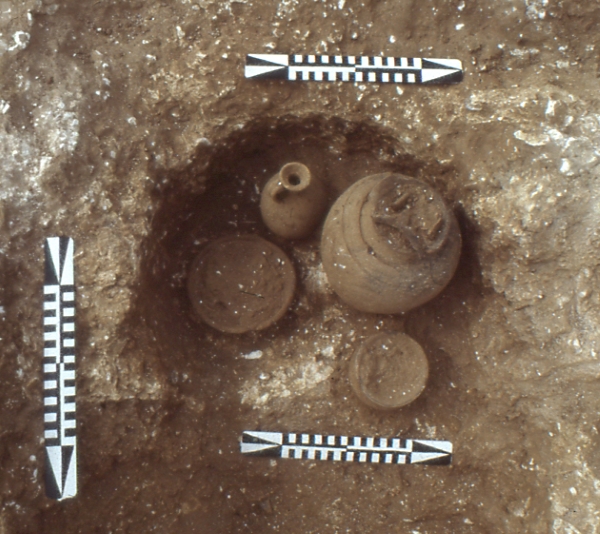
VM 239The image for Day 239 of the VM_365 project shows Grave 5 from the Thorne Roman cemetery. This cremation burial, dating to the first century AD, was excavated along the Monkton Gas Pipeline route between 1983-4.
Four pottery vessels were deposited in the grave and include a large urn, which contained the cremated remains of a child under the age of 12 years old, and three smaller accessory vessels; a small urn, a dish and a flagon.

The urn containing the cremation was a large jar in native grog tempered pottery with rough tooled chevron decoration on the shoulders. The ring necked flagon, in a pink buff sandy fabric, was made in the Canterbury district and had a three ribbed strap handle. The small beaker and dish were both made of smooth grey ware similar to Upchurch Ware but probably made locally on the banks of the Wantsum Channel.

A cremation burial in a globular amphora from the smae cemetery has previously featured on Day 236 of the VM_365 project.

References

Perkins, D. R. J. 1985. The Monkton Gas Pipeline. Archaeologia Cantiana CII, 43-69.

VM_365 Day 238 Grave 275, Sarre Anglo Saxon cemetery

VM 238

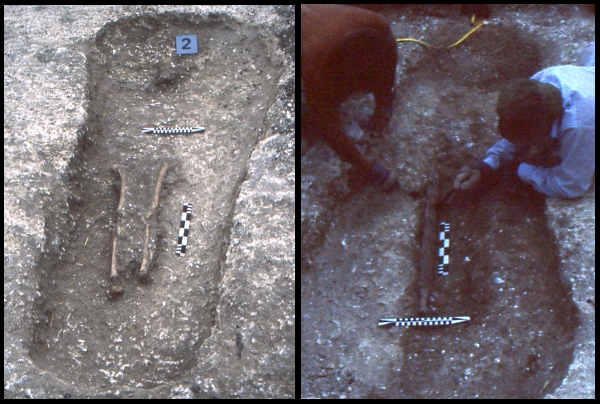
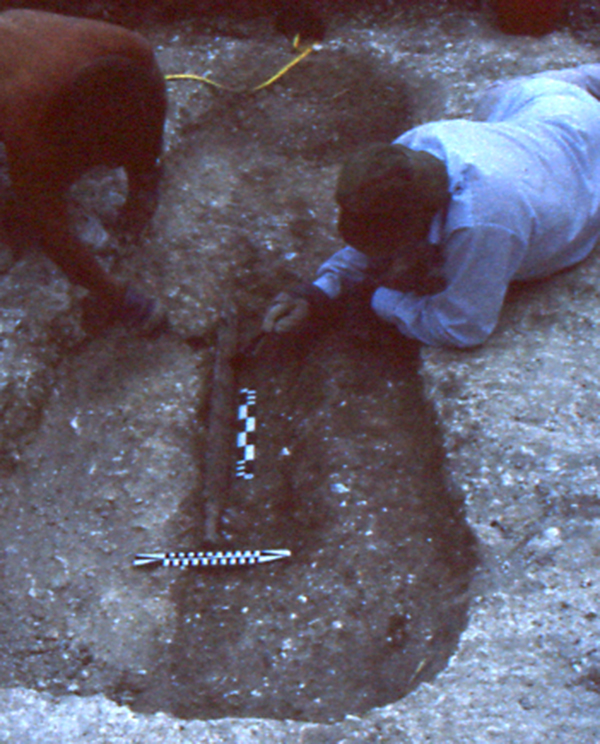
Today’s VM_365 image shows the fully exposed skeleton within Grave 275 of the Sarre Anglo Saxon cemetery (left) and the sword which lay above it under excavation (right).

As you can see from the photo on the right, the grave was very shallow, the surrounding soil and chalk having been eroded over the years and the skeleton and the sword were in danger of being completely destroyed by ploughing. The skeleton of the adult male aged 25-30 was already in a poor condition with part of the skull destroyed by the recent passage of the plough and only the long bones of legs remained intact, although very fragmentary.

The sword had been placed over the skeleton on the lid of the coffin with the hilt pointing toward the head and the sword tip toward the feet. An iron knife and a bronze buckle plate also accompanied the burial.

An image of the sword and its XRay featured on Day 117 and details of the excavation of the sword on Day 237.

VM_365 Day 237 Excavation of an Anglo Saxon sword

VM 237

The image for Day 237 of the VM_365 project shows the excavation of an Anglo Saxon sword from the Sarre cemetery in 1990. The sword was excavated from Grave 275 which contained the skeletal remains of an adult male aged between 25 to 30 years old.

This image, from the slide archives, is the only one we have which shows the excavation of the sword in progress. As you can see from the image, the sword was found above the body, probably originally placed on the lid of the coffin, with the skeletal remains located at a lower level in the grave.

The sword and details on its manufacture, as well as an X-Ray  image have previously featured on Day 117 .


VM_365 Day 236 Roman cemetery site, Thorne, near Cliffsend

VM 326

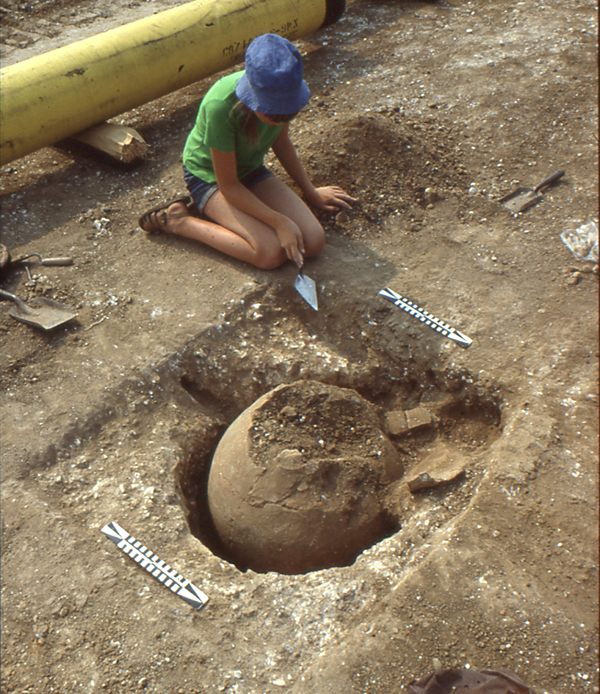
This archive image for Day  236 of the VM_365 project shows a Roman cremation burial under excavation on the Monkton Gas Pipeline in 1983.  A small  cemetery of nine graves including inhumations and cremations was found near Thorne Farm during the installation of the gas pipeline.

The image above shows Grave 6, a cremation contained in a large globular amphora (Dressel type 20). The upper edges of the vessel, including the handles and the rim, were missing; lost through plough damage or stripping the soil for the pipeline.  An adult and a young child were represented by the cremated bones. The bones of small rodents and amphibians , frogs or toads, were found in a soil deposit above the cremated bone.   These creatures had presumably been trapped in the hollow void above the cremation deposit in the vessel after its burial.

The location of cremation and inhumation cemeteries of Roman date can be seen on our map of Roman Thanet shown on Day 61.