Category Archives: Archaeology

VM_365 Day 132 Roman glass from Minster Villa

Roman window and vessel glass

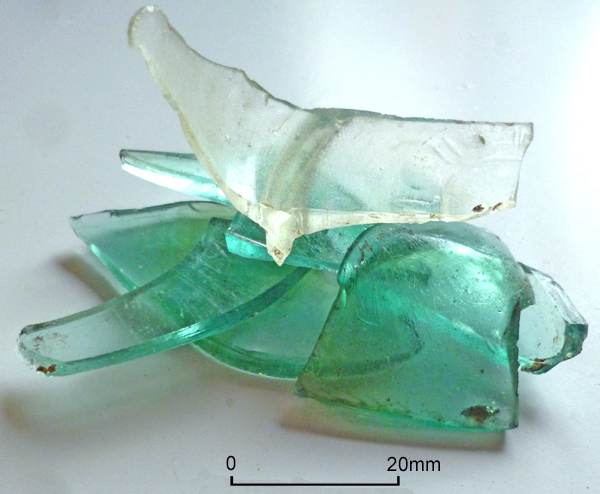
The image for day 132 of VM_365 is a selection of the fine glass fragments that were found in the excavations at the Roman Villa at Minster in Thanet.

No complete vessels were recovered from the site, but the fragments of sheet glass and the small pieces of vessel glass, including body sherds bases and rims, tell us that glass was as common on this site as it was on any other Roman building, where glass is sometimes better represented more completely in the archaeological record.

The glass sherds are in a range of colours, most commonly blues, greens and clear. One rare sherd is made from canes of glass in different colours welded into a muti-coloured pattern on the body of a vessel.

Typically for glass of this period the sherds are hard and clear, demonstrating the Roman’s mastery of glass making and the frequency with which glassware was used on the table and windows were used in their buildings.

Large sheets of glass were difficult to make and the windows in a building like the Minster Villa would have been composite structures with the glass held in place with a metal framework, like the one from the Tivoli Villa which was shown in VM_365 Day 78.

The small sample of glass vessel sherds shown here represent one of the most important pieces of evidence of the Roman way of life in Thanet from the 1st to the 3rd century AD.
VM_365 Day 131 Roman water Pipe

Second century AD Roman water pipe

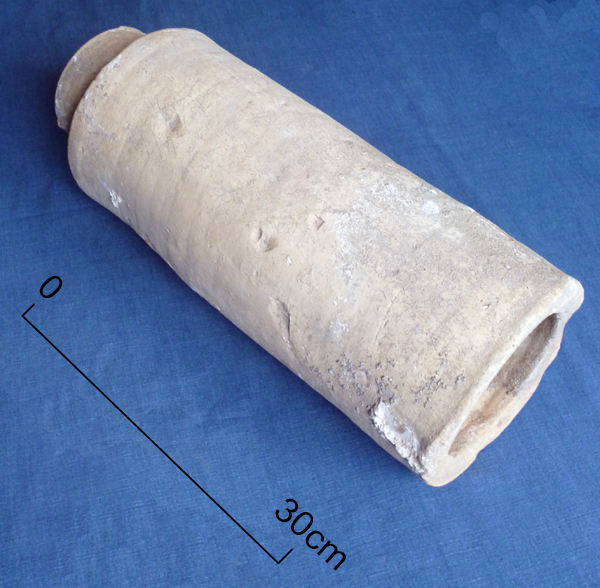
The  image for Day 131 of VM_365  is of a Roman ceramic water pipe dating to the second century. Like the perforated lead drain cover that was shown in Day 130, the pipe was excavated  from the area near a bath house at the Roman Villa at Minster.

Ceramic pipes like this one were manufactured to have an extended collar formed at one end, which would fit into the opening of another pipe, forming an interlocking series that could be made as long as was needed. The joints may have been mortared to prevent leaking. Water would flow through the pipes under gravity. Similar systems of pipes were even used by the Romans to lift water across valleys and even to raise water from one level to a higher elevation.

The pipe at Abbey Farm was found on its own, used in part of the drain leading from the lowest of a series of rooms of the bath house (Room 41 of Building 6A), which conducted the water that was discharged from the bath house into a drainage ditch.

Room 41 had originally been a cold plunge bath (room 41a) but it  was later adapted to become a hot plunge bath through the construction of a hypocaust  below the floor. A new tile lined drain measuring 2.65 metres long was assembled to discharge the  water into the  ditch. It was  later extended using more tiles and this ceramic pipe which may previously have been  used in another part of the site.

The ceramic water pipe is one example of the distinctive,  mass produced and specialised building materials that the Romans introduced to Britain.


VM_365 Day 130 Roman perforated Lead drain cover from Villa at Minster, Thanet

Perforated lead drain cover from Roman villa at Minster

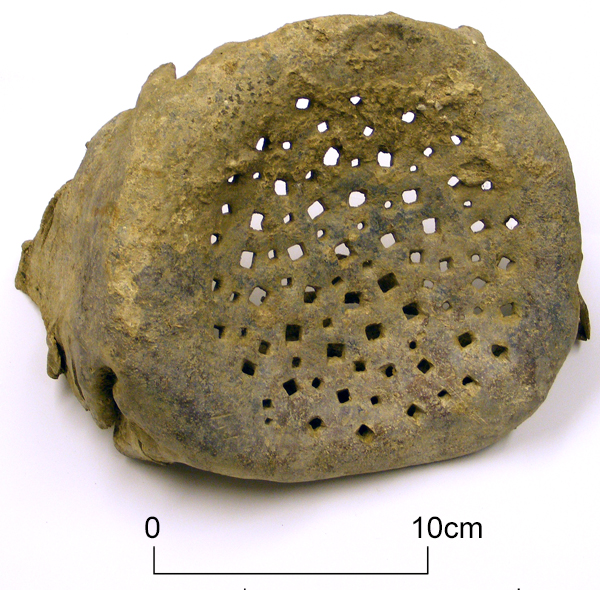
The image for VM_365  Day 130 is of an unusual  perforated lead drain cover dating to the 2nd century AD, which was found at the Abbey Farm Roman Villa site at Minster in 2004.

The object was made by bending a thick lead sheet  over the end of a pipe which is no longer present, forming the strange folded look of the outer flange. Using a square object, the pattern of small holes were punched into the surface of the lead that would have covered the opening of the drain pipe. It appears that the lead covering was intended to create a vent to distribute the flow of water, or perhaps a filter to prevent larger material from passing through the drain. Ceramic drain pipes were found on the site and the cover may have been fitted to one of these.

The lead cover was found in a ditch at the Villa  adjacent to a detached Bath House located by the south west corner of the boundary wall of the main villa complex (Building 6A).  The ditch was located outside a small sunken room at the south western corner of the bath house (Room 42), which was later used as a stoking chamber for the hypocaust systems under the floors of two adjacent rooms.

Before it was converted into a stoking chamber this room  may have been a sunken bath,  with the external ditch acting as a drain. The lead cover was found at the base of the ditch and although it was not found in place it seems likely to have been part of the system of drainage  for the sunken bath in this room.

References

Parfitt, K. 2007. The Roman Villa at Minster-in-Thanet. Part 4. the South West buildings, 6A and 6B. Archaeologia Cantiana Volume 127, 261-296.


VM_365 Day 129 Roman disc brooch from Villa at Minster

Roman disc brooch from Minster in Thanet

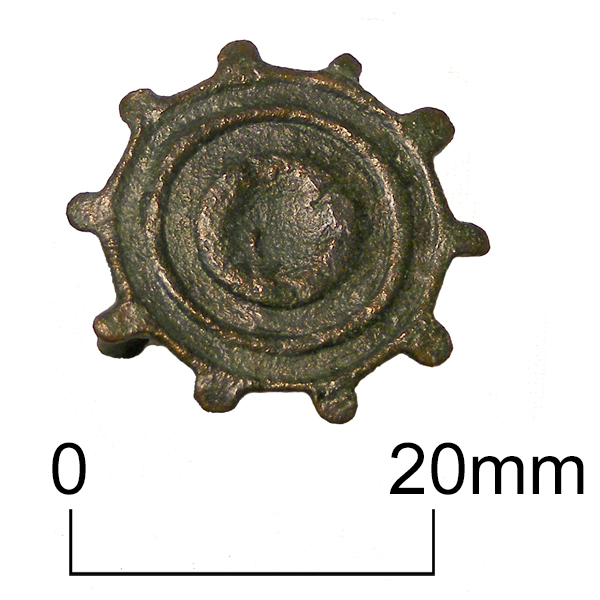
The small disc brooch shown here for Day 129 of the VM_365 project was recovered from the plough soil above the site of the Roman Villa at Minster in Thanet in the 1996 excavation season.

The circular brooch has ten small lugs radiating from the outer circumference and has a raised circular bead surrounding an indented central area.

The raised bead creates two fields which were probably originally filled with coloured enamel, although the decoration seems to have worn off over time in the soil conditions.

At the back of the brooch the shaft of the pin in the sprung clasp mechanism which held the brooch on has broken off , but the raised clip that retained the pin and the two lugs to hold the spring mechanism are still attached to the flat back.

VM_365 Day 127 Viking period polished and perforated shale disc

Kimmeridge shale perforated disc, later Saxon or Viking period.

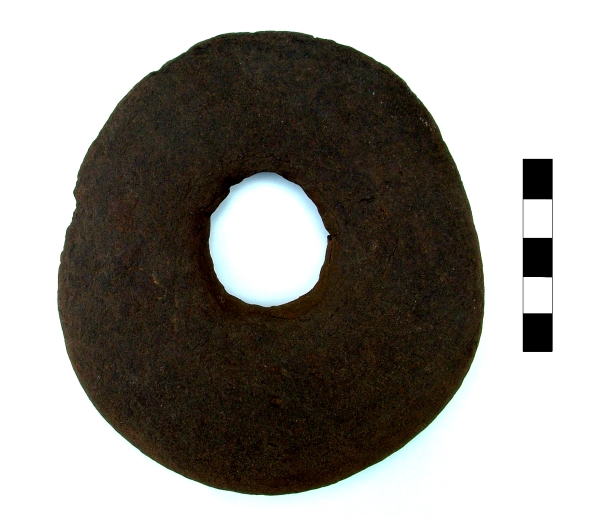
Our image for Day 127 of VM_365 is of this disc of Kimmeridge shale, found at Cliffsend, Ramsgate near the former shore of the Wantsum channel.

Kimmeridge oil shale is easily worked and the black surface of the material could be polished to a glossy sheen, making it attractive throughout history for manufacturing decorative objects and ornaments. In this case the ground conditions in the deposit where the disc was found have caused the surface to become pitted and rough. The disc may have been a personal ornament or been combined with other materials into a decorative or practical object.

The disc was found in a plough truncated ditch and the pottery and rubbish found in association with it suggest it probably dates to the 8th or 9th century, one of the rare finds from this Later Anglo-Saxon or Viking period in Thanet’s archaeological record.

VM_365 Day 126. Late Iron Age Bridle Bits from North Foreland

VM 126

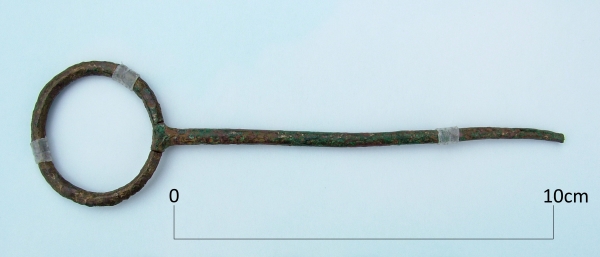
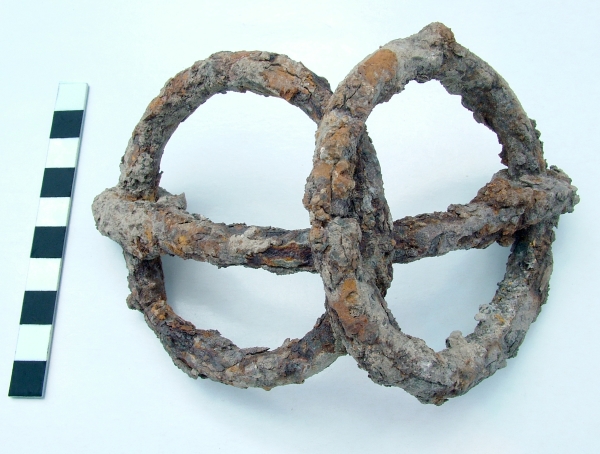
VM 365 Day 126, today’s image shows one of the two sets of what are thought to be Horse bridle bits, both consist of a pair of iron rings linked by loops at either end of a curved iron bar. They were found during the excavation of a pit at the Iron Age settlement at North Foreland, Broadstairs.

Both of the bit sets were found in the fills of the same pit dated by the associated pottery to the Late Iron Age around 150-50 BC. X-Ray images showed that each of the rings had a break in it, possibly to allow the bar to be attached to the rings which could then be hammered shut.

Bronze Bridle bits of this type, with a single plain bit, are more commonly found but these sets are unusual for Iron bits because they are made of a single curved piece of iron, rather than the more typical two or three piece iron examples.

Perhaps the two sets of bits were used together for a specialised purpose. It is possible they have a different function altogether and the similarity with horse bridle parts is a deceptive coincidence.

VM_365 Day 125. Iron Age Worked bone object from North Foreland

VM-125

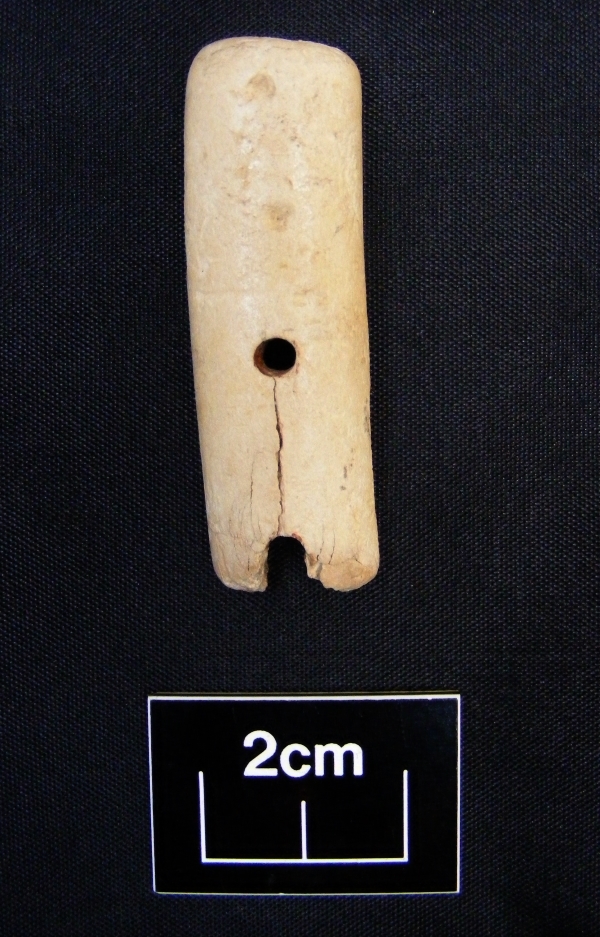
Today’s VM 365 Day 125 image is a fragment of worked bone found during excavations at North Foreland in 2001.

The worked bone was found in a large pit dated to the late Iron Age by the pottery contained within its fill.  Also found, at the base of the pit, were two sets of iron bridle bits.

This fragment of worked bone measures 52mm by 16mm and has been worked to form a relatively uniform convex curve along its length. It is probably a knife handle,  there is iron staining on the back and it is pierced by two holes, presumably for rivets to join the handle to the iron blade and its matching bone piece on the other side of the knife.  If you look carefully at the top of the piece you can see two shallow circular depressions where two false starts have been made for the rivet holes.

VM_365 Day 124 Iron Age chalk loom weights from North Foreland.

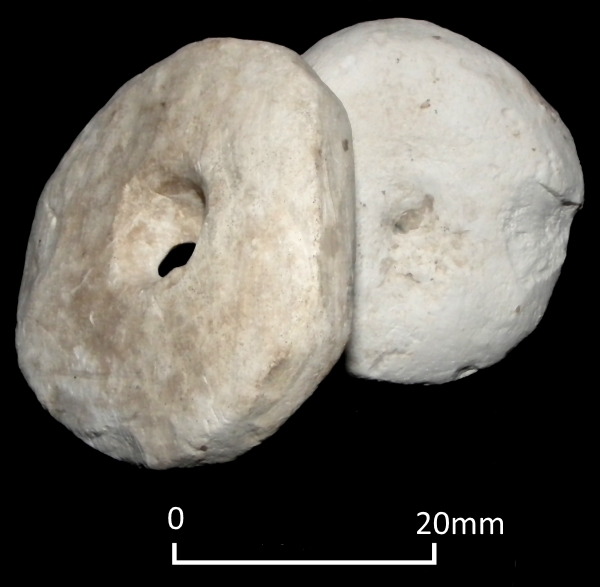
Today’s VM 365  image for Day 124 is of two loomweights that were found among the soil and rubbish used to backfill an abandoned grain storage pit at North Foreland, Broadstairs, one of two similar  pits that were found near to each other. The other pit had been used later to bury a woman in the upper part of the cut.

Two Iron Age chalk loomweights from North Foreland, Broadstairs.
Two chalk loomweights from the Iron Age settlement at North Foreland, Broadstairs.

The loom weights were found in the upper fills of  the pit, among pottery dating to the middle Iron Age.  Other domestic waste in the pit fill included animal bone, marine shells, flint, daub, charcoal, and burnt and charred grain and chaff from species such as oats, barley, wheat and spelt.

The loomweights were carved from chalk, which may have been picked up from the coast nearby. The weights may not have been used before they were dumped in the pit with the other rubbish. One weight was certainly unfinished as the hole in the centre did not penetrate all the way through the chalk and must have abandoned while it was still being worked on.

VM_365 Day 123 Decorated bone or ivory pin from Iron Age burial at North Foreland, Broadstairs.

Bone pin with incised decoration from Iron Age Burial, North Foreland Broadstairs.

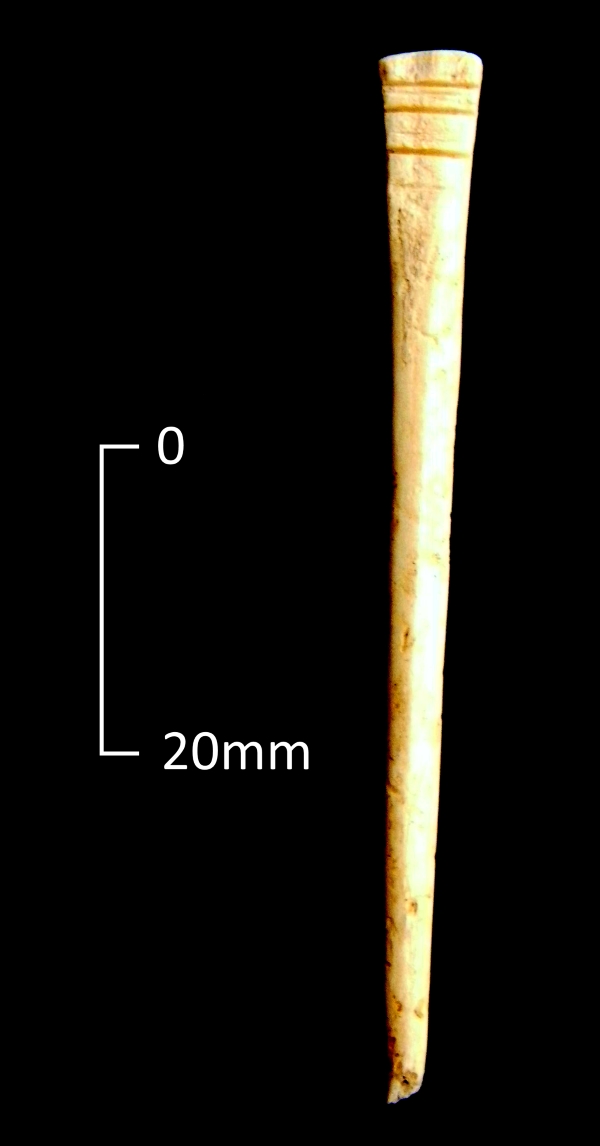
For Day 123 of VM_365 we have an image of a small decorated pin that was found in association with the Iron Age woman who was buried in the grain storage pit at North Foreland, Broadstairs.

The blue glass beads that were near the neck of the burial have been shown in a previous post for VM_365, along with the complicated story of the pit’s primary use and of the things that had later been used to fill it.

At first glance the pin, which was also found in close association with the skeleton, appears to be a much simpler object than the exotic glass beads, but it has a more complex story to tell.

The pin is carved from a piece of dense bone, or possibly ivory. The shaft has been carved to taper toward a point, which has unfortunately broken off.  Close examination of the surface of the shaft reveals fine facets along the length. The whole surface of the pin was polished to a smooth sheen.  At one end the pin was  flattened to form a head and on the side shown in the image the head was decorated with three incised lines.

This object could possibly have been a dress fitting or even a hair pin, another indicator that the woman buried had some status and was not simply thrown in the pit with other unwanted debris.