Category Archives: Archaeology

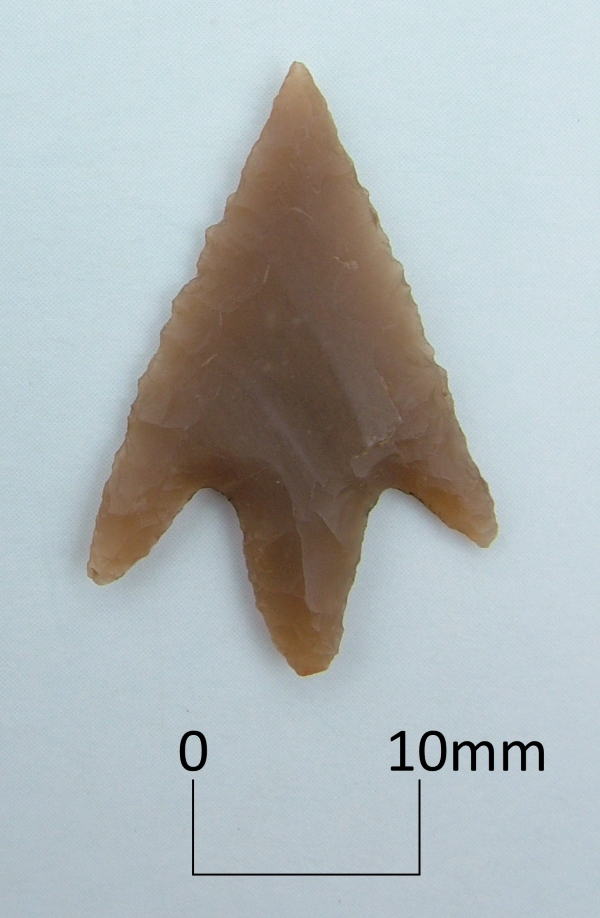
VM_365 Day 162 Early Bronze Age barbed and tanged arrowhead from Drapers Mills, Margate

VM 160

The image for Day 162 of VM_365 is of another fine example of Early Bronze Age flint work from Thanet. This barbed and tanged arrowhead was found at Draper’s Mill, Margate in 1980, as a residual object recovered during the excavation of a Roman building.

This tiny object embodies all the skills of the Early Bronze Age flint knappers who could create such a well proportioned and symmetrical tool through the careful flaking of tiny chips from such a small piece of stone.

Other similar barbed and tanged arrowheads have featured in earlier VM_365 posts, arrow heads found with a burial close to QEQM Hospital featured in VM_365 Day 24 and an arrow head found in excavations at Lord of the Manor, Ramsgate was shown as VM_365 Day 141 .


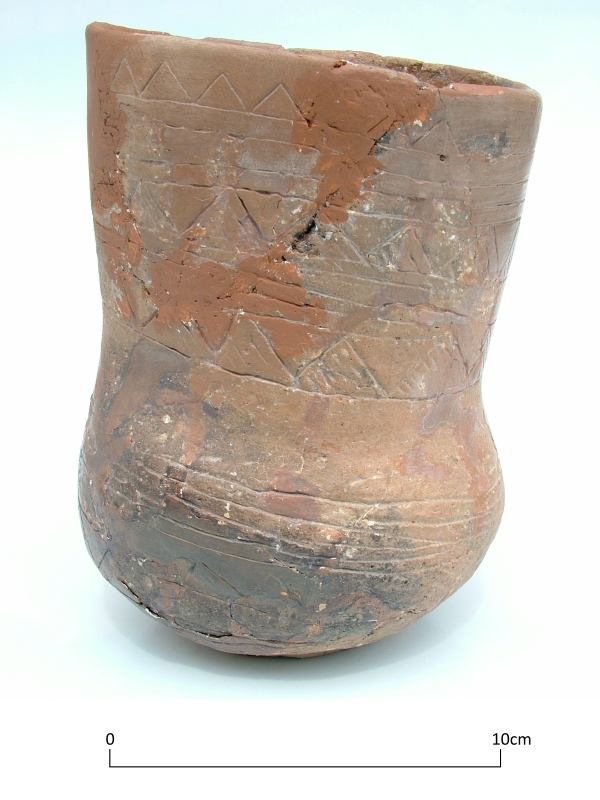
VM_365 Day 161 Beaker from Manston, Ramsgate

VM 161bToday’s VM_365 image shows a Beaker vessel, which has been heavily restored, that accompanied the same burial as the  plano-convex flint knife and ‘V’ perforated jet button shown on Day  159 and Day 160.

The Beaker was found on its side on the base of the grave which was cut into the chalk geology. One large sherd from the neck and rim were found lying about 10 cm away from the main body, suggesting that the burial had been disturbed at some point in its history, possibly when a later Anglo Saxon burial may have been cut into the earlier burial.

A radiocarbon date from bone from the skeleton buried in  the grave dates the burial to 1680±50 BC.

The beaker is approximatley 10cm high with a base diameter of 6cm is made of light brown fabric. Grey patches of firing clouds on the body are indicative of an open firing. The core of the fabric  is grey, indicating that the short firing at a low temperature had not succeeded in burning out the natural organic inclusions in the clay.

The decoration on the vessel was made with a toothed comb, which has been carelessly used. On the upper part of the vessel the impressions of the comb’s teeth are so blurred that they seem to be incised. The decorative scheme consists of rows of chevrons, encircling combed lines and filled triangles. There is a basal zone of paired finger nail impressions

The vessel is unusual in that although the fabric is fine, the vessel is well fired and finished but the vessel is  asymmetrical and the decoration has been carelessly applied. The lop sided shape of the vessel is possibly a result of the clay being too wet, causing it to sag.
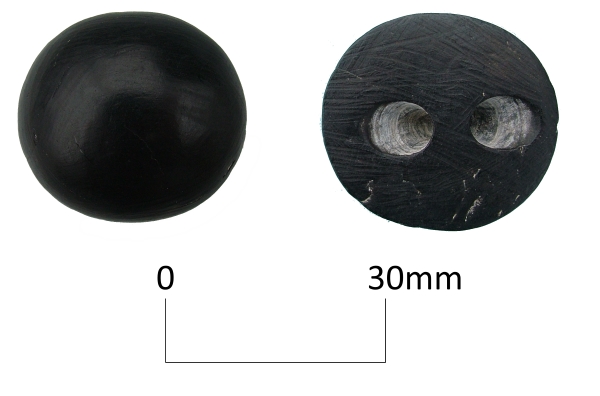
VM_365 Day 160 ‘V’ perforated Jet Button

VM 161

Today’s image shows the front and back views of a jet button that was found within the same grave as yesterday’s plano-convex flint knife from Manston, near Ramsgate in 1987.

The jet button was found resting on the floor of the grave to the west of the skull. Jet buttons of this ‘V’ perforation type that are also associated with a flint knife and a Beaker vessel are known as far afield as Devon, Berkshire and Wiltshire.

VM_365 Day 159 Flint Knife from Manston

V 159

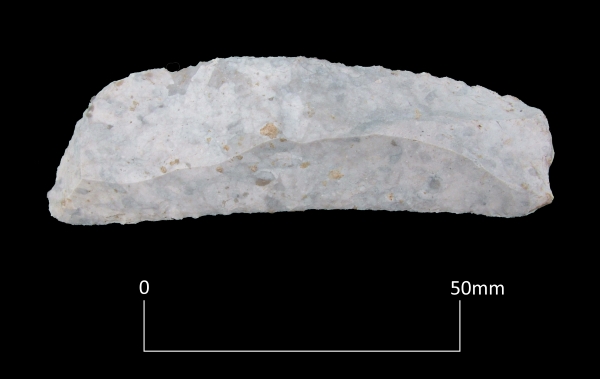
Today’s VM_365 image shows a plano-convex flint knife found within a grave that was excavated at the centre of a Bronze Age barrow at Manston, near Ramsgate in 1987.

The grave contained the remains of a slightly built young adult in a crouched position accompanied by the flint knife, which was located just above the skull, as well as a jet button and a long-necked beaker vessel.


VM_365 Day 158 Late Iron Age bone skewer

VM 158

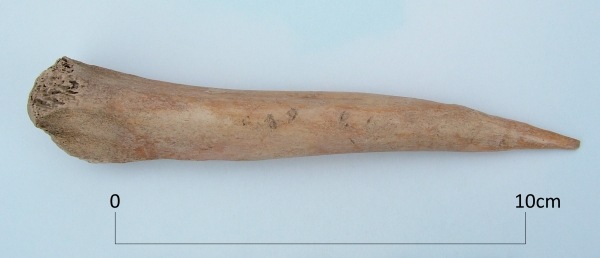
Today’s VM_365 image shows a skewer roughly fashioned from a small animal bone.

This object was found within a Late Iron Age hut floor at Ebbsfleet, Thanet in 1990. The hut floor was made up of a 15cm thick layer of flint pebbles which was covered with a deposit consisting of pottery dating to the late Iron Age, many animal bones, some of which had been roughly fashioned into skewers or awls, a clay spindle whorl and marine shells.

It is not clear what this object would have been used for. Perhaps it was used for extracting marine molluscs from their shells, perhaps it was used in some way during weaving, or perhaps it was a general purpose tool that could be quickly fashioned and used in a myriad of ways.

VM_365 Day 157 Iron Age salt container from South Dumpton Down

VM 157

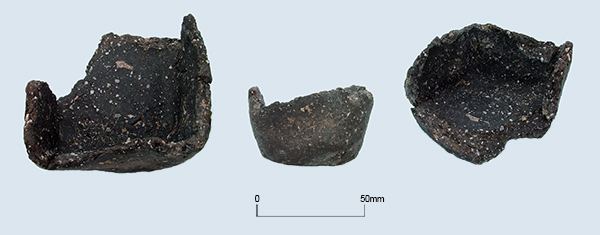
Today’s image for Day 157 of VM_365 shows three views of an interesting  square pottery vessel, which may have been used as a salt container.

The square pot is made of a thick, flint tempered fabric, fired to a dark brown to black colour. The flint tempering can be seen in section where parts of the wall of the container have broken. The container was found at the Iron Age  coastal site at South Dumpton Down, Broadstairs where concentrations of post holes within a boundary enclosure seem to represent the focus of the settlements within the enclosure. The square vessel was found within the fill of one of the main groups of post holes.

The suggestion that this was a salt container was made by the ceramic specialist, Nigel Macpherson-Grant in his report on the pottery.  Because it is essential to the biological functions of livestock, and a valuable method of preserving produce to extend its life, salt was a valuable commodity in the Iron Age period, as it was throughout history. Salt may have been extracted from the sea water near to the settlement.


VM_365 Day 156 Iron Age Bone Pin from Broadstairs

VM 156

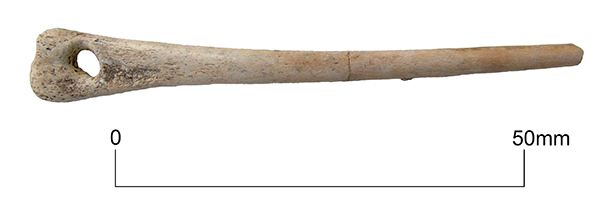
Today’s VM_365 image is of an Iron Age bone pin  excavated from a pit at Dumpton Gap, Broadstairs in 1994.

The pit had been used for the disposal of domestic refuse which included animal bone, quern stone fragments and sherds of pottery dating to the Early Iron Age before being used to bury a single adult individual in a similar way to the burial at North Foreland.

The bone pin, possibly used to fasten a cloak, was found at  the left shoulder of the skeleton, fragments of an Iron buckle were found at the right shoulder.

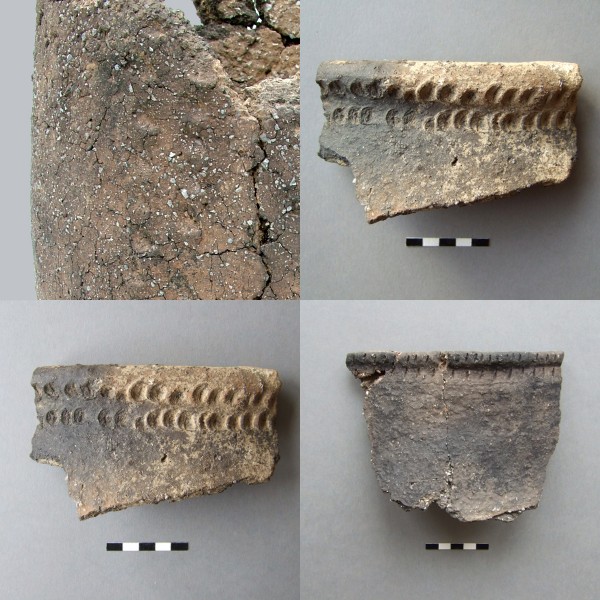
VM_365 Day 155 Ghosts of other things preserved in Bronze Age pottery decoration

Bronze Age pottery with skeumorphic decoration, possibly emulating stitching in leather.
Bronze Age pottery with skeuomorphic decoration, possibly emulating stitching in leather.
The image for Day 155 is of a nearly complete body and three rim sherds from four  pottery vessels, all from excavations in Thanet and dating from the Middle Bronze Age, in the date range of c.1550-1350 BC.
The vessel on the top left is a Middle Bronze Age vessel from a cremation group in Ramsgate, which is decorated along its side with a single vertical row of marks from a finger tip.  The three other rim sherds have a regular repeated pattern of decoration around the rim, made with a finger tip and finger nail. What inspired the potters who made these vessels to adopt this scheme of decoration?
Perhaps they used a model from some other part of their experience of the materials that were in common use in their community to generate a scheme of decoration which would be familiar to them and give prompts about what the appropriate functions of the vessels were and what uses they could be put to. The term skeuomorph is used to describe such decorative schemes that retain residual, but often completely redundant, elements from some other source. Even in our digital world we continue to make one thing look like another so that an object retains a familiarity and usability and helps us understand how the function of an object relates to what we know.
The decorative scheme on these contemporary Middle Bronze vessels may be skeuomorphs of the stitching that would have been required to create vessels from hard leather or perhaps another material that was less durable than pottery like the birch bark bucket found with the Egtved Girl who died in southern Jutland, Denmark and was buried in an oak log coffin, dated by dendrochronology to 1370 BC. The bucket held an alcoholic drink, probably a form of ale.
http://media-cache-ec0.pinimg.com/736x/07/0f/29/070f293b5ec3a4e638f9cbacfd535151.jpg
Birch bark bucket found in the Oak log grave of Egtved Girl.
The various locations of the schemes around the rims and up the side of the Bronze Age pottery vessels from Thanet could be emulating the vertical join in soft material, like a  hard leather tube or birch bark and the stitching that created a usable rim. The survival of a more varied range of material in more favourable archaeological contexts should help us understand how echoes of their familiar forms were preserved in the material that does survive in the more limited range of archaeological materials that can be recovered from Thanet’s dry chalk soils.


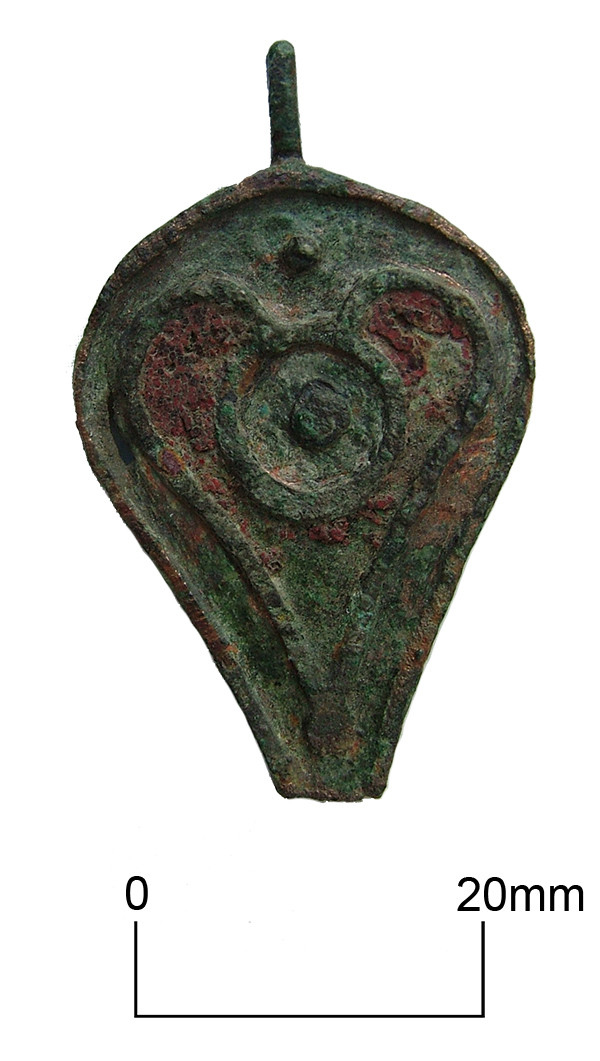
VM_365 Day 154 Roman Box Seal lid from Minster

VM 154

The image for Day  154 of the VM_365 project shows a 2nd to 3rd century Roman seal-box lid, found in the excavation of the Roman villa at Minster.

Seal-boxes were small bronze containers, used to seal the openings of documents and parcels. The box protected inside an impression made in a piece of wax from an intaglio seal, a carved image on a hard stone which was perhaps mounted on a signet ring.  The wax seal impressions from an intaglio served as private or public signatures, guaranteeing that the contents of the sealed document or parcel were authentic.

To secure a parcel,  a cord was passed through a central hole in the base of the seal-box forming a loop. The two ends of the cord were  wrapped around the parcel and through two additional holes on the underside of the box. The loose ends were passed through the central loop and pulled tight, through two notches either side of the base. The cords were held in place with beeswax and the personal seal iwas pressed into the wax, protected in transit by closing the lid of the seal box over it.

Our example is a leaf shaped seal box lid in  bronze, with an enamelled heart shaped design on the lid.

Further reading

Holmes, S. 1995. Seal-boxes from Roman London. London Archaeologist 7.15, 392-395.

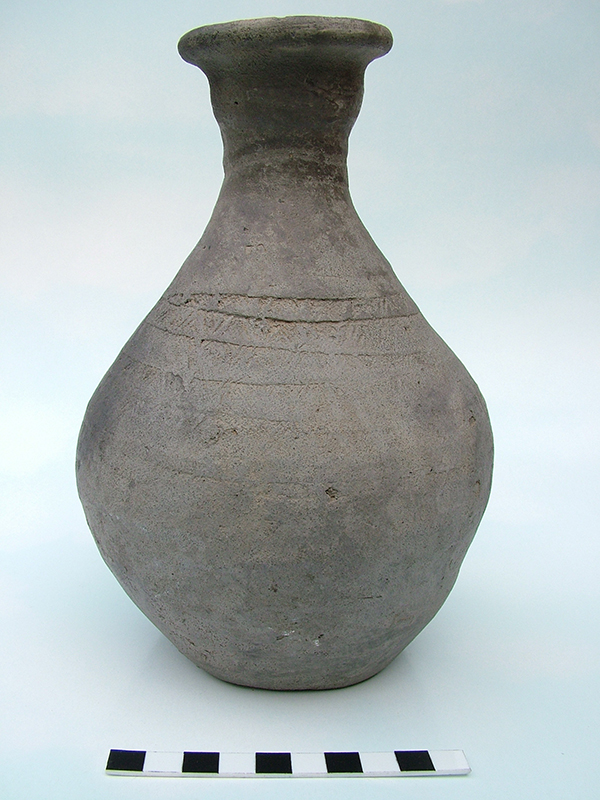
VM_365 Day 153 Anglo Saxon bottle vase from Sarre

VM 153

For Day 153 of the VM_365 project our image shows an Anglo Saxon ceramic bottle vase, excavated in 1990 from Grave 277 at the Anglo-Saxon cemetery at Sarre, the iron châtelaine ring and keys shown in yesterday’s post came from the same grave.

The bottle vase shown here is wheel turned in a smooth grey fabric and has been decorated with a lightly impressed rouletted chevron design. Fourteen similar vessels were excavated from graves in the same cemetery by John Brent in 1862.

Vessels of this type were manufactured on the continent by the people of the Frankish Kingdom, who also used them as grave goods. Examples from east Kent; other cemeteries in Thanet and graves from the Sarre cemetery are known to have been continental imports, considered by archaeologists to be luxury items. The decoration on the vessel from Sarre shown here is similar to, although slightly more complex, than an example found in grave 156 at Buckland Anglo-Saxon cemetery near Dover.

The vessel shown today has been carelessly cut from the potters wheel with wire so that it does not stand straight. It has been considered unlikely that a ‘second’  like this would  have been included in a shipment of luxury goods from the continent.

It has been suggested that because of the inferior execution of the manufacture of the vessel, it may have been the product of a less able local Anglo-Saxon potter rather than  a continental Frankish import. This idea perhaps underestimates several aspects of human nature that may have been at play in production, trade and consumption in Anglo-Saxon society.