VM_365 Day 76: Dr Thomas and Dr Arthur Rowe

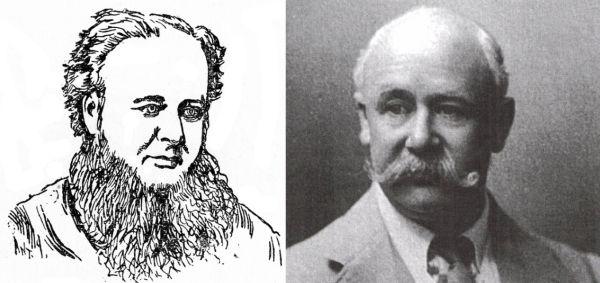
From left to right: Dr. T. Smith Rowe and Dr. A. Rowe.
Dr. Thomas Smith Rowe (Left) and Dr. Arthur Rowe, Margate archaeological investigators.

Dr Arthur Rowe was born in Margate in 1858 and practised as a GP and surgeon until he retired at the age of 51 to concentrate on his other interests, microfossils, the formation of chalk and local history and archaeology in Margate.

Rowe took a great interest in archaeological discoveries that were made as the town of Margate expanded and he was responsible for recording a number of Anglo Saxon burials during roadworks at Half Mile Ride, next to the present cemetery and Council Tip, in 1922; excavating the Iron Age settlement and Roman building found whenTivoli Park Avenue was being constructed in 1924 and recording a number of burials that were eroding from the cliffs at Westgate in 1925.

Rowe was a contemporary of Howard Hurd who had carried out archaeological research in Broadstairs and the two men corresponded by postcard while Rowe was excavating the Tivoli Villa, with Hurd offering Rowe advice on his excavation.

Rowe died of an untreated tooth infection in 1926, while working on a report of his excavations. On his death he bequeathed his collection of Margate books, pictures and prints to  the corporation of Margate and his collection of archaeological artefacts, mainly pottery, to the British Museum.

Arthur Rowe’s Margate collection formed the Rowe Bequest and various parts of the collection are to be found in Margate Library’s Local Studies Collection and at the Margate Museum.

Part of the archaeological collection in the Rowe bequest was probably built up by Arthur Rowe’s father, Thomas Smith Rowe, who is less well known than his son but passed on an interests in local history to his son. Thomas Smith Rowe was also a Doctor and Surgeon and was well respected in Margate. Amongst other appointments he was Senior Visiting Surgeon to the Royal Sea Bathing Infirmary and Honorary Surgeon to the Alexandra Orphanage and Victoria Hospital for Children . Thomas Rowe also took part in the formation of the Margate Centre of St John’s Ambulance Association in 1879.

Dr T. Smith Rowe died in 1907 aged 82.

References

Moody, G. 2008. The Isle of Thanet from Prehistory to the Norman Conquest. The History Press, 20.

Perkins, D. R. J. 1987. The Jutish Cemetery at Half Mile Ride, Margate: A Re-appraisal. Archaeologia Cantiana CIV, 219-236

With thanks to Bob Pantony for his research on the Rowe Bequest presented in a lecture in 2012 celebrating 25 years of the Trust for Thanet Archaeology.
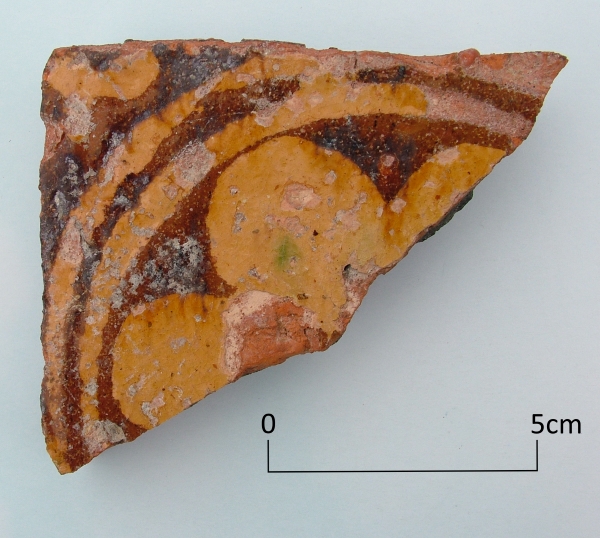
 

VM_365 Day 75. Decorated Medieval Floor Tile from Salmestone Grange

VM 75

Today’s image shows a fragment of a 14th century glazed medieval floor tile found in 1979 during excavations at Salmestone Grange, Margate by the Isle of Thanet Archaeological Unit.

Salmestone Grange was a Benedictine Monastic Grange founded in the 12th century by the Monks of St Augustine’s Abbey, Canterbury. The Grange operated as an administrative centre for their large estate, part of which covered most of Thanet. The Grange was also occasionally used as a retreat for the Monks.

The excavations, carried out in 1979, were located in the now ruined south western end of the domestic range, in the area of the garderobe and dormitory built in the 14th century by Thomas Ickham, Sacristan to the Abbot of St Augustine’s.

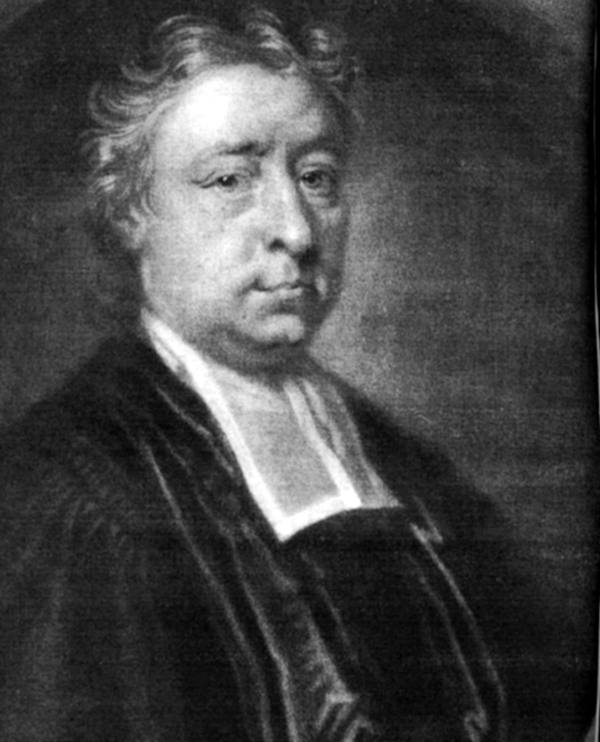
VM_365 Day 74. Reverend John Lewis: Thanet’s first Historian

VM 74
John Lewis 1675-1746

Today’s image is of the Reverend John Lewis, vicar of the parish of Minster and Thanet’s first historian. His book, The History and Antiquities of the Isle of Thanet published in 1736 was a study of the area that had been his home for 30 years. His book covered the etymology of local place names, the geography of the island and local miscellanea but also, and most importantly, he was aware of a growing interest in the survival of ancient features in the landscape and ancient artefacts found locally, which he described in detail. He included plans and illustrations of places and finds of antiquarian interest including the first Bronze Age Hoard recorded on Thanet at Birchington and the standing Bronze Age Barrows at Hackemdown Banks, North Foreland.

Lewis’ work was heavily drawn on by a number of publishers of traveller’s guides and also by Edward Hasted whose Thanet volume of The History of the County of Kent,  published in 1800, largely reproduced Lewis’ account with minor amendments. Lewis’ History and Antiquities remains to this day an interesting and valuable source of local history of the late 16th and 17th centuries which should be a first port of call for anyone interested in the history of the area.


VM_365 Day 73 Roman Bakers Oven at Broadstairs

VM 73

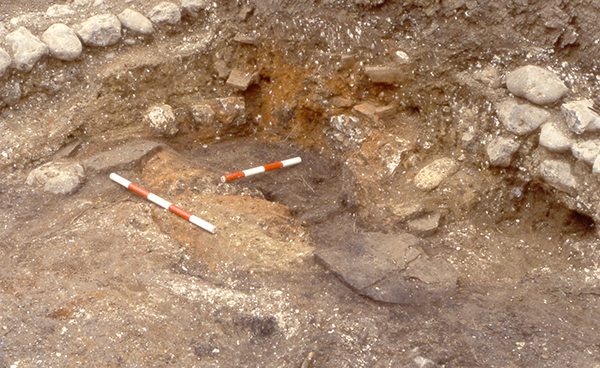
Today’s image is from the Roman cellared building described previously in our VM365 Day 44 post. The picture above shows the remains of an oven constructed from clay and tile. Elsewhere, in the floor, we found several ovens or kilns, one of which was constructed from fragments of millstones and on one of the corners of the building there was a quern stone set in the floor used for grinding grain.  From the soot collected in the clay and tile oven shown above charred Spelt, Emmer, Barley and Oat grains were recovered suggesting that this structure is likely to have been used as a bakers oven.

It would be interesting to know what type of bread can be made from grains like this.

VM_365 Day 72. Geological Phenomena

Patterned Ground
Patterned Ground

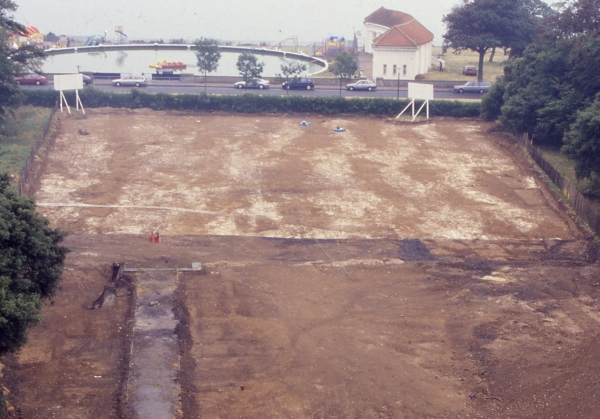
Today’s image shows a common geological phenomena that we sometimes encounter on archaeological sites called patterned ground. It looks rather like the ripples you get in the clouds called a Mackerel sky. It is very visible in this picture, taken in 2002, at a site on the cliff top at Ramsgate. The ripples in the ground are actually masking a large Iron Age and Roman enclosure ditch on the left hand side of the picture and a middle Bronze Age mortuary structure comprising a small ring ditch surrounding a group of pits containing pottery vessels and cremated human bone in the north part of the site.

Around 21,000 years ago, large areas of patterned ground were formed as the land surface went through cycles of freezing and thawing. Fine clay and silts percolated into the fractures in the chalk producing the linear stripes and polygons that you can see here.

VM_365 Day 71. Results of the Workshop flotation.

VM 71

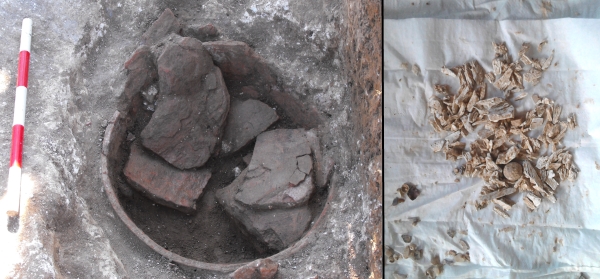
Following on from Saturday’s Environmental Archaeology Workshop, where we processed some samples from a Roman cremation burial, today’s image shows the cremation vessel under excavation alongside an image of the human bone that was extracted from the heavy residue.

The cremation vessel is a large copy of a globular amphora vessel in a local, pink, sandy fabric dating between c. 170-200 AD. The tiny slivers of burnt  human bone shown in the right hand side of the image are all that remain of this heavily truncated cremation. The fragments measure between 2 and 10 mm in length and were painstakingly picked out from the heavy residue by hand by the team who took part in the workshop.


VM_365 Day 70. Can’t take a class to a site? Take the site to the class!

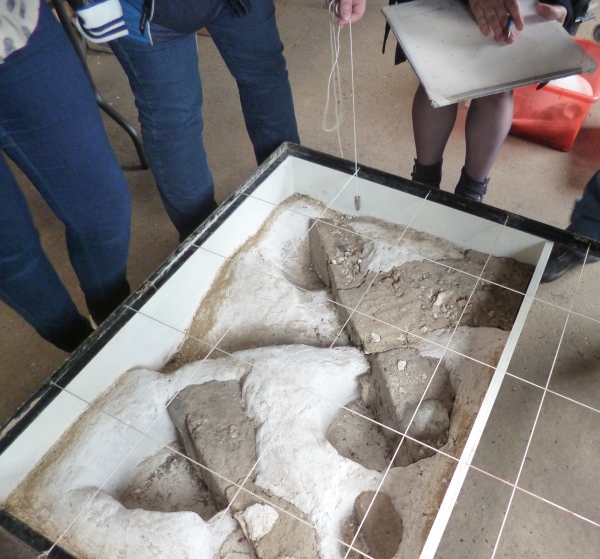
Learning to record a site with our mini-excavation in a box

On VM_365 Day 70 we have an image of aother of our resources for teaching the principles of archaeological recording. Understanding the recording process is essential for grasping how archaeologists build up the story of the past from finds and paperwork. Another dimension is added to the finds and images from our Virtual Museum when the archaeological excavation process behind the discoveries is familiar to the audience.

It can be useful to take people to an excavation so they can spend time learning how an archive is built up for a site by planning, drawing sections and recording contexts. But, many of the excavations that archaeologists carry out now are in locations like building sites that are not easily accessible, especially to very young, elderly or disabled people.  When we want to explain the processes of recording, it is not always possible to take a class on to a site or hold an extended workshop on a busy excavation.

So the Trust solved the problem by creating a Site in a Box which can be used indoors to teach archaeological methods with plenty of time to practise. Using our experience of the archaeology of the area, and a certain creative flair, we have reproduced an authentic slice of prehistoric Thanet  to work on at our leisure

While our Dig and Discover activities that featured in VM_365 Day 68 are useful for teaching the principles of finds recovery and the materials that are commonly investigated by archaeologists, the Site in a Box can be used more effectively to gain an understanding of how the recording of archaeological excavations creates the information that is needed to understand the context of the material that is recovered.

We hope that our Site in Box will help as many people of possible understand the background to the finds and images that we post in the VM_365 project.

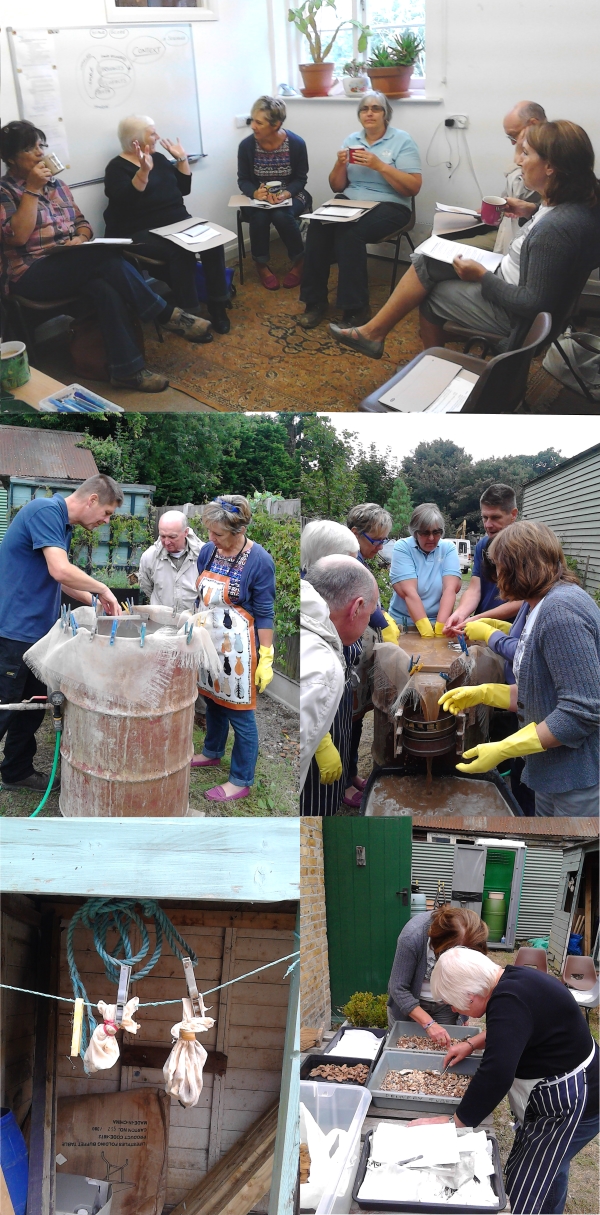
VM_365 Day 69 Environmental Archaeology Workshop Day – September 6th 2014

A medley of images from our environmental archaeology workshop with IOTAS

Following a successful community archaeological excavation at Lord of the Manor Ramsgate in 2013, the Isle of Thanet Archaeological Society have been keen to learn more about the post excavation process so that they can progress with writing up and publishing their results.

The Trust has been able to help out with planning a series of workshops, sharing our professional expertise and our resources to introduce the next steps that follow beyond the field work of an archaeological dig.

Today we organised a workshop on environmental archaeology with a practical session in processing samples using our flotation tank. We took the opportunity to run through some stored samples from some interesting contexts from earlier sites which had been put into storage.

One sample processed was the contents of a 3rd century cremation vessel found at a site in Westgate where fine slivers of burnt bone were recovered from the residue, proving that at least a small amount of the cremated remains had survived the heavy disturbance that the site had suffered in later years. More will be learnt form the fine organic material that was floated from the sample, which was hung up to dry in the September sun and will be processed in a few days time.

The day proved to be both educational and sociable with the unexpected provision of cakes and snacks to supplement the flow of tea and conversation on archaeology and the environment.

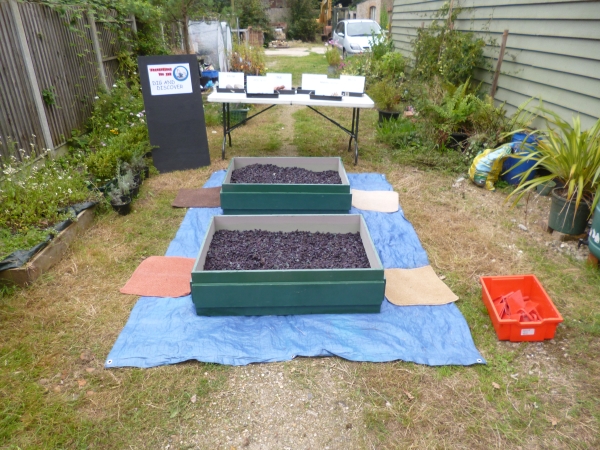
VM_365 Day 68. Dig Boxes!

VM 68

Our Dig and Discover boxes went on a journey to Lympne, near Hythe today. They will be used on Sunday 7th September by the newly formed Studying History and Archaeology in Lympne group, SHAL for short, at their stall at the Lympne Village Fair and Dog Show to interest people in archaeology and, hopefully, gain new members for their group.

We took the opportunity of being able to set up the Dig and Discover resources to record the process of setting it out and listing the equipment that we use, with a view to producing a How to Guide for other people who may want to borrow the equipment, or set up their own Dig and Discover package.

VM_365 Day 67 17th century Malthouse, King Street, Margate

VM 67

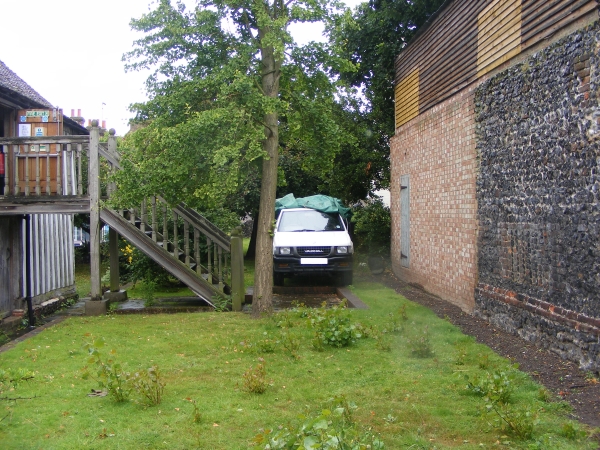
Today’s journal entry is inspired by Margate Brewery’s recent blog post about their future new premises at the High Street, Margate where they have established a 17th origin for their building which has been associated with beer, wine and spirits for most, if not, all of its lifetime.

While we are no experts in these kinds of structures, this made us think of other buildings in Margate connected with brewing and probably one of the least know standing buildings is a structure known as The Barn which is located to the rear of the Tudor House on King Street. This flint structure, shown on the right hand side of the picture, partly rebuilt in modern brick and heavily altered over the years, has been identified as a purpose built Malthouse constructed in the 17th century and used to malt barley to be used in the brewing of ale.

The Reverend John Lewis published an interesting passage in 1736 about malting and brewing in Margate:

‘…Malting is another Branch of the Trade of this Place, which was formerly so large, that there about 40 Malt-houses in this parish. But this trade also is now gone much to decay; tho’ certainly here might be the best Malt in England, the barley which grows here being so very good, and the Land naturally so kind for it. The Malt, it seems, here made, having formerly been very coarse for the Use of the Distillers, it has so much lost its Credit, that the present Maltsters find little Encouragement to make their Malt fine for a London Market, where they are almost sure to be out-sold by the Hertfordshire and North Country Malt-men, whose Malt bears a better name

About 40 Years ago, one ____Prince of this Place drove a great Trade here in brewing a particular Sort of Ale, which, from its being first brewed at a Place called North-down in this Parish, went by the Name of North-down Ale, and afterwards was called Mergate Ale. But whether it is owing to the Art of brewing this Liquor dying with the inventor of it, or the Humour of the Gentry and People altering to the liking [of] the Pale North Country Ale better, the present Brewers vend little or none of what they call by the Name of Mergate Ale, which is a great Disadvantage to their Trade ‘

(Lewis 1736, 134)

The breweries being established in Margate are not so much a new phenomenon, more a return to an old local tradition of brewing fine beer.

References

Austin, R.  2014. Tudor House, Margate. In Canterbury’s Archaeology 2012-2013. Canterbury Archaeological Trust, 21-22

Lewis, J. 1736. The History and Antiquities as well Ecclesiastical as Civil, of the Isle of Tenet, in Kent. Second Edition (Reprinted by Michaels Bookshop, Ramsgate)