VM_365 Day 116 Anglo Saxon Buckle

VM 116

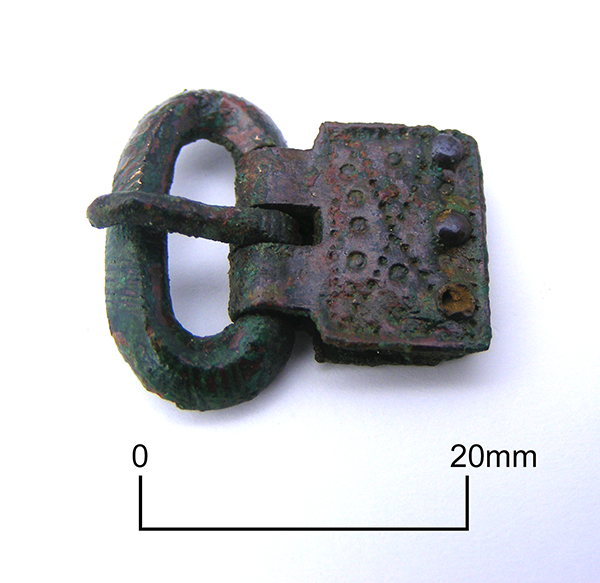
Today’s image is of a tiny  decorated buckle found at the Anglo Saxon cemetery at Sarre, near Birchington in 1990. It was found within grave 288,  disturbed in antiquity, with the bones of the skeleton, possibly a male aged 30-35 years, piled at the foot of the grave.

This small buckle dating to the 6th-7th century is made of bronze with a folded rectangular plate fastened by three rivets. It would have been mounted on a strap rather than a belt as the loop could only accept a strap end less than 10mm wide. It is decorated with incised lines, punched rings and lines of punched dots. Buckles of this form are common but as they are more usually plain, this decorated example is slightly more unusual.

Reference

Perkins, D. R. J. 1992. The Jutish Cemetery at Sarre Revisited: Part II. Archaeologia Cantiana CX, 83-120.

VM_365 Day 115 Iron Age Loom Weight

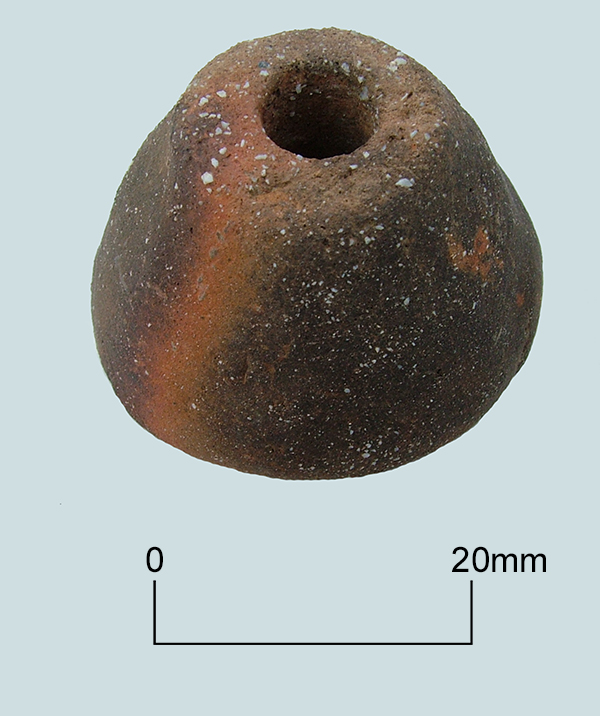
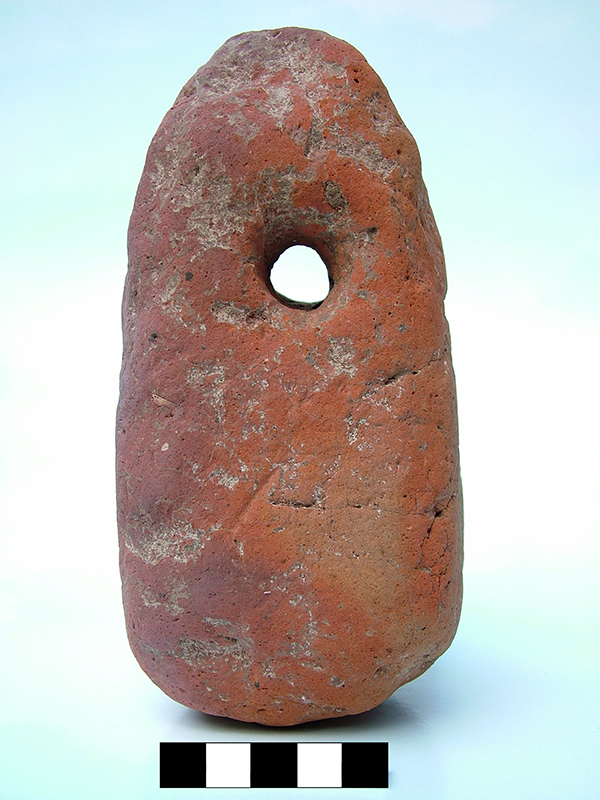
VM 115Following on  from Day 110 and Day 114’s Iron Age woollen cloth making theme, today’s image is of a fired clay Iron Age Loom weight found at Northdown, Margate during excavations in 1971.

Simple warp weighted looms designed to stand against the wall were commonly used to weave cloth during this period. The loom weights, such as the one shown above, were tied to the bottom of the warp (vertical) threads to add tension whilst the cloth was being woven.

VM_365 Day 114. Iron Age Spindle Whorl

VM 114

Today’s image is an Iron Age ceramic spindle whorl found at Ebbsfleet, near Ramsgate in 1990.

Spindle whorls such as these  were used when spinning by hand and placed on a spindle to add weight to help maintain and increase the speed of the spin needed to turn wool into yarn   Spindle whorls, along with other objects associated with cloth making such as loom weights and weaving combs are commonly found on Iron Age sites.

This spindle whorl was found on the surface of a layer interpreted as a hut floor. Other finds associated with the floor included late Iron Age pottery, bone skewers, animal bone and shell.

Reference.

Perkins, D. R. J.  1992. Archaeological Evaluations at Ebbsfleet in the Isle of Thanet. Archaeologia Cantiana CX, 269-311.

VM_365 Day 113. Iron Age Faience Beads from North Foreland, Broadstairs

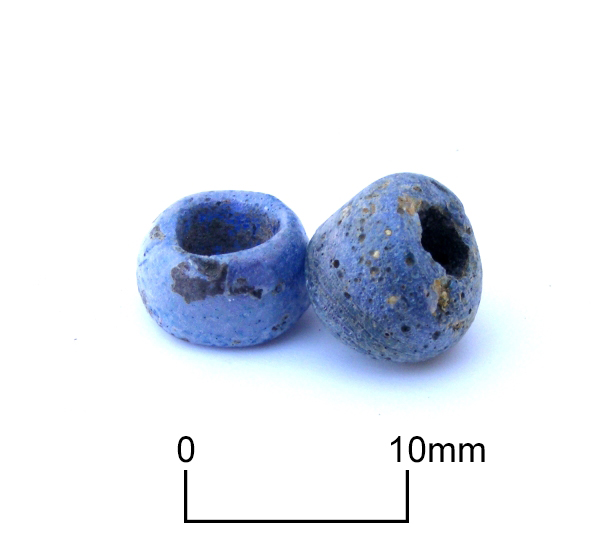
Two of three faience beads found with an Iron Age burial at North Foreland, Broadstairs

Today’s image for VM_365 Day 113 shows two beads made from an early type of glass called faience. These were two of three that were found at the neck of the skeleton of a woman buried in the fill of an old grain storage pit at North Foreland, Broadstairs in the Iron Age. The third bead had decayed so far it could not be recovered.

These beads were probably strung on a necklace, but the cord joining them and any other beads in organic material such as wood have not survived.

Beads like this were made from an uncommon material, based on a manufacturing technique that ultimately originated in Egypt and so are thought to have been items that carried a high prestige in the Iron Age.

The beads with this burial add a layer of detail to the interpretation of whether it was part of a deliberate and formal rite, or whether it was in some way hasty or casual, which the association with an abandoned feature of the nearby settlement seems to suggest.

VM_355 Day 112. Roman Brooch from Minster.

VM 112

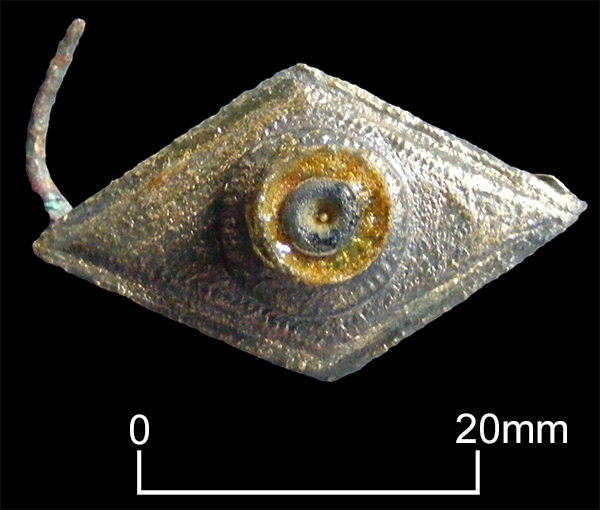
Today’s image is another brooch found at the Roman villa site at Abbey Farm, Minster.

This lozenge shaped plate broochwith an intact pin, although bent, is made of copper alloy.  It measures 33mm long and 18mm wide and has a circular hollow back. There is a central raised projection that was filled with enamel that is now coloured yellow and dates to the 2nd to 3rd centuries.

Other Roman brooches from the site have been posted on Day 88, Day 89, Day 90 and Day 96.

VM_365 Day 111. Shale bracelet from Margate

VM 111

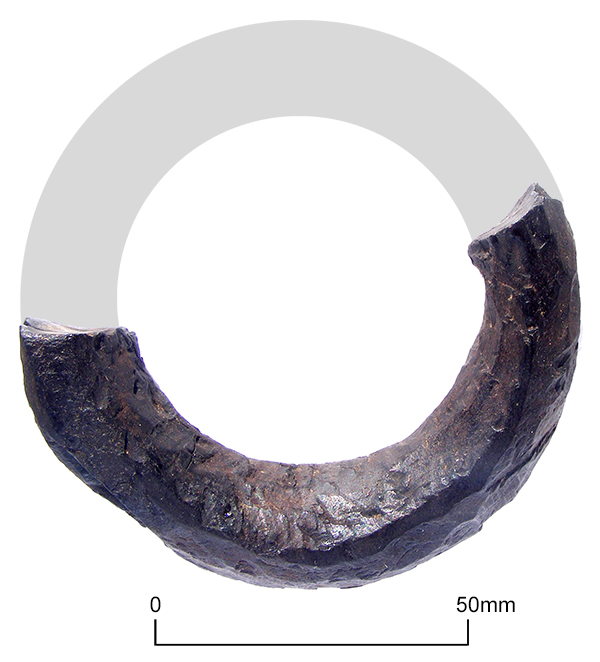
Today’s image is part of an Iron Age shale bracelet found during an archaeological evaluation at Hartsdown, Margate in 1995. The bracelet was found in a storage pit that had been filled with rubbish when it was no longer needed.

The bracelet is carved from Kimmeridge shale with ground faces on the front and back, the inner and outer surfaces are unpolished.

VM_365 Day 110. Iron Age Weaving Comb

VM 110

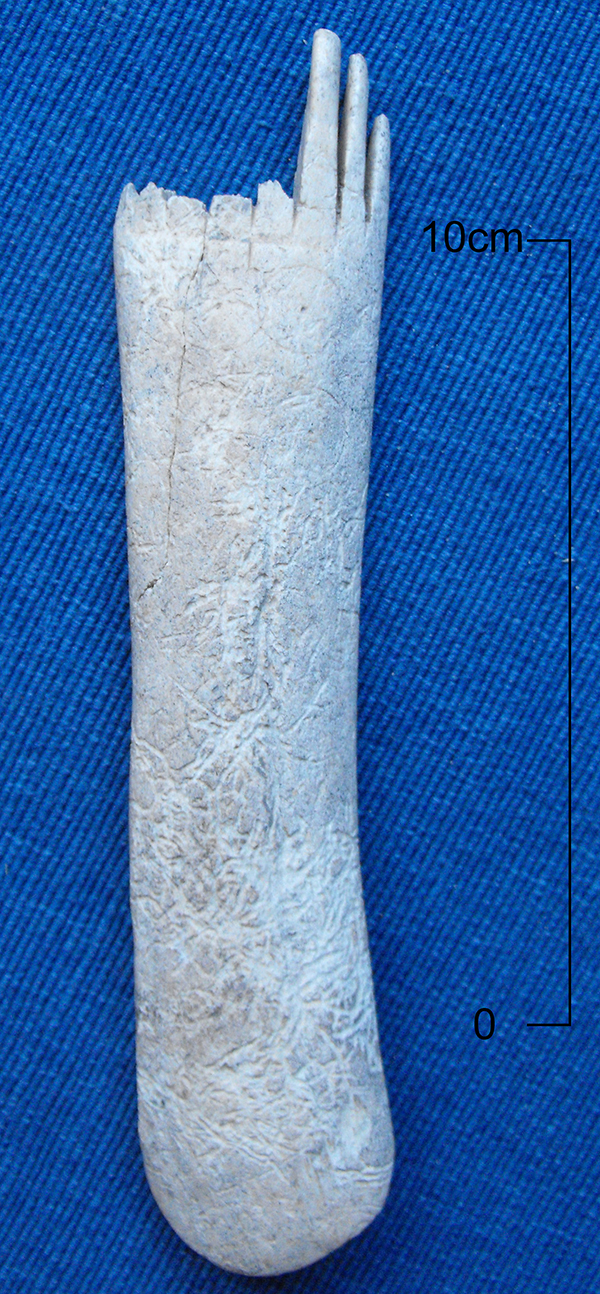
Today’s image is of an Iron Age weaving comb from the Iron Age settlement at Dumpton Gap, Broadstairs.

Most clothing would have been made from sheeps wool woven by hand on wooden looms. Combs such as these were used to push threads in place while weaving. Other artefacts associated with cloth making such as loom weights, used to hold the threads taut on the loom, and spindle whorls, used for making the yarn are also commonly found on settlement sites.

This particular comb was found in a rubbish pit dating to the late Iron Age, around 25 BC-25 AD. It is made from animal bone and has been decorated although the irregular lines you can see on the surface are caused by tiny plant rootlets scaring the surface whilst it was in the ground.

It is not clear if this comb had actually been used as it appears to be unfinished. If you look carefully at the upper part of the comb there are four circles marked out, two overlapping, and two others are visible in the middle on the right side. These circles were scored using a compass and would then have been carved to form ring and dot decoration. The decoration on this comb did not progress beyond scoring the circles; perhaps it was a practice piece, as two sets of the circles appear to overlap and it was discarded, perhaps the teeth broke before the decoration could be finished, or, perhaps it was needed before it could be finished and was used anyway.

VM_365 Day 109. Roman Kitchen Round up

VM 109

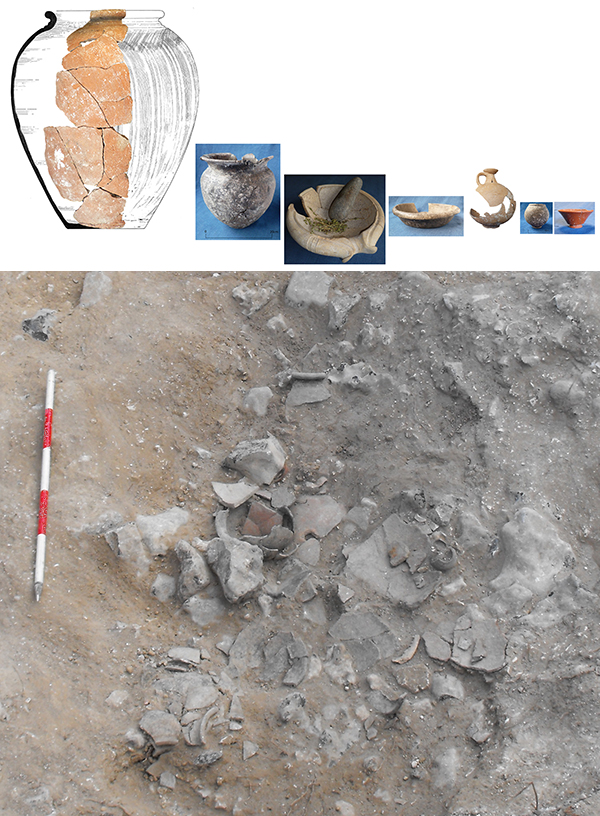
For Day 109 of VM_365 our image shows a line-up of the images of the reconstructible vessels that were present in the dump of pottery from the Roman Building at Fort House, Broadstairs. Each of the pots, a samian cup, a poppy head Beaker, a flagon, dish, mortarium and two storage jars, one small and one very large , has been shown in earlier posts which have told the story of the Roman site in Broadstairs where they were found and how the vessels were excavated and reconstructed.

The images have been scaled to show the range of sizes in the deposit and you might be able to pick out  some of the individual  vessels that are illustrated in the lower part of the image which shows a photograph of the deposit at the time of the excavation. The pottery assemblage from this deposit (context 1022) was the largest from the excavation site at Fort House, with 841 sherds weighing in at 29.815 kg.

Analysis of the forms and fabrics indicated that at least 25 vessels are represented, these include one flagon, six jars, three bowls, two dishes, four beakers and two storage jars. At least two cups were present and one mortaria. There were three other vessels that could not be identified. One of the finest pots present is a complete cup in Central Gaulish samian fabric (Dr. 33 type).

The fabric of the vessels can tell us something about their manufacturers and the markets that supplied the pottery used on the site. Nearly half of the pottery was made in hand-made ‘Native Coarse Ware’ fabric, fired in high temperature kilns to a hard finish. A quarter of the material was supplied by Roman pottery kilns located along the Thames, which produced vessels in Black Burnished 2 fabric, North Kent Fineware and other greywares. Three of the pots may have been manufactured locally and the samian cup would have been imported.

The flagon and the mortarium that have been reconstructed were products of Roman pottery kilns located in Canterbury. The Mortarium probably came from a kiln that is known to have been close to Dane John mount in Canterbury, or it may be the product of a closely related manufacturer. As one sherd from a jar made in a Canterbury Greyware fabric is the only example of  the products of the kilns of the Canterbury Greyware industry, the range of fabrics represented indicates that the date of the whole group of vessels is later than 175 AD.

The freshly broken condition of most of the vessels that were represented in this assemblage suggests that they were dumped, in one action, immediately after breakage around AD 200, or soon afterwards. The characteristics of the breaks in the pots, which often emanate from a single point where a piece is missing, suggest they might have been deliberately smashed, perhaps with a sharp object.

These vessels can reveal a fascinating snapshot of a moment in time when Broadstairs was part of the Roman world, but we will never really know the full story of what happened to create the pottery dump which has generated such a valuable trail of evidence.


VM_365 Day 108. Roman Native Coarse Ware jar from Broadstairs

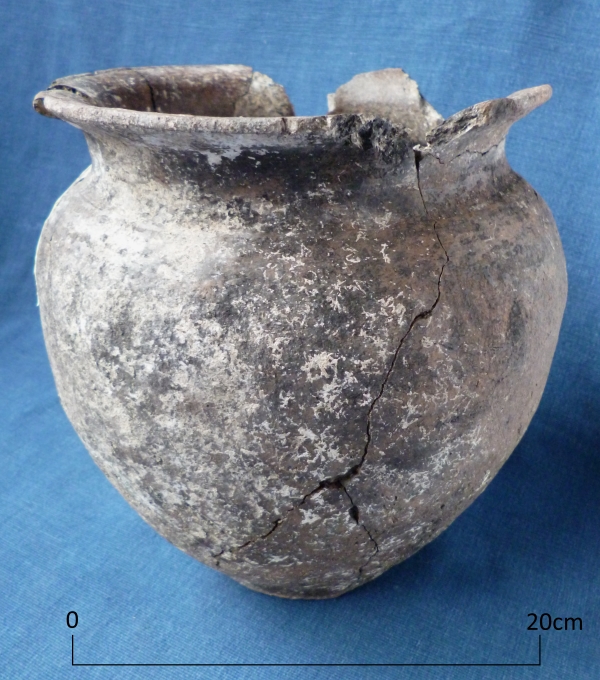
VM 108Today’s VM_365 image is the vessel we featured being reconstructed yesterday from the Roman Kitchen at Fort House, Broadstairs. This everted rim storage jar is made in a black ‘Native Coarse Ware’ fabric similar to the dish shown on Day 104. It is one of six storage jars of a similar size and fabric and dates between 170-250 AD.
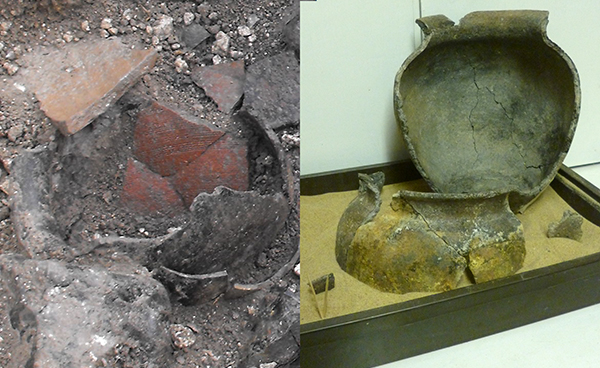
VM_365 Day 107 Where have all the fragments gone?

Large Roman jar undergoing reconstruction.
From the ground to gluing tray, large Roman jar undergoing reconstruction.

In the image for VM_365 Day 107, we have one of the last of the vessels from the Roman kitchen at Broadstairs that can be reconstructed. The large jar is shown in the ground during excavation and on the right in the sand tray we use to hold the sherds in place while they are glued together. All of the vessels from the same site shown in the previous VM_365 posts over the last few days have been through this method of reconstruction.

First each sherd must be recovered, located and fitted together in a dry run, to see what order they need to be glued in. The process of sticking the sherds together must be carried out very precisely and in small stages as otherwise the pieces of the vessel may not meet in the middle when the last piece is added.  When the glue is applied the sherds must be held in exact position until the bond is made. Any errors will mean that the next pieces can’t be properly fitted.

The large jar was one of the most obvious near complete vessels within the thick deposit of sherds, however once it was lifted it was clear that it had been broken before it was thrown in and the jar came apart into a number of large pieces. Some of the sherds from one side of the vessel had been spread elsewhere in the deposit and had to be picked out from the spare pieces left over after we had matched as many as possible. We may still be missing a few in the end!

We’ll post more on this vessel once the glue has dried and we can take a proper photograph of the result.