Category Archives: Archaeology

VM_365 Day 172 Early Neolithic Pottery from Ramsgate

VM 172Today’s VM_365 image for Day 172 shows one of the sherds of pottery found  in 2007 in the ditch fills of an Early Neolithic causewayed enclosure at Court Stairs, Ramsgate.
This sherd is typical of the Southern Decorated tradition which was current during the second half of the Early Neolithic, broadly datable to between c.3600-3350 BC. In this case, the sherd has been indirectly dated by Carbon dating of an ox skull to 3636-3625 cal. BC.

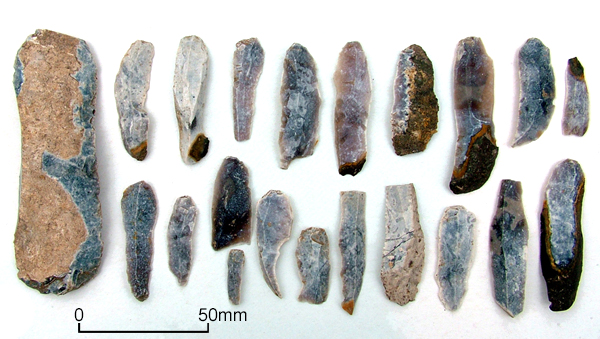
VM_365 Day 171 A feast of flintwork, blades from Neolithic site at Pegwell

Selection of flint baldes from Neolithic site at Pegwell Bay
Selection of flint blades from Neolithic site at Pegwell Bay

Today’s image for VM_365 Day 171 is of a selection of blade flakes from the flintwork that was found in an excavation on a site at Courtstairs, near Pegwell Bay in 2007.

Although only one stretch of conjoined pits forming a curving line were exposed in the excavation, the finds from the site showed that a sample of the second Neolithic Causewayed enclosure to be found in Ramsgate area had been revealed.

Most of the finely worked flint dated to the Earlier Neolithic period, however a significant proportion was residual, with only a few contexts containing only fresh-looking single period lithics.  Other contexts had a mix of fresh and earlier residual material.

Many blade flakes were recovered from the pit fills, some contexts producing significant quantities. Finely worked blades and bladelets which had been soft hammer-struck from blade cores were particularly common, with serrated blades frequently represented.

The flintwork form this site is a rich source of information on the craft and technology in use in this period and there will be more to come from this site in future VM_365 posts.


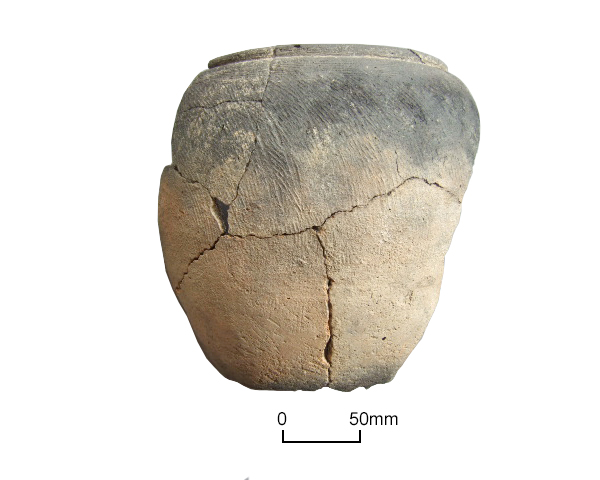
VM_365 Day 170 Reconstructed Iron Age comb decorated jar

Late Iron Age 'Belgic' comb decorated jar.
Late Iron Age ‘Belgic’ comb decorated jar.

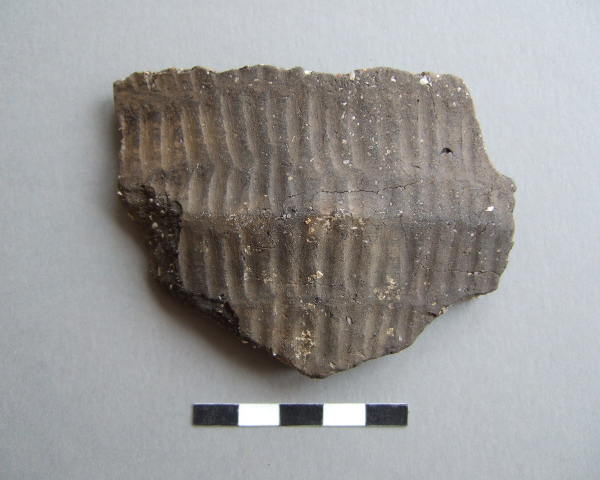
The image for VM_365 Day 170 is of the reconstructed profile of a Late Iron Age jar with a beaded rim and combed surface decoration. This pot was found broken into many pieces in the lower fill deposits at the base of a storage pit, during an excavation on the site of Margate Football club in 2003.

The vessel is made from a grog tempered  fabric, meaning that crushed pot has been used as a filler to stiffen the clay in the body of the vessel. Pots of this type were common in the later Iron Age period 50BC to 25AD.

Vessels with these characteristics are often classed as ‘Belgic’, after Julius Caeser’s assertion that the Iron Age tribes of southern Britain, including Kent, were related to the tribes of Belgae, who lived around the northern coast of Gaul between the west bank of the Rhine to the Channel

The comb decoration has only been applied to the upper section of pot. The area below the rim was decorated with a circuit of horizontal combed lines, then the shoulders and sides of the pot were covered using a series of arching strokes from just below the horizontal line toward the middle and lower part of the vessel.

The comb decoration was common in the Late Iron Age period and there are several variations represented in the application of the decoration among the vessels found in Thanet.

VM_365 Day 169 Where earth and sky meet. Iron Age potters surface decoration techniques

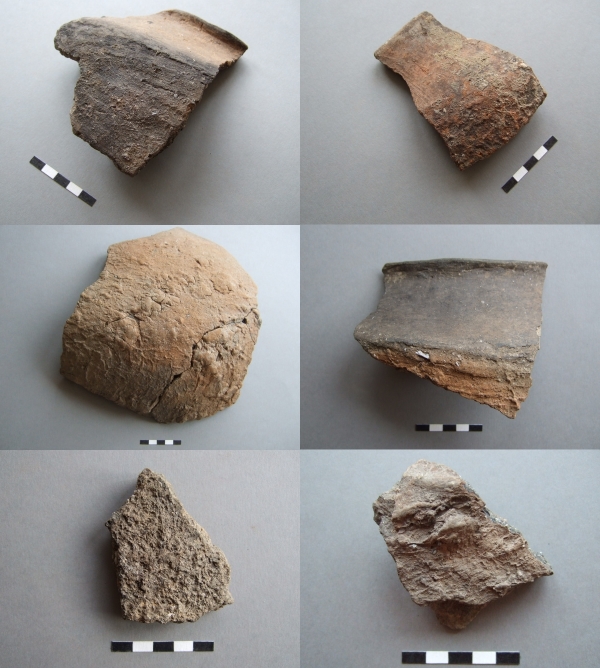
VM 169-1The image for VM_365 Day 169 shows a series of pottery sherds from Iron Age kitchen/storage-ware vessels from Margate, which have deliberately applied clay coarsening on the surface. The general currency of coarsewares of this type was the Early to Mid Iron Age period, between c.600 and 350 BC.

Some of the bodysherds show how the appearance of different methods of surface treatment; wet clay slurried; ‘pebble-dashed’ tacky; lumpy, sometimes produce almost bizarre surface effects on the vessels.

Some of the sherds show how the rustication tended mostly to be applied below the shoulder, although as one of the examples shows it is not always the case.

It has been suggested, with some reference to the contrast of application of coloured finishes to contemporary Halstatt/La Tene art styles, that the very evident tonal variation of the vessel finishes, the smooth and the coarse elements of the pattern, had some meaning for the maker. With the rusticated coarsewares of this type it has been suggested that the difference in visual tone represents a smooth sky or heaven above the rough lumpy surface of the earth below.

Maybe it is simply a practical innovation, without such embedded symbolism, simply making an easy-grip surface for greasy fingers on large heavy pots.
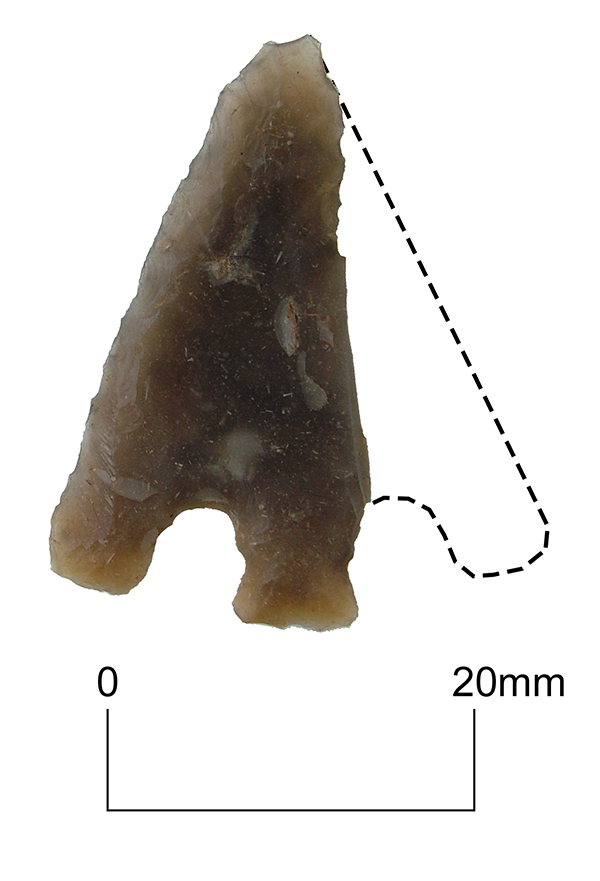
VM_365 Day 168 Retouched Flint Arrowhead

VM 168

Today’s VM_365 Day 168 image shows a late Neolithic/Early Bronze Age arrowhead from Cliffsend.
This barbed and tanged arrowhead had broken along one of the barbs and instead of being discarded, the edge was retouched so it could be reused.

Other examples of flint objects that have been reworked into a useable object following damaged were posted for Day 165 and Day 50.

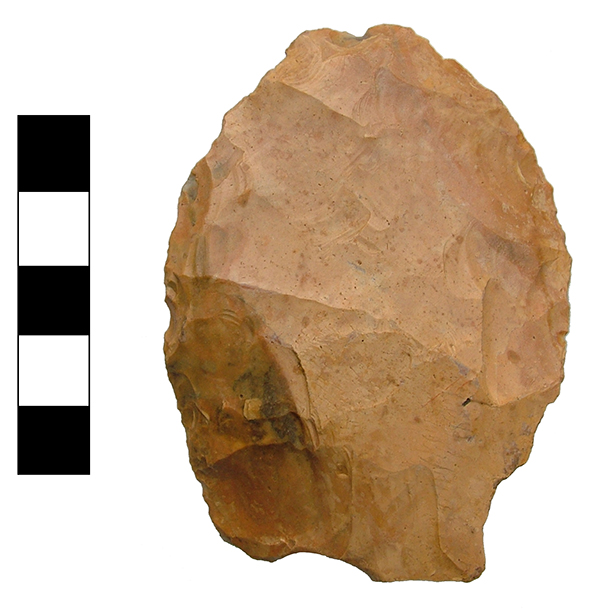
VM_365 Day 166 Palaeolithic Hand Axe from Westwood, Broadstairs

VM 166

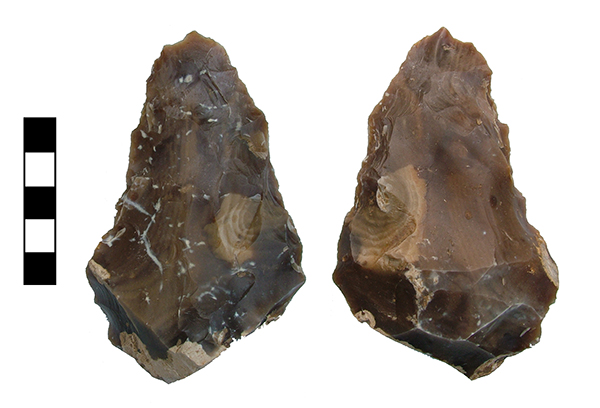
Today’s VM 365 image for day 166 shows the two faces of a small flint Palaeolithic hand axe which was found at Westwood, Broadstairs in 2000.

The axe is of Acheulian pointed heavy butted type and measures less that 10cm in length. It is unpatinated and is sharp on its edges and struck facets indicating that it had not moved far from the place where it was lost or discarded approximately 400,000 years ago.

VM_365 Day 165 Reworked Polished Flint Axe

VM 165

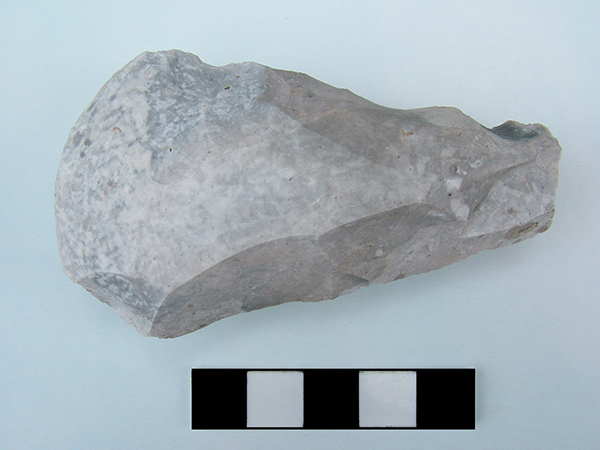
The image for Day 165 of the VM_365 project shows a reworked polished flint axe that was found in the primary ditch fill of a Beaker period barrow at North Foreland, Broadstairs in 2004.

This was originally a small polished axe that was reworked to make it usable after it broke at the butt end. The butt end was tapered to aid re-hafting and the cutting edge was re-sharpened.


VM 365 Day 164 Earliest Iron Age red oxide painted pottery from Minnis Bay, Birchington

VM 164

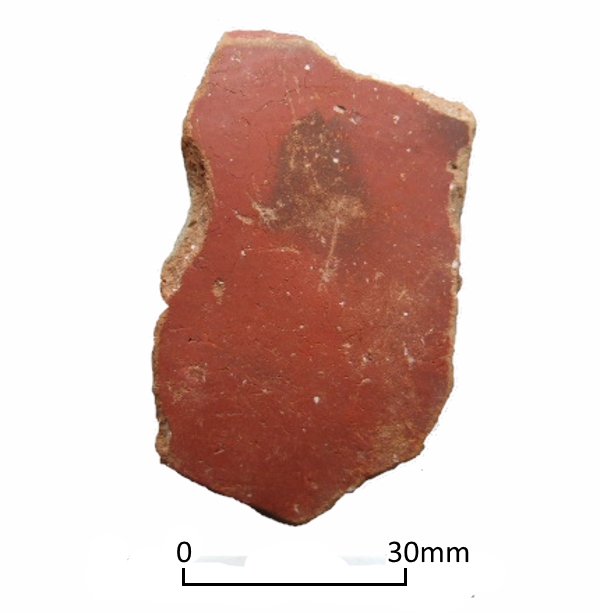
Today’s image is of a sherd of Earliest Iron Age pottery with a bright red finish applied to its outer surface.  Around 900 BC, in the earliest phase of the Iron Age, a new technique was adopted by potters where  vessels were decorated by applying  iron-oxide powder as a slip to the outer surfaces.

Like the finger tip decoration  that was applied to bronze age on vessels that was shown on VM_365 Day 155, this technique is a skeuomorph, using the inspiration of one decorative form as a reference to create another decorative style.   The  process evolved with the deliberate intention of  emulating the bright colour of freshly made and polished bronze vessels.

The technique was only applied on thin-walled fineware bowls, which were most ike the bronze models. The sherd shown in the image is from a bowl found at Minnis Bay, Birchington which can be  dated broadly to around 900 to 600BC .

VM_365 Day 163 Moulded shoulder vessels characteristic of Early to Middle Iron Age period

Early to Mid Iron Age fineware bowl with moulded shoulder, with sherds from similar vessels

Early to Mid Iron Age fineware bowl with moulded shoulder, with sherds from similar vessels

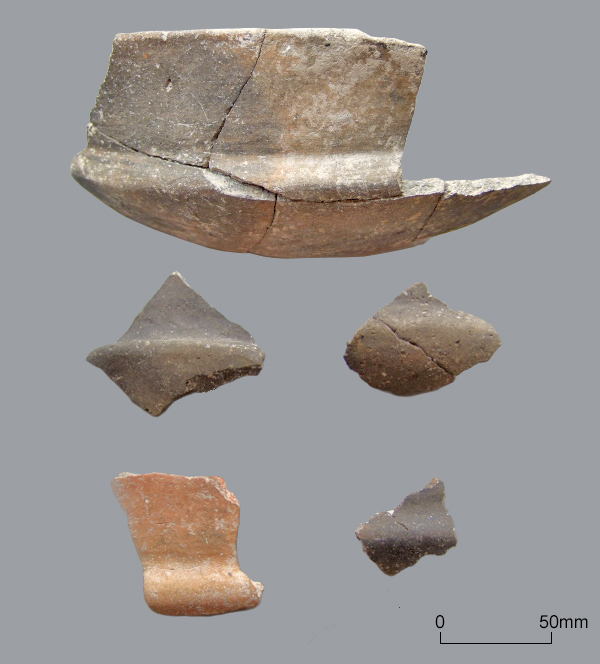
Today’s image for VM_365 Day 163 shows some examples of a characteristic of pottery from the Early to Mid Iron Age period, dating around c.600-500 BC. This earliest phase of Early to Mid Iron Age pottery is epitomised by fineware bowls that have complex, moulded shoulders. The vessel form was based on examples that were coming in to Britain from North East France and other areas of the continent.

A fairly complete example of a vessel with this characteristic shape from Fort Hill Margate is shown at the top of the image. The four sherds below are from a series of other vessels  showing variations of forms with the characteristic moulded shoulder that is typical of this period.

Vessels with this distinctive shape would not be easy to make, requiring careful and firm moulding at the shoulder junction. The pots frequently break at this point because the pieces of clay that make up the vessel’s body, formed of coils or slabs,  are sometimes poorly joined together.

The bowl and sherds shown in the VM_365 image show how small, but very characteristic pottery sherds and fragments can be used to identify the potting traditions form a specific period that are represented among the many sherds that may be present among the finds recovered from an excavated feature, or in the assemblage of pottery from a site.

The VM is grateful to Nigel Macpherson Grant for the images and information for today’s post.