Category Archives: Archaeology

VM_365 Day 202 The Beck bronze hoard Minnis Bay

VM 202

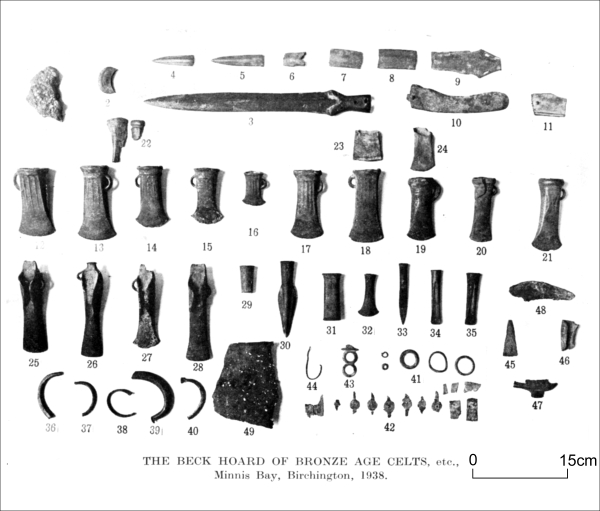
Today’s image for Day 202 of the VM_365 project is of the bronze objects, pottery and other artefacts in what has become known as the Beck Hoard.

In 1938 a boy called James Beck noticed some dark patches on the flat wave cut platform on the beach beyond the cliffs at Minnis Bay, Birchington. With the assistance of Antoinette-Powell Cotton who lived nearby at Quex Park, James excavated and recorded several of the pits and the finds within them.

In one of the pits the large bronze hoard shown today’s image was recovered, along with some large sherds of pottery. The hoard contained swords, palstave and socketed axes, spear heads along with smaller bronze objects, ingots and fittings. The details of the Beck hoard were published in Archaeologia Cantiana by G.F. Pinfold, curator of the Powell-Cotton Museum and Major Percy Powell-Cotton.

The pits were once  much deeper, having been cut from a land surface that stood at a higher elevation, which had been truncated by wave action to the level of the eroded platform that lies at the base of the present cliff line.

The Beck hoard is one of several that have been found on the present coastline of the north side of Thanet, the earliest discovery being the Mutrix Farm hoard which was shown in VM_365 Day 81. Rapid erosion of the soft deposits along this coastline is eating its way into the valleys and hill tops that would have been some distance from the sea in the Bronze Age landscape.
VM_365 Day 201 Memories of metal on ring stamped Bronze Age pottery from Margate

VM 201

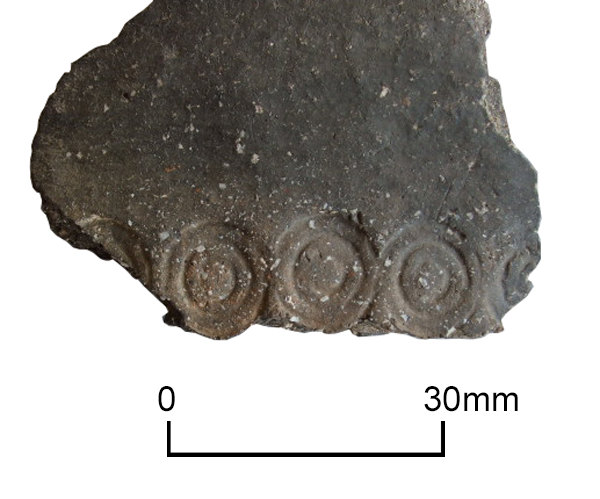
Today’s image is of a decorative motif on a piece of  pottery from the transitional period between the Middle and later Bronze Age.

The sherd from a vessel closely related to the one shown in Day 199, which contained the Birchington Bronze Hoard. Close inspection of the globular bowl from Birchington shows that it was decorated with a horizontal row of stamped rings, following the centre line of the body.

The sherd shown in the VM_365  image today is from another similar flint and grog tempered vessel, this time from Margate. The Margate pot is also likely to have been decorated with a single row of stamps from an object carved with a series of raised concentric circles. The stamping was added after the outer skin of the pot had been burnished to a smooth finish. On the current evidence – including the dating of the hoard from within the Birchington bowl the date of the vessel the sherd came from and other pots like this should be placed between c.1350-1150 BC.

Like much of the decoration applied to Bronze Age pottery, the ring pattern is thought to be skeuomorphic,  each of the stamped rings emulating the rivets that would have joined two sections of a bronze bowl into a globular shape.

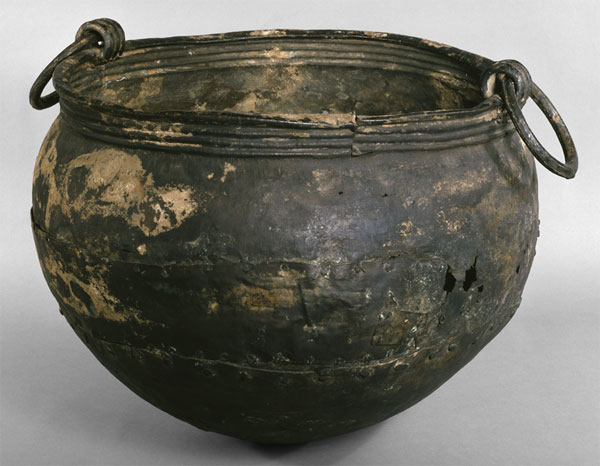
A bronze cauldron  that was found at Shipton on Cherwell in Oxfordshire which is now in the Ashmolean Museum, gives an idea of the riveting patterns on bronze vessels that may have inspired the ring stamp motif on the pots from Birchington and Margate.


VM_365 Day 200 Difficult to date

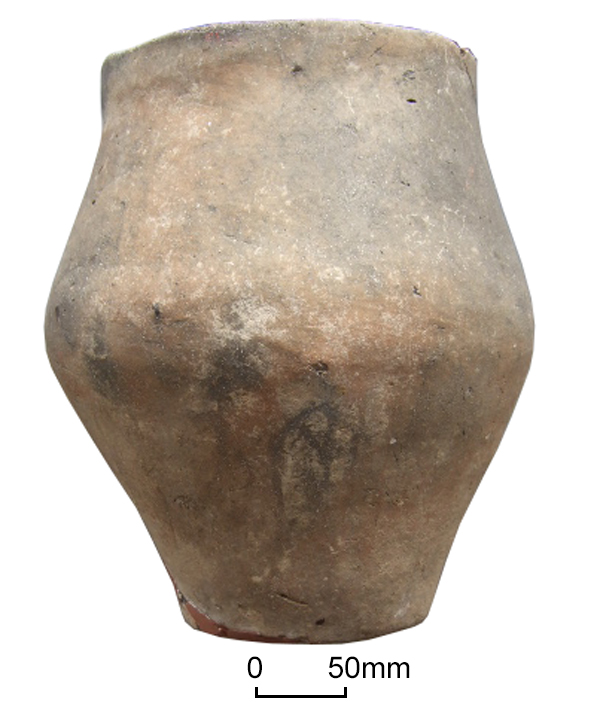
VM 200The image for Day 200 of the VM_365 project is of a complete pottery vessel which was found on a building site somewhere in eastern Cliftonville, Margate. The significance of this pot is that it has proved very difficult to date using the conventional methods of fabric analysis and typology that archaeologists use to date prehistoric pottery.
The ceramic of most periods have ‘signatures’; typical vessel shapes and types of decoration. Sometimes fragments of pottery, or a complete vessel as in this case, can be found that defies ready interpretation.
The fabric of the vessel in the image is flint tempered and it is quite well made, but it does not belong easily in any Later Prehistoric period. The vessel can’t be from an earlier prehistoric period, before around 1500 BC,  because all Early to Middle Neolithic pots were flint tempered, but had round bases.  The other Early Prehistoric potting traditions; Late Neolithic Grooved Ware or the Early Bronze Age Beakers and Urns; were predominantly made from grog-tempered fabric.
Sometimes the context of discovery of a vessel helps to fit it into a particular period, but all we know about this vessel is that it was recovered from a building site, without any further information. Specialists who have examined the vessel have been left scratching their heads, although one has suggested a date in the Middle Iron Age, somewhere between c.400-300 BC or a little later, although it is far from typical of the pots of that period.
This interesting puzzle shows that although archaeologists have been able to characterise the typical pottery from many periods, and fit them into a complex scheme describing the development and progress of styles and potting techniques, there is always the rare possibility of an outlier which has previously been unrecognised emerging  and upsetting the established rules, leaving room for new research and ideas to be developed.
We are grateful to Nigel Macpherson Grant for today’s image and posing this ceramic conundrum.

VM_365 Day 199 The Birchington Bronze Hoard

VM 199

After Powell-Cotton et al 1924.

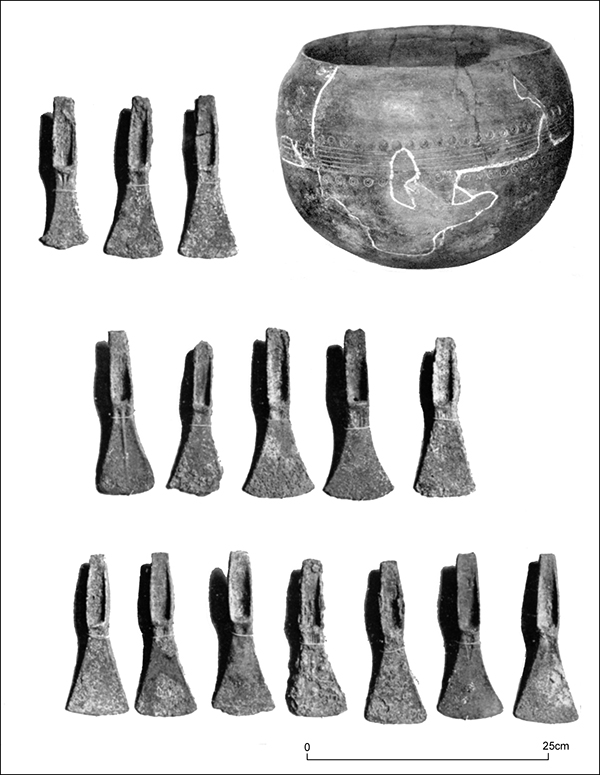
The image for Day 199 of the VM_365 project shows a Middle Bronze Age Bronze Hoard found in 1904 during brickearth extraction at Birchington.

The hoard comprised 14 palstave axes found in a globular fineware bowl of Deverel Rimbury type. Deposition within a pottery vessel is unusual and few other similar examples exist.

The vessel, which had been broken and the lower parts of which were missing, was stamped with two bands of concentric impressed rings above and below a band of scored horizontal lines. The vessel was restored in 1923.

References

Powell-Cotton, P. H. G. and Crawford, O. G. S. 1924. The Birchington Hoard. The Antiquaries Journal 4, 220-226.


VM_365 Day 198 Middle Iron Age painted pottery

Image of Iron age paint decorated pottery
Early to middle Iron age polychrome decorated pottery

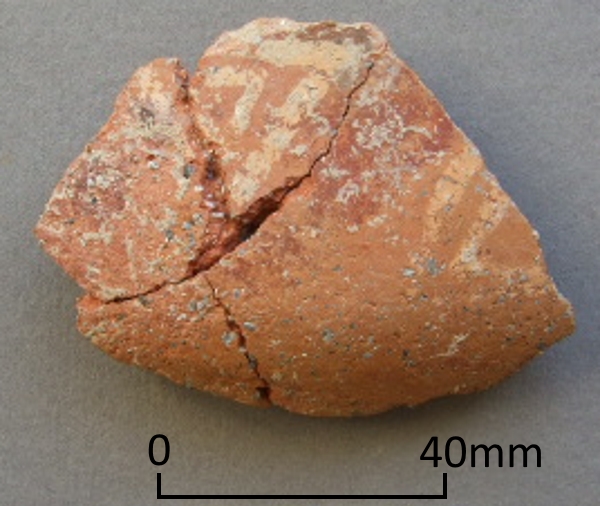
The image for Day 198 of the VM_365 project is of a sherd of multi-coloured or ‘polychrome’ decorated fineware pottery, dating from the Early to Middle Iron Age.

This group of conjoining sherds from a small-diameter beaker or round bodied jar, made in a fine fabric, was found at Sarre in 1991. The exact dating could be narrowed down further in the future, but it can be safely dated to between  around 450-350 BC.

The body of the vessel is painted with a triangular or chevron decoration in cream to white pigment.  The triangles are infilled with red iron-oxide pigment. This fragment of vessel is probably the best example that we currently have of this type of polychrome decorated pottery from Thanet.

Although only a small fragment of the pattern is present, it is possible to reconstruct the shape of the body of the pot from the curve of the sherds and to imagine how the pattern extended over the whole surface of the  exterior of the vessel.


VM_365 Day 197 Fragments of Late Bronze Age Sword from Manston

VM 197

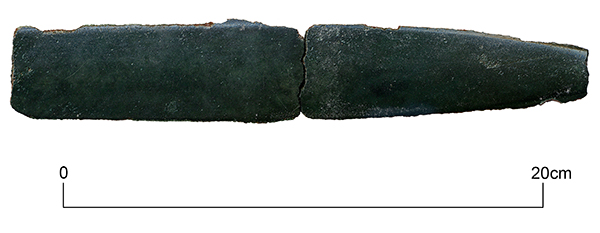
Today’s  image for Day 197 of the VM_365 project shows two fragments from a sword blade found as part of a Late Bronze Age Bronze Hoard at Manston in 1994.

These two joining fragments of a leaf-shaped sword blade were found along with the narrow -bladed palstave axe and pegged spearhead shown in previous VM_365 posts. Traces of the ground edge of the sword  can just be seen on both fragments.

VM_365 Day 196 Bronze Age looped palstave axe from Manston

VM_196

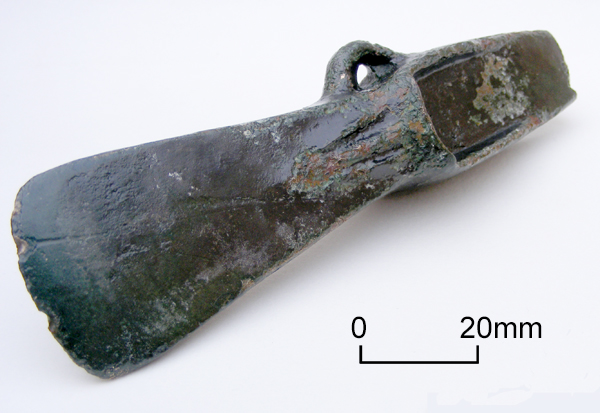
The image for Day 196 is another of the bronze objects found in a late Bronze Age hoard at Manston, the same group of objects as the pegged spear head shown in Day 194.

The axe has both a slot to fit a wooden haft and a loop that could be used to secure the axe head to the haft with some form of binding.

Axes and other objects like those in the group were cast in two part moulds and often the join between the two sections of the mould can be seen as a fine extrusion line  along the central axis of the object. The casting may also include ornamental patterning or ribbing as can be seen in this example.

The ability to manipulate the production of bronze and cast it into objects like these has been seen as a skill that gave power and mystique to the bronze workers in Bronze Age society.

VM_365 Day 195 Another reconstructed Jar from the Roman Kitchen at Broadstairs

VM_195

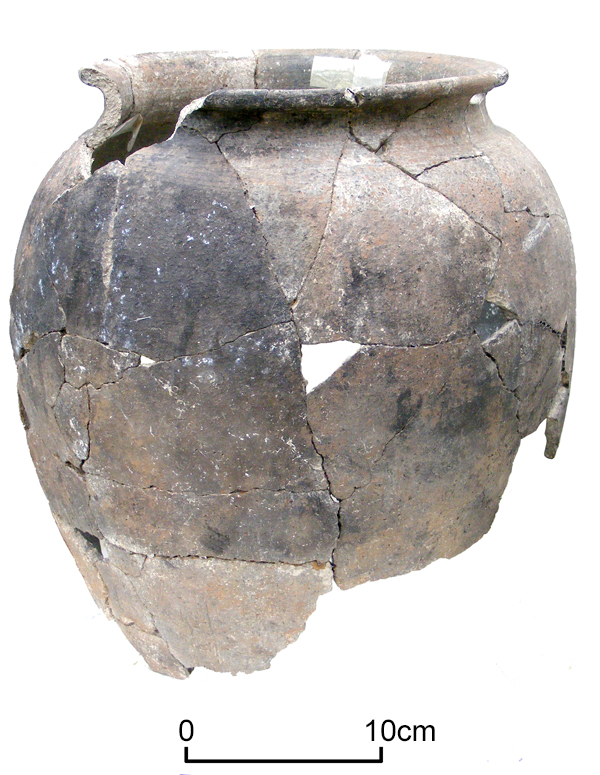
The image for Day 195 is of another vessel from the Roman Kitchen found in the remains of a Roman building excavated at Broadstairs, a Knife-trimmed necked-jar in a grey-black Native Coarse Ware with grog and sand filler. The diameter around the exterior of the rim is 240 mm. and the surface is fired grey with patchy black and pink surfaces. This particular style of vessel can be dated to around 170-250 AD.

One hundred and twenty fresh sherds from the vessel were recovered from the thick deposit of pottery, making up nearly three quarters of this pot. Previous VM_365 posts have shown how vessels from the thick layer of pottery in one context have been reconstructed and this is the last of large jars that has been carefully pieced together by one of the Trust’s volunteers.

Like many of the other pots recovered from this deposit, the vessel appears to have been deliberately destroyed. A series of holes has been punched along the widest part of the body, as if the pot was systematically pierced with a thin rod or blade. Reconstructing the vessels has shown this pattern of holes punched with  sharp object to be preserved in the distribution of sherd breaks in several of the larger pots and a moratorium recovered from the deposit.


VM_365 Day 194 Pegged spearhead from Manston dating to the Late Bronze Age

VM_194

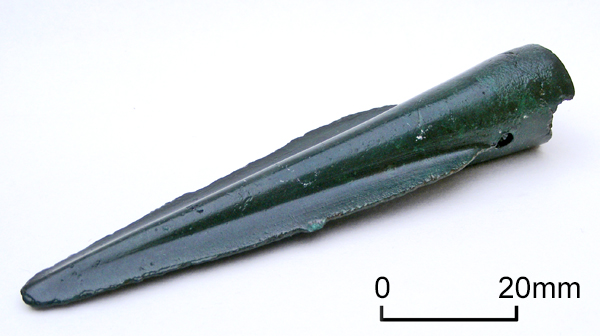
The image for VM_365 Day 194 is of a Late Bronze Age pegged spear head, dating to the period 1150 – 600 BC.

This type of spear head is found in a region spanning the Thames Valley, Cambridge Fens and the east Midlands and of course in East Kent. These pegged spearheads have considerable variation in dimension and detail and can be anything from 10 to 40cm in length.

The leaf shaped blade extends from a circular central shaft, which is hollow socket at the top end, where the spear shaft would have been fitted, secured with a pin through the holes on opposite sides of the shaft. The blade in this example is slightly worn around the edges from corrosion.

This example was found with other tools and pieces of scrap bronze in a group at a site at Manston. The slightly glossy appearance to the surface is caused by a conservation treatment applied to prevent any further corrosion.

VM_365 Day 193 Drawing by Thanet Heritage Pioneer Dr David Perkins

After Sketches of Historic Thanet 1993.
After Sketches of Historic Thanet, 1993.

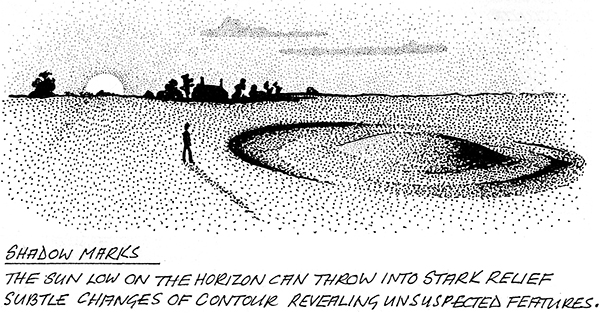
Today’s VM_365 image  for Day 193 is a reproduction of one of the illustrations produced by Dave Perkins, the first Director of the Trust for Thanet Archaeology and a founding member of the Isle of Thanet Archaeological Society.

Dave Perkins began as a gifted volunteer on the Lord of the Manor excavations in the mid 1970’s, progressing through his own intellectual efforts to become instrumental in founding the Trust and becoming the Isle’s first professional archaeologist, to eventually achieving his Doctorate in Archaeology from University College London in 1999.

Dave Perkins had originally been trained as an artist and illustrator and was a great believer in the power of drawings and images to inform and educate people in the subject of archaeology, an aim that lives on in this VM_365 project.

Sketches of Historic Thanet, from which this image is drawn, was Dave’s lively and informative introduction to the archaeology and history of the Isle of Thanet where he was born in 1939 and where he died in 2010.

References

Perkins, D. 1993. Sketches of Historic Thanet. Second Edition. Isle of Thanet Archaeological Society.