The vessel had been crushed flat by the pressure of the soil above and a significant portion had to be reconstructed so that the vessel could be properly identified and drawn.
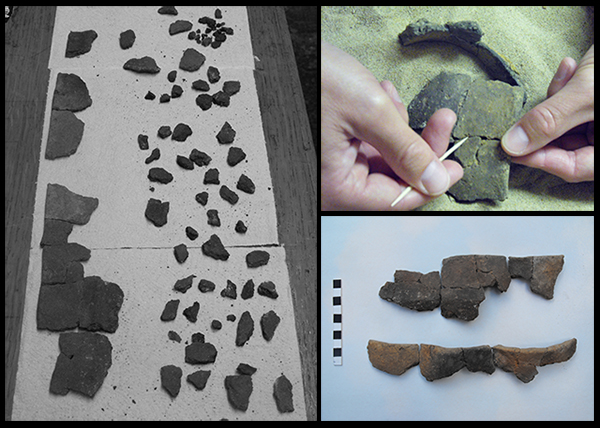
After excavation the washed fragments of pottery from the flattened urn were allowed to dry. Joining sections of the rim and body were laid out on a table in order (image left) and were then painstakingly glued and left to dry in a sand tray (top right).
Not all the sherds could be glued together and in the end it was generally only the thicker parts of the rim that could be joined (bottom right). However enough was reconstructed to provide a profile of the vessel and allow our prehistoric ceramics specialist to understand the vessel and produce an illustration reconstructing the full profile.
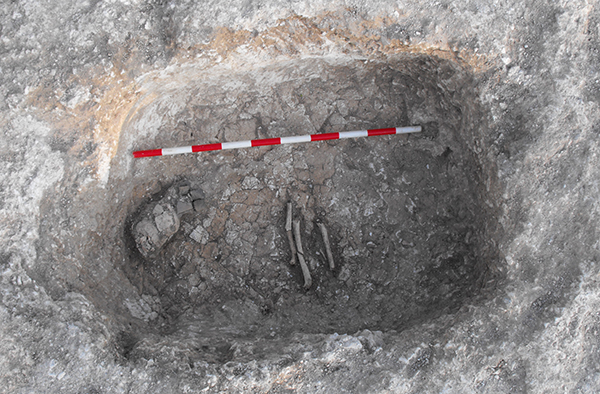
Following on from yesterday’s image of the Bronze Age barrow at Bradstow School, Broadstairs, today’s picture for Day 232 of the VM_365 project shows the crouched burial of a child which was inserted on the periphery of the Barrow.
The grave, which is cut into the chalk geology, contained the remains of a child lying crouched on its left hand side facing south. Only the child’s skull, shown on the left side of the image and some of the long bones of the legs survived.
A collared urn was placed as an accessory vessel on the southern side of the skull. Sherds from the urn can be seen as grey fragments showing up against the white bones of the skull and the brownish discolouration of the chalk at the base of the grave.
The grave was inserted on the periphery of the barrow , presumably some time after the barrow had been constructed for a central primary burial which may lie outside the area of excavation.
Round barrow excavated at Bradstow school, Broadstairs in 2009
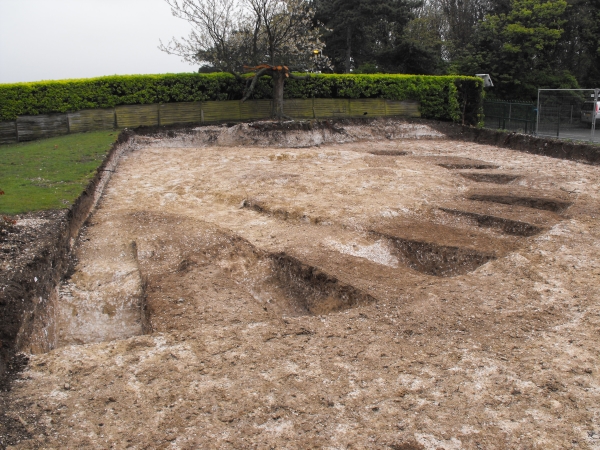
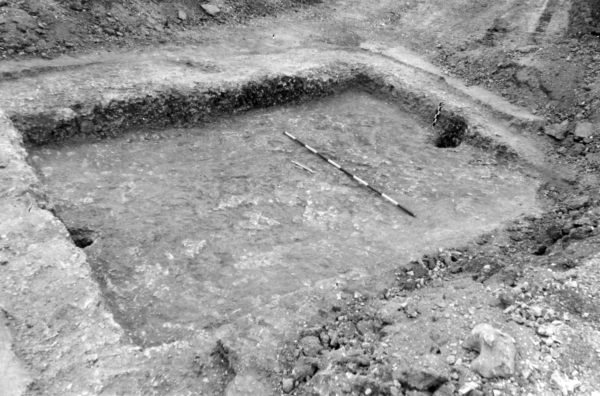
The image for Day 231 of the VM_365 project is of the portion of the ring ditch of a round barrow which was excavated at Bradstow School, Broadstairs in 2009. The image shows the regular series of segments taken out of the fill of the ring ditch to reveal sections at intervals around the circuit.
The ring ditch is one of a group of four similar ring ditches which are distributed around the terminal of a dry valley where it meets the east facing aspect of a rounded chalk-downland hill, now occupied by the extensive grounds of the Bradstow school, formerly a private House called Valletta House.
The Bronze Age landscape of the hilltop has been revealed in a remarkably extended series of investigations that began with an excavation carried out in 1910 by Howard Hurd, who featured in the post for Day 40. Hurd revealed a double ring ditch, probably representing a barrow that had been extended or refurbished at some time during its period of use as a funerary monument. Two further ring ditches were recorded in excavations carried out by the Broadstairs and St.Peters Archaeological Society (BSPAS) with the assistance of the British Museum (BM), to the west and south west of Hurd’s excavation.
The construction of a new facility for Bradstow School within part of the playing field in 2006, resulted in the discovery and excavation of a very large causewayed ring ditch, which may have been a ceremonial enclosure rather than a funerary monument like those that had been discovered by the earlier work. Nearby an unusually small ring ditch contained four graves, an unusual feature that does not fit into the conventional classifications of prehistoric burials in Thanet.
When a former garden site standing immediately adjacent to the western most of the ring ditches recorded in the BSPAS and BM excavations was chosen as the location of a new swimming pool for the School, there was a further opportunity to explore the Bronze Age landscape of this Broadstairs hill top. Evaluation trenches revealed the circuit of another ring ditch, which was partly excavated before the pool was built. This excavation was carried out nearly a century after Howard Hurd’s discovery of the barrow under the lawns of Valleta House.
The centre of the barrow where a primary burial might be expected was not exposed in the excavation. Two rectangular graves were associated with the ring ditch, one within the circuit which was severely truncated and contained no human remains. The other grave was perhaps inserted on the periphery of the barrow at a later date, it contained the remains of a child, lying crouched on its left hand side facing south, with a collared urn placed as an accessory vessel on the southern side of the skull.
The ring ditch excavated in 2009, which had a diameter of approximately 24m continued the linear series of barrows that line the edge of the arc that is formed by the intersection of the dry valley with the hill top. Each point around the arc commanded a vista across the lower lying land and the sea, which may have been an important factor in the choice of location for these burial mounds in the Bronze Age and of the large causewayed ring ditch which stood very near to them.
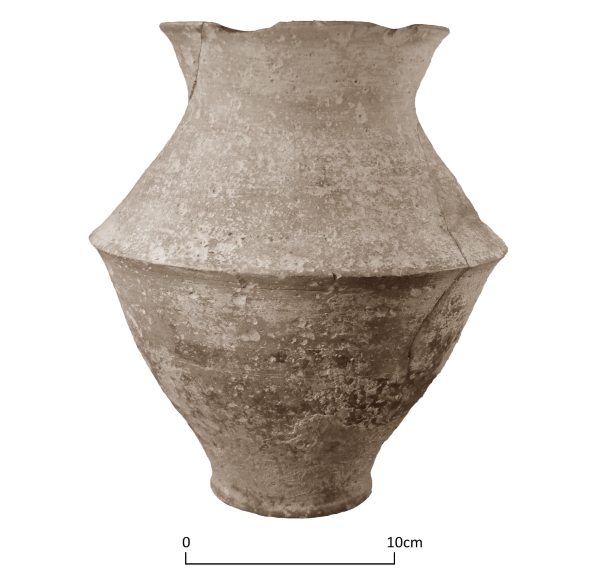
Today’s image for Day 230 of VM_365 shows a Roman vessel which was found during grave digging at the modern cemetery at Tothill Street, Minster in the 1920’s.
This greyware biconical urn with a carinated rim was found in association with three other vessels, presumably all from the same cremation group. The group also included a carinated beaker in grey ware with black spots measuring approximatley 10 cm high, a grey ware bowl or platter about 18cm in diameter and a flagon in red fabric measuring approximatley 17.5 cm high. This cremation group dates to the late first to early second century AD.
The biconical urn contained fragments of burnt human bone representing the cremated remains of the individual buried in the pit. The other vessels are likely to be ancillary vessels deposited in the grave pit alongside the urn, possibly containing food and other offerings for the afterlife.
These vessels were reported in the Antiquaries Journal in 1924 by Mr W. Whiting, an early Roman ceramics specialist who also later worked on the pottery from the early excavations at Richborough Roman Fort in the 1930’s.
Today’s image for Day 229 of the VM_365 project shows an Anglo Saxon sunken featured building, which was excavated during a Watching Brief on a pipeline at Sarre in 1991.
Sarre is perhaps better known for its extensive Anglo Saxon cemetery which has featured in many of our posts (Day 19, 33, 34, 35, 116, 117, 119, 120, 142, 147, 149, 150, 151, 152, 153 and 227) but to the east of the cemetery near the abandoned Perkins Chalk pit, this contemporary settlement evidence was discovered.
The Sarre structure was rectangular in plan measuring 3 metres by 4 metres and 0.4 metres deep and was cut into the chalk geology. Two opposing postholes were located at either end of the central axis of the cut. A shallow ledge is visible along one long edge, suggesting the possibility that a planked floor was supported by it.
A discussion of the function of Sunken Feaured Buildings has previously featured in VM_365 along with a description of a similar building found at Margate on Day 83.
Although only one structure was observed during this work, other evidence of Anglo Saxon settlement is likely to survive in the surrounding fields waiting to be discovered.
The image for Day 228 of the VM_365 project is of a resource the Trust has created for teaching some of the themes of prehistory in primary school workshops, a table top Beaker burial given its first trial recently at a primary school in Broadstairs. The tabletop layout includes a skeleton in a crouched position, accompanied by a replica Beaker vessel and a contemporary barbed-and-tanged arrowhead.
One element of the workshop is a discussion of pre-history as an idea, drawing out the sense that it describes periods in the development of human societies where no stories told directly by the people themselves exist. Studying prehistoric periods requires a process of investigation, based on the observation of objects and the circumstances of discovery. To generate narratives from the evidence requires imagination to draw out associations and analogies with contemporary life experiences.
The burial and accompanying objects create a detailed scenario to provoke discussion and demonstrate how archaeologists have used the detailed investigation of the pottery, flintwork and the human remains separately to provide data. Revealing the burial from under its covering of grassy topsoil (top images) adds a sense of the theatre of discovery which is such a part of the archaeological investigation process.
The combination of the artefacts and the burial into a recognisable archaeological scenario gives the children an insight into the practical circumstances of investigation where archaeologists generate their data. They can take part themselves in creating and debating their own versions of the narrative of the burial.
For an archaeologist well versed in the complexities of theoretical approaches to prehistory and the interpretative models and debates that are generated from them, it is fascinating to see these same arguments arise among such young minds based on the first principles of observation and imagination provoked by a Beaker burial presented in their own classroom.
Beyond the educational aspects of the activity, there is the opportunity to create a great deal of fun, with much ooing and aahing as the bones are revealed followed by a flood of questions and a great deal of humour. Previous VM_365 posts on prehistoric pottery and human bone themed education activities were made way back on Day 11 and Day 12
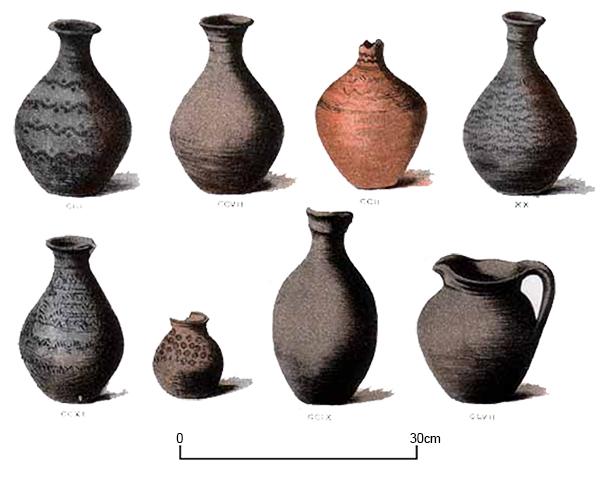
The image for Day 227 of the VM_365 project is taken from the illustrations of pottery vessels excavated at the Anglo Saxon cemetery at Sarre in the mid 19th century which were published in Archaeologia Cantiana by John Brent in 1868. The Sarre cemetery was not investigated again until over 100 years later in 1990 when a number of graves were excavated before a pipeline was laid across the site.
The range of pottery vessels shown above, described by Brent as Anglo Saxon narrow necked pottery, include wheel turned bottle vases and a jug. One of the graves from the 1990 excavation contained a wheel thrown bottle vase similar to those above which was shown on Day 153 of the VM_365 project.
References
Brent, J. 1868. Account of the Society’s Researches in the Saxon Cemetery at Sarr. Part 3. Archaeologia Cantiana 7. 307-321
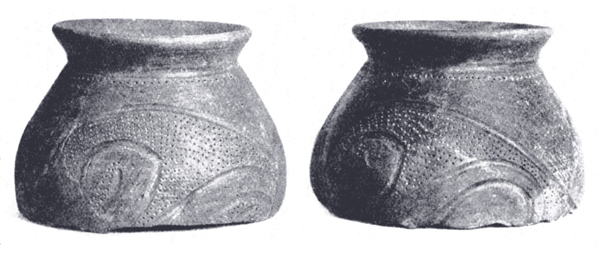
Today’s image for Day 226 of the VM_365 project shows two different views of the upper part of a Middle Iron Age pot decorated with geometric patterns in the distinctive continental La Tène style.
La Tène was a culture with its own distinctive decorative style which developed in Europe during the Iron Age and is named after the Swiss site where evidence of it was first discovered in 1857. The La Tène culture flourished in the area north of the Alps around Belgium, Eastern France, Switzerland, Austria, Southern Germany, the Czech republic, Poland, Hungary and Romania. Artefacts influenced by this style are found in Britain and parts of Ireland.
The vessel was found in excavations by Dr Arthur Rowe in 1924 at Tivoli, Margate and was probably made locally, influenced by the continental style. Other continentally influenced vessels have been found at Margate, with the pattern picked out in red paint, found at Fort Hill on the eastern side of Margate during excavations in the 2000’s.
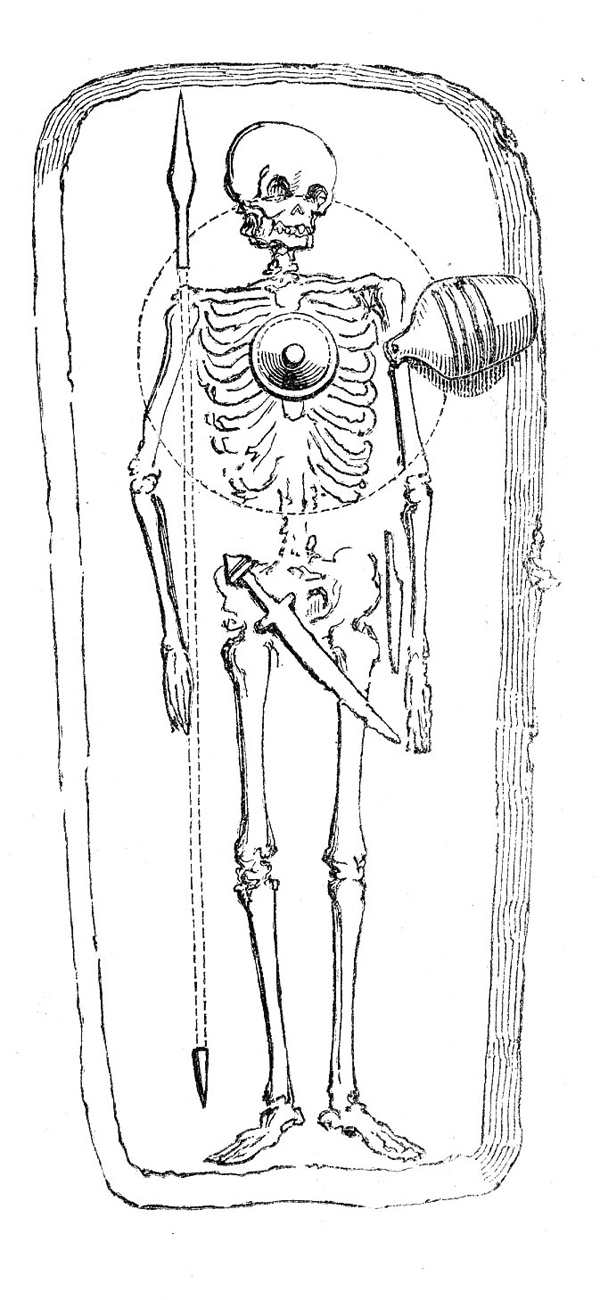
The image for Day 225 of the VM_365 project is an illustration of one of the Anglo-Saxon graves from Ozengell, Ramsgate drawn by F. W. Fairholt in the mid 19th century.
The Anglo Saxon cemetery at Ozengell was discovered in 1846. While workmen were digging a cutting for the new South Eastern Railway line from Ashford to Margate a large number of graves were dug through in fields near an Inn on the road to Canterbury from Ramsgate called Lord of the Manor. Many of the graves within the route of the cutting were destroyed and their artefacts sold off by the workmen before any record of them could be made.
However, William Rolfe, a Sandwich Antiquarian, managed to secure a number of the artefacts from the cemetery for recording and was able to arrange for around thirteen undisturbed graves to be opened for investigation by a group of antiquarians including Charles Roach Smith, Thomas Wright and the illustrator, F. W. Fairholt who drew many archaeological finds of the period.
Fairholt drew this image during his visit and it is an excellent representation of the layout of the one of the graves. The illustration shows the skeleton of a male, with the remains of a shield on his chest, a spear on his left side, an iron knife at his right hip, a short sword across his pelvis and a pottery vessel at his right shoulder.
The cemetery was not investigated again until over 100 years later, during the 1960’s, 1970’s and early 1980’s and most recently in 2013. Artefacts from graves investigated during the 1980’s have featured on Day 204,Day 206, Day 209 and Day 211 of the VM_365 project.
Fairholt’s meticulous attention to detail means that his contemporary grave plan gives a level of information comparable with those made over 100 years later.
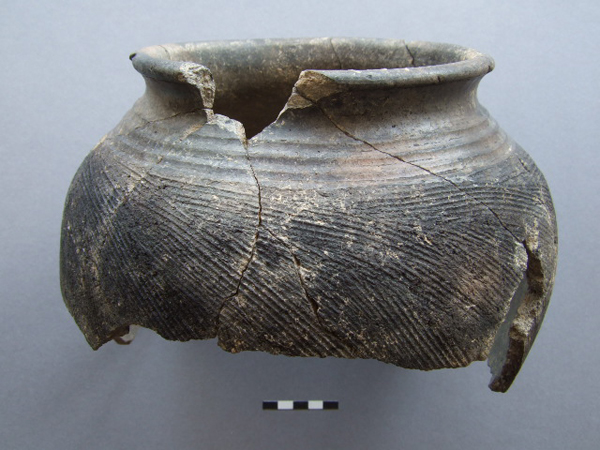
The jar rim is everted, a term that describes a curved or straight rim that leans outward from the upper edge of the vessel. The vessel has been decorated with three shallow horizontal grooves at the upper shoulder, which create the impression of raised beads. The rim and upper body are burnished to a low sheen and the lower part of the body is decorated all over with oblique curved stripes, formed with a narrow toothed comb.
Close examination of vessels of this type help to reconstruct the range of potting techniques and decorative schemes that were introduced in the Late Iron Age.
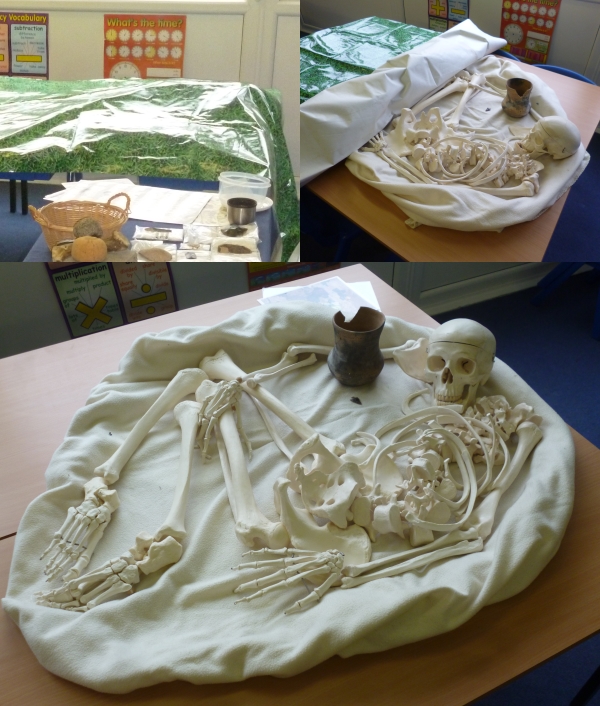 The image for Day 228 of the VM_365 project is of a resource the Trust has created for teaching some of the themes of prehistory in primary school workshops, a table top Beaker burial given its first trial recently at a primary school in Broadstairs. The tabletop layout includes a skeleton in a crouched position, accompanied by a replica Beaker vessel and a contemporary barbed-and-tanged arrowhead.