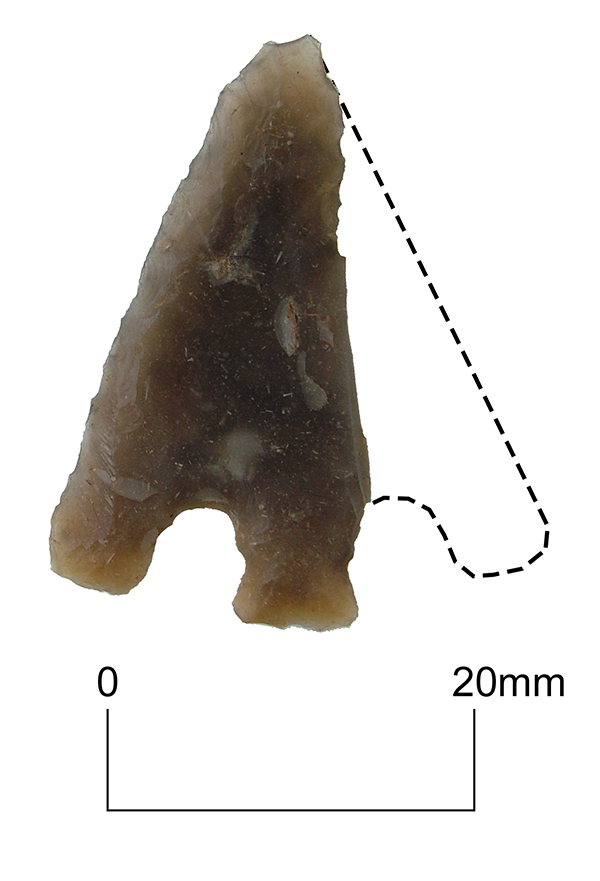
Today’s VM_365 Day 168 image shows a late Neolithic/Early Bronze Age arrowhead from Cliffsend.
This barbed and tanged arrowhead had broken along one of the barbs and instead of being discarded, the edge was retouched so it could be reused.
Other examples of flint objects that have been reworked into a useable object following damaged were posted for Day 165 and Day 50.
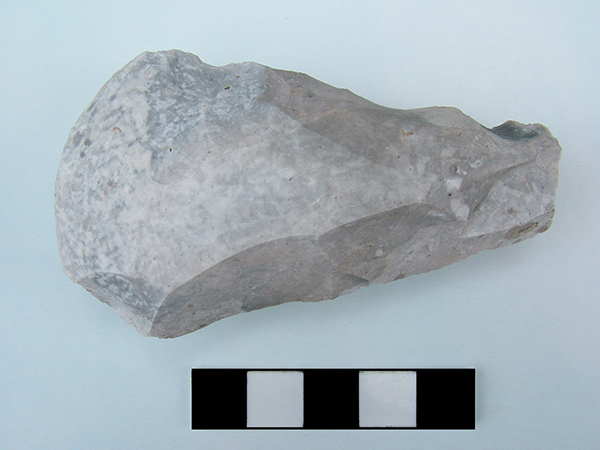
Today’s VM_365 image shows another Palaeolithic handaxe which was found in Broadstairs, half a kilometre north east of the hand axe featured in yesterday’s post.
The axe is of Cordate type and was found redeposited within the debris of an Iron Age hut floor.
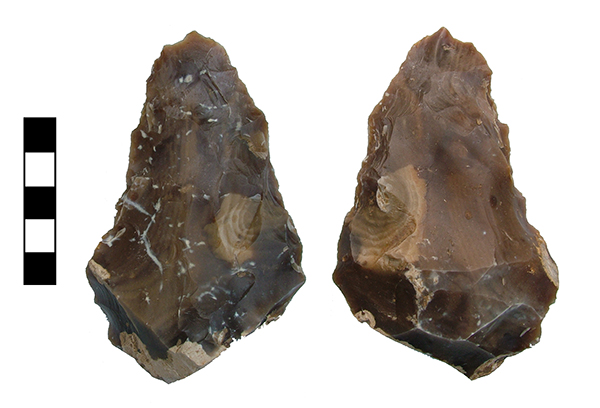
Today’s VM 365 image for day 166 shows the two faces of a small flint Palaeolithic hand axe which was found at Westwood, Broadstairs in 2000.
The axe is of Acheulian pointed heavy butted type and measures less that 10cm in length. It is unpatinated and is sharp on its edges and struck facets indicating that it had not moved far from the place where it was lost or discarded approximately 400,000 years ago.
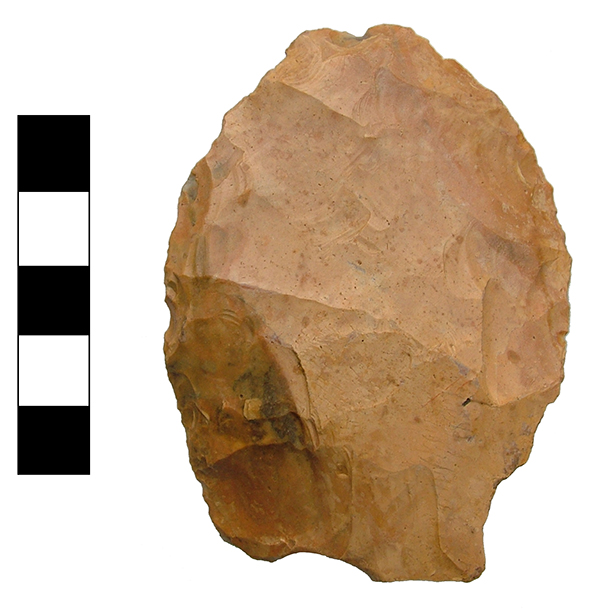
The image for Day 165 of the VM_365 project shows a reworked polished flint axe that was found in the primary ditch fill of a Beaker period barrow at North Foreland, Broadstairs in 2004.
This was originally a small polished axe that was reworked to make it usable after it broke at the butt end. The butt end was tapered to aid re-hafting and the cutting edge was re-sharpened.
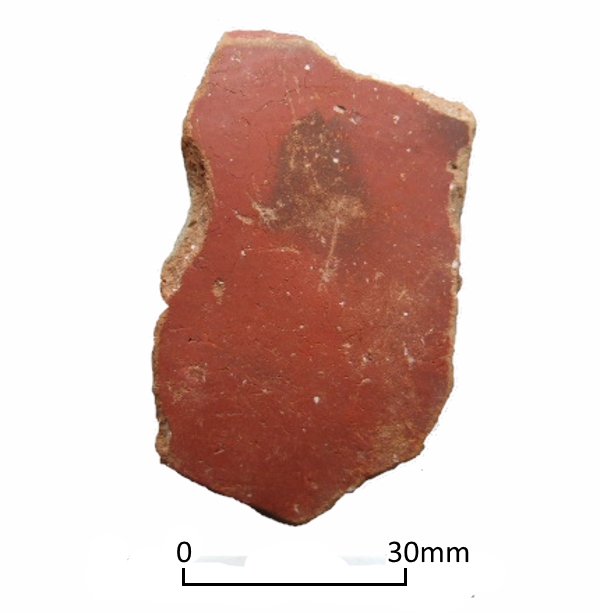
Today’s image is of a sherd of Earliest Iron Age pottery with a bright red finish applied to its outer surface. Around 900 BC, in the earliest phase of the Iron Age, a new technique was adopted by potters where vessels were decorated by applying iron-oxide powder as a slip to the outer surfaces.
The technique was only applied on thin-walled fineware bowls, which were most ike the bronze models. The sherd shown in the image is from a bowl found at Minnis Bay, Birchington which can be dated broadly to around 900 to 600BC .
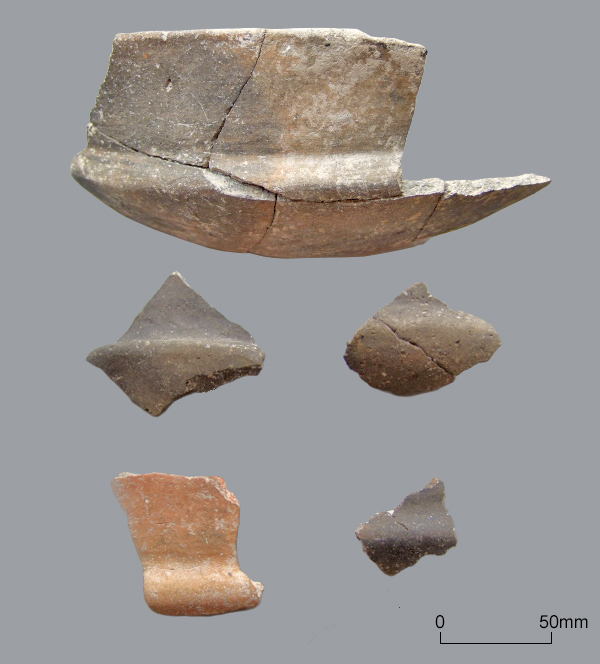
Early to Mid Iron Age fineware bowl with moulded shoulder, with sherds from similar vessels
Today’s image for VM_365 Day 163 shows some examples of a characteristic of pottery from the Early to Mid Iron Age period, dating around c.600-500 BC. This earliest phase of Early to Mid Iron Age pottery is epitomised by fineware bowls that have complex, moulded shoulders. The vessel form was based on examples that were coming in to Britain from North East France and other areas of the continent.
A fairly complete example of a vessel with this characteristic shape from Fort Hill Margate is shown at the top of the image. The four sherds below are from a series of other vessels showing variations of forms with the characteristic moulded shoulder that is typical of this period.
Vessels with this distinctive shape would not be easy to make, requiring careful and firm moulding at the shoulder junction. The pots frequently break at this point because the pieces of clay that make up the vessel’s body, formed of coils or slabs, are sometimes poorly joined together.
The bowl and sherds shown in the VM_365 image show how small, but very characteristic pottery sherds and fragments can be used to identify the potting traditions form a specific period that are represented among the many sherds that may be present among the finds recovered from an excavated feature, or in the assemblage of pottery from a site.
The VM is grateful to Nigel Macpherson Grant for the images and information for today’s post.
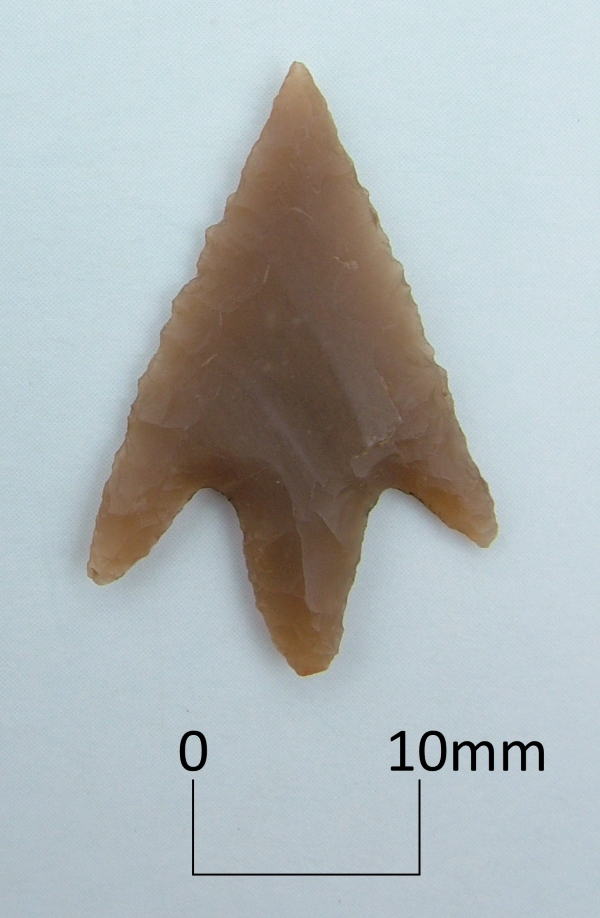
The image for Day 162 of VM_365 is of another fine example of Early Bronze Age flint work from Thanet. This barbed and tanged arrowhead was found at Draper’s Mill, Margate in 1980, as a residual object recovered during the excavation of a Roman building.
This tiny object embodies all the skills of the Early Bronze Age flint knappers who could create such a well proportioned and symmetrical tool through the careful flaking of tiny chips from such a small piece of stone.
Other similar barbed and tanged arrowheads have featured in earlier VM_365 posts, arrow heads found with a burial close to QEQM Hospital featured in VM_365 Day 24 and an arrow head found in excavations at Lord of the Manor, Ramsgate was shown as VM_365 Day 141 .
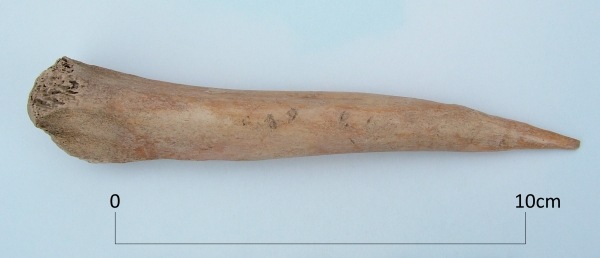
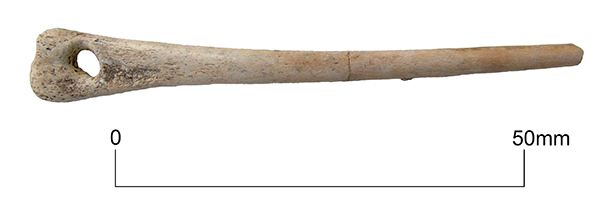
Today’s VM_365 image shows a skewer roughly fashioned from a small animal bone.
This object was found within a Late Iron Age hut floor at Ebbsfleet, Thanet in 1990. The hut floor was made up of a 15cm thick layer of flint pebbles which was covered with a deposit consisting of pottery dating to the late Iron Age, many animal bones, some of which had been roughly fashioned into skewers or awls, a clay spindle whorl and marine shells.
It is not clear what this object would have been used for. Perhaps it was used for extracting marine molluscs from their shells, perhaps it was used in some way during weaving, or perhaps it was a general purpose tool that could be quickly fashioned and used in a myriad of ways.
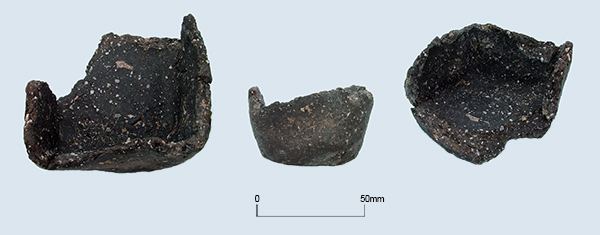
Today’s image for Day 157 of VM_365 shows three views of an interesting square pottery vessel, which may have been used as a salt container.
The square pot is made of a thick, flint tempered fabric, fired to a dark brown to black colour. The flint tempering can be seen in section where parts of the wall of the container have broken. The container was found at the Iron Age coastal site at South Dumpton Down, Broadstairs where concentrations of post holes within a boundary enclosure seem to represent the focus of the settlements within the enclosure. The square vessel was found within the fill of one of the main groups of post holes.
The suggestion that this was a salt container was made by the ceramic specialist, Nigel Macpherson-Grant in his report on the pottery. Because it is essential to the biological functions of livestock, and a valuable method of preserving produce to extend its life, salt was a valuable commodity in the Iron Age period, as it was throughout history. Salt may have been extracted from the sea water near to the settlement.
Today’s VM_365 image is of an Iron Age bone pin excavated from a pit at Dumpton Gap, Broadstairs in 1994.
The pit had been used for the disposal of domestic refuse which included animal bone, quern stone fragments and sherds of pottery dating to the Early Iron Age before being used to bury a single adult individual in a similar way to the burial at North Foreland.
The bone pin, possibly used to fasten a cloak, was found at the left shoulder of the skeleton, fragments of an Iron buckle were found at the right shoulder.