Category Archives: Archaeology

VM_365 Day 152 Chatelaine and keys from Sarre

VM 152

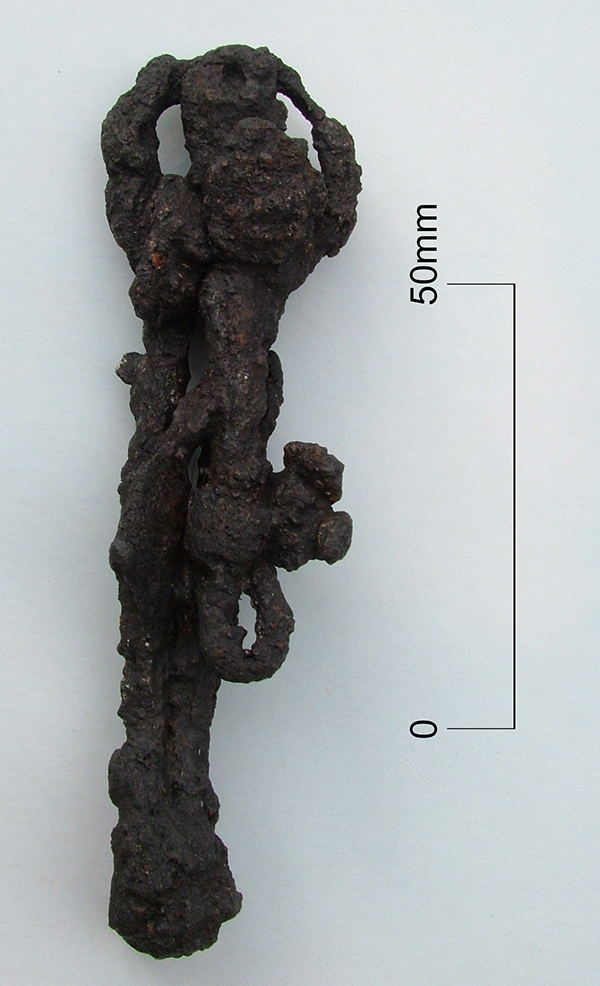
Today’s image for VM_365 Day 152 shows a heavily corroded iron châtelaine ring holding two iron keys or latchlifters which were excavated from grave 277 at Sarre in 1990.

This grave was undisturbed. Because of its small size and the lack of survival of much of the bone. was interpreted as the grave of a child, probably female.  Along with the châtelaine and keys, a bottle vase and an iron knife were also found accompanying the individual in the grave.

The two keys or latchlifters were suspended from the iron ring and were accompanied by a hook ended object with a sliding fitting on its shaft, which may be a keeper designed to hold the  châtelaine fast to a girdle when it was worn around the waist.
VM_365 Day 151 Anglo Saxon Iron Knife from Sarre

VM 151

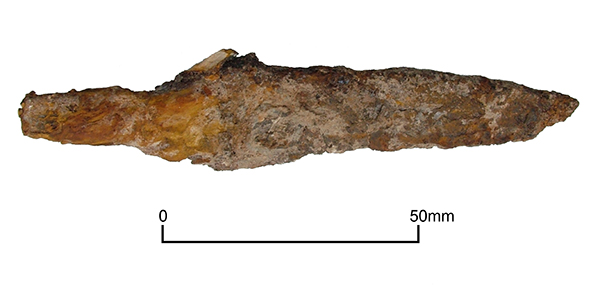
Our image for VM_365 Day 151 shows one of the most common artefacts excavated within Anglo Saxon graves; an iron knife.

Iron knives are often found in both male and female graves and come in many different types. This example was found in grave 279 at Sarre excavated in 1990. The grave it was found in had been heavily disturbed, probably through contemporary grave robbing. Skeletal material of four individuals was found scattered throughout the grave fill suggesting that the grave may originally have held multiple occupants.

Although this knife is heavily corroded you can clearly identify the tang and the blade. This knife originally had a wooden handle into which the tang fitted.  Iron knives from Anglo Saxon graves have been classified according to their size and shape by Vera Evison. This knife is of a late 6th to 7th century type and conforms to Evison’s type 1 classification.


VM_365 Day 150 Gold looped pendant from Sarre

VM 150-1

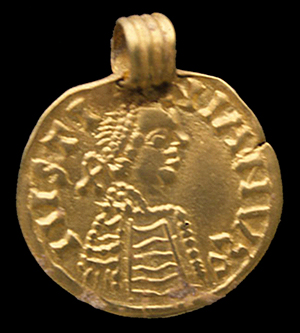
Today’s VM_365 Day 150 image shows a gold pendant excavated from an Anglo Saxon grave  at Sarre in 1990. The pendant is no longer in our possession and the image above was taken at the time of the excavation.

The large, well cut grave (grave 286) had been disturbed by grave robbing in antiquity and skeletal material, objects and fragments were scattered throughout the fill.  The skeletal material that could be identified indicated that the skeleton was of an adult and the grave goods suggest that it is likely to be an adult female. Objects found within the grave included a silver and glass keystone pendant, an iron key, iron knife, amber and glass beads, a bronze casket handle  and a Bronze key.

The pendant, weighing 1.63 grammes, is a made from a gold tremissis; a 6th century Merovingian coin that has had a  hanging loop added. The coin was minted in Austria or Burgundy in the name of Justinian I (527-565 AD) and its composition  has been measured using X-ray fluorescence spectrometry comprising 85.6% gold, 11.9% silver and 2.35% copper.

Reference

Perkins, D. R. J. 1991. The Jutish Cemetery at Sarre Revisited: A Rescue Evaluation. Archaeologia Cantiana CIX pp139-166


VM_365 Day 149 Silver Square Headed Brooch from Sarre

VM 149

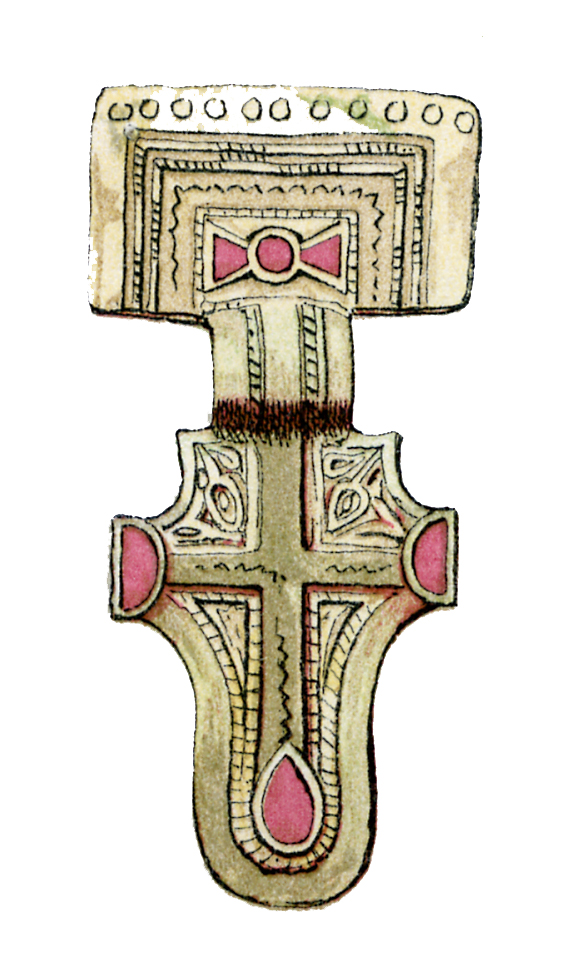
Today’s VM_365 image for Day 149 is of an illustration of a late sixth century,  silver, small square-headed brooch found in Grave 4 at Sarre by John Brent in 1863. This coloured illustration was published in 1863 in an account of the Kent Archaeological Society’s researches of the cemetery at Sarre.

The brooch is very similar to the example found in 1982 during the excavation of the Monkton Gas Pipeline which we posted for Day 147.

It is suggested that both brooches, as well as an example from Bifrons, Howletts all came from the same workshop and although very similar, they vary in slight details and do not come from exactly the same mould.

This brooch was found in the grave of a female along with a Great Square Headed brooch, a bell beaker, weaving baton, crystal ball and spoon, gold braid and other smaller items.

References

Brent, J. 1863. Account of the Society’s Researches in the Saxon Cemetery at Sarr, Part 1. Archaeologia Cantiana V, 305-22.

Perkins, D. R. J. and Hawkes, S. C. 1984. The Thanet Gas Pipeline Phases I and II (Monkton Parish), 1982. Archaeologia Cantiana CI, 83-114.


VM_365 Day 148. Medieval Jug from Margate

VM 148

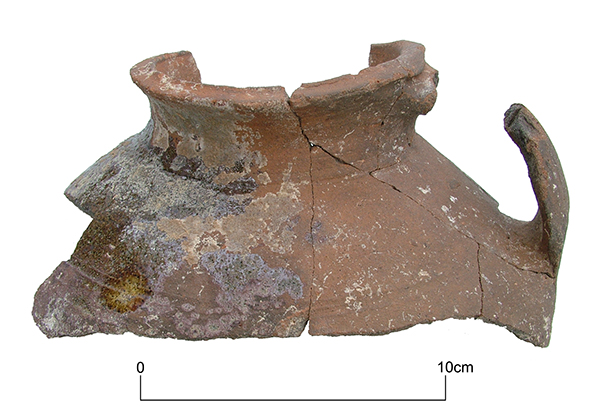
Today’s Day 148 VM_365 image shows part of a medieval jug excavated from a pit at East Northdown, Margate in 2003.
The upper part of this later 14th century globular bodied jug was found in 17 pieces within the fill of a pit, much of it is missing, including part of the handle, but enough was present to reconstruct the upper part of its profile. The jug was manufactured in Canterbury and is made of Canterbury Tyler Hill sandyware with a date range of c.1350-1400/1425 AD.

VM_365 Day 147 Silver Square Headed Brooch from Minster

VM 147

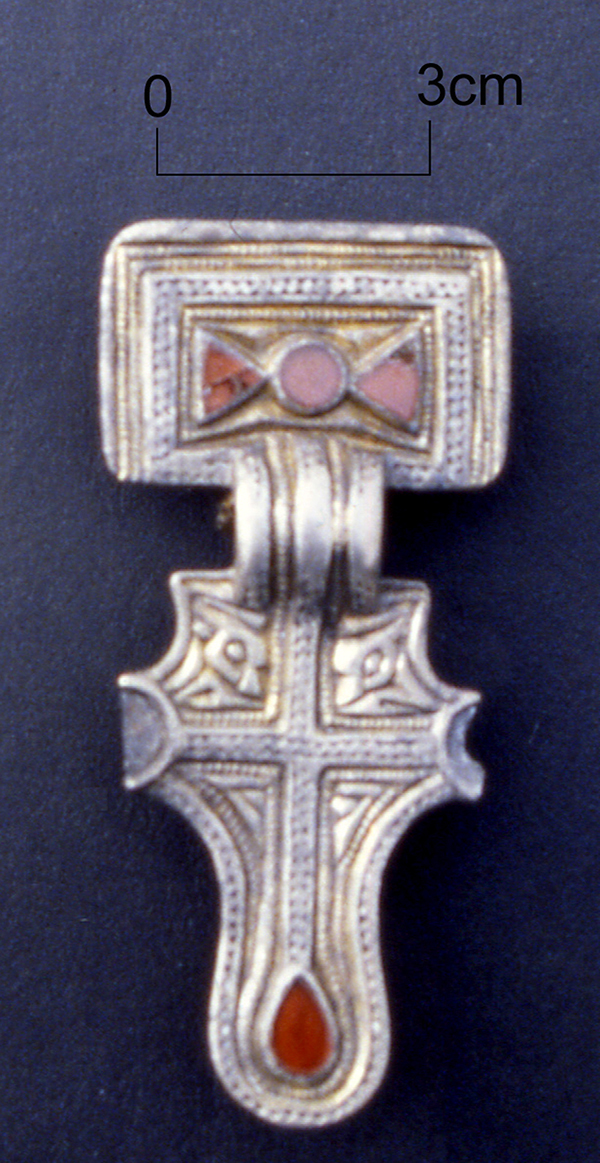
Today’s image for VM_365 Day 147 is a small silver square headed brooch excavated from an Anglo Saxon grave at Monkton near Minster in 1982. The brooch is no longer in our possession and the above photograph was taken in 1982.

The brooch was found in the grave of a female buried in the second third of the sixth century. Remains of gold threads similar to those found at Sarre were found on the skull and other finds included a bronze ring for a purse or bag at her waist, a bronze buckle and amber beads over her upper body.  The brooch was found on her left shoulder.

The brooch is made of silver with gilding applied by mercury amalgam. It is a Kentish type with similar brooches found at  the cemeteries at Sarre and Bifrons and may have been worn alone as a cloak fastener.


VM_365 Day 146 Small Saxon jar from Westgate

VM 146

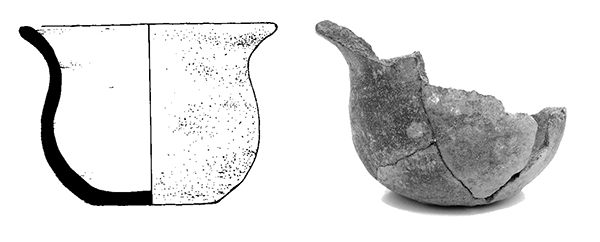
The image for VM_365 Day 146 shows a mid Saxon handmade jar and its illustration from a site near St Mildred’s Bay, Westgate which was excavated in 2006.

The small handmade jar has an everted-rim and is made in a rough patchy grey/black fabric  with a hard ‘gooseflesh’ finish. It is encrusted internally with lime. The external rim diameter measures 100mm. It is an example of an ‘Ipswich’ type ware, characteristic of c.AD.750/75-850 dated assemblages from East Kent.

The jar was found in the same pit as the large fragments of daub shown in Day 145’s article.

VM_365 Day 145 Mid Saxon clay daub from Westgate.

VM 145

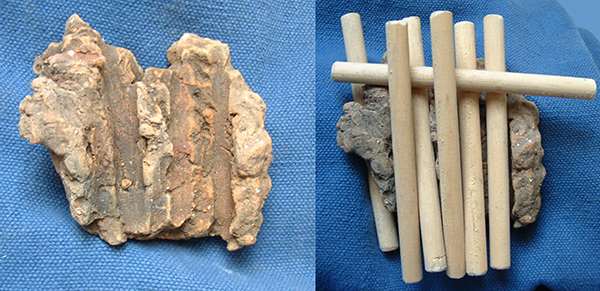
Today’s image for Day 145 of VM_365 shows one of the large fragments of daub which was excavated from a mid Saxon site near St Mildred’s Bay, Westgate in 2006.

The picture on the left shows a fragment of daub measuring approximately 15 cm high and you can clearly see the impressions left in the daub from the wooden rods and sails which formed the structure that it covered. The picture on the right is a reconstruction of where the rods and sails would have been placed, using similar diameter pieces of wooden dowel.

These fragments of daub were redeposited in a pit and mixed with a dark grey sooty soil, there was no evidence for an in situ structure. This deposit of daub appears to be from a demolished structure used to fill this pit, possibly used as packing to create a post pad or platform. Other finds from this pit included burnt chalk, burnt flint, animal bone and five sherds of pottery from the same small handmade jar.

We do not know what the original structure would have been but it could have been part of an oven or kiln.


VM_365 Day 144 Anglo Saxon bone pin beater from Westgate

VM 144

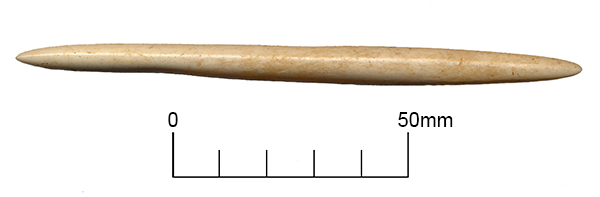
The image for Day 144 of VM_365 is of a bone double ended pin beater found in the fill of a pit at a small middle Saxon site excavated near St Mildred’s Bay,  Westgate in 2006.

Pin beaters were used to beat down threads while using a warp weighted loom.

The pin beater  is made of bone or ivory and measures 121 mm long, 3mm at its narrowest point at the end and 8mm at its widest point at the centre. It has an ovoid, slightly flattened profile and has been polished through use to a very smooth and glossy finish. Both ends have been carved to form a point.

This pin beater was found in the fill of a rectangular pit along with fragments of burnt daub, animal bone and marine shell, as well as a single pottery sherd from a jar dating between 450-700 AD.

Other finds from the same site included large fragments of burnt daub with rod and sail impressions and an iron lock mechanism possibly from a chest or casket.


VM_365 Day 143 Roman Personal Grooming set from Minster

VM 143

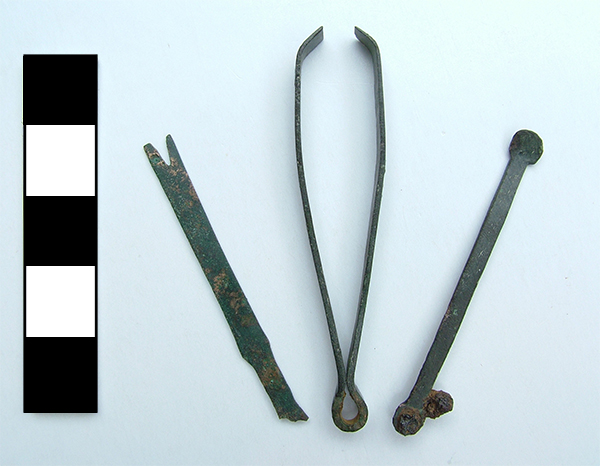
For Day 143 of  VM_365we have an image of a Roman personal grooming set excavated from the villa at Minster in 1997.

This set, all made from copper alloy, comprises (left to right) an instrument for cleaning fingernails, tweezers and an ear scoop or cosmetic spoon. The three items would have been suspended together with an iron loop, traces of which you can see adhering to the end of the ear scoop and inside the end of the tweezers. The end of the nail cleaner has broken but you can just make out the curve where the hole for the ring was.

Personal grooming sets such as these would probably have been used by both men and women and are commonly found on both settlement sites and within graves.