Category Archives: Roman

VM_365 Day 32 Pottery from a period of change – Iron Age people become Romans

Locally made pottery Jar, encapsulating the transition from Iron Age to Roman culture

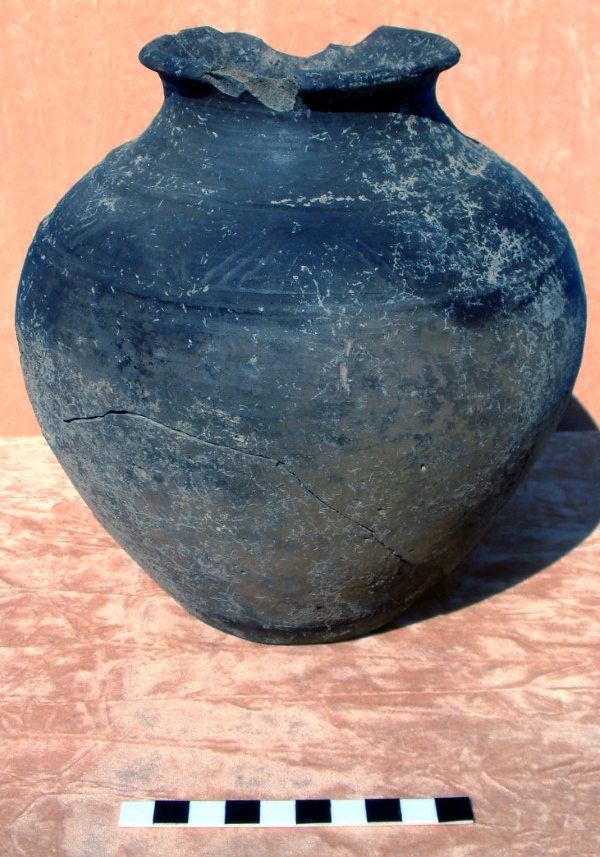
Today’s image for Day 32 of the  VM 365 project is of a pottery vessel dating from an interesting period in history which is well represented in Thanet’s archaeological record, the later stages of the Roman conquest of Britain (50-75/100 AD).

Dating from a period when Late Iron Age pottery traditions were giving way to new Romanising production techniques, this near complete jar in a pottery fabric known as Thanet silty ware is decorated with raised beads and a chevron pattern around the upper part of the body. This particular vessel dates no later than 60-75 AD, a couple of decades after Britain was invaded and occupied by Roman forces.

The jar was recovered from the fill of a pit (cut 216) at an excavation at a site in Sea Parade, Birchington, it  survived almost intact with only one large crack in the body of the jar and some damage to the rim. Characteristically for this type of vessel it has been deliberately made with three holes in the base, much like a modern flowerpot.

The many complete or near complete vessels of this period that have been recovered in excavations carried out at Minnis bay, particularly those of Antoinette Powell-Cotton in the 1950’s and 1960’s. The pottery sherds and vessels from these sites  have been the foundation for classification and dating this important sequence of  pottery, which spans a time of major cultural change.
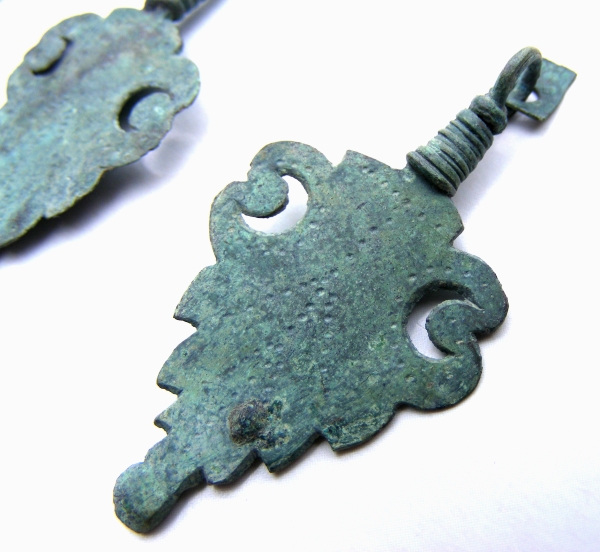


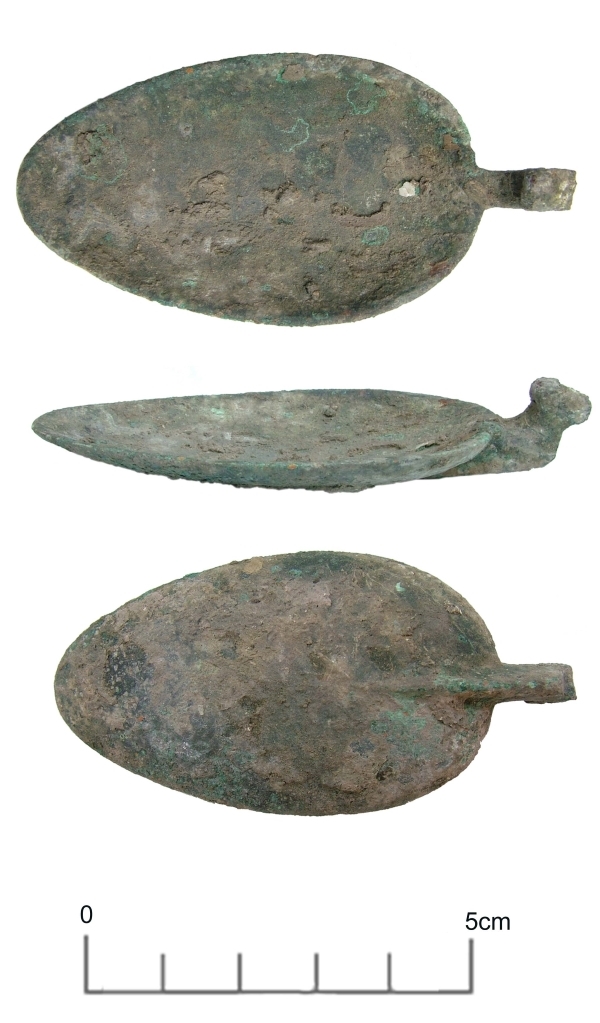
VM_365 Day 23 Roman Spoon

VM_23Just how old are spoons? A spoon (apart from a knife) is probably the oldest utensil known to man, being used to scoop up food to eat and for mixing and measuring. The oldest spoons were probably just scoops made from shells, later developing into purpose made scoops with handles and made from wood and bone. Some of the earliest known spoons with handles dating from around 1300 BC have been found in ancient Egyptian tombs and are carved from ebony and ivory.
Our copper alloy spoon bowl, found in a Roman building at Broadstairs in 2004, is much younger, dating to the late second century AD and is without its handle. It was found associated with an oven on the floor of the cellar in a thick sooty deposit that also contained pottery, iron nails, rings and fittings as well as a Roman military belt buckle suggesting that old timber and even clothing was being used to fuel the fire.

You can read more about the site in Moody, G. 2007. Iron Age and Roman British Settlement at Bishop’s Avenue, North Foreland, Broadstairs. Archaeologia Cantiana CXXVII

VM_365 Day 17: The Boxer

VM 17

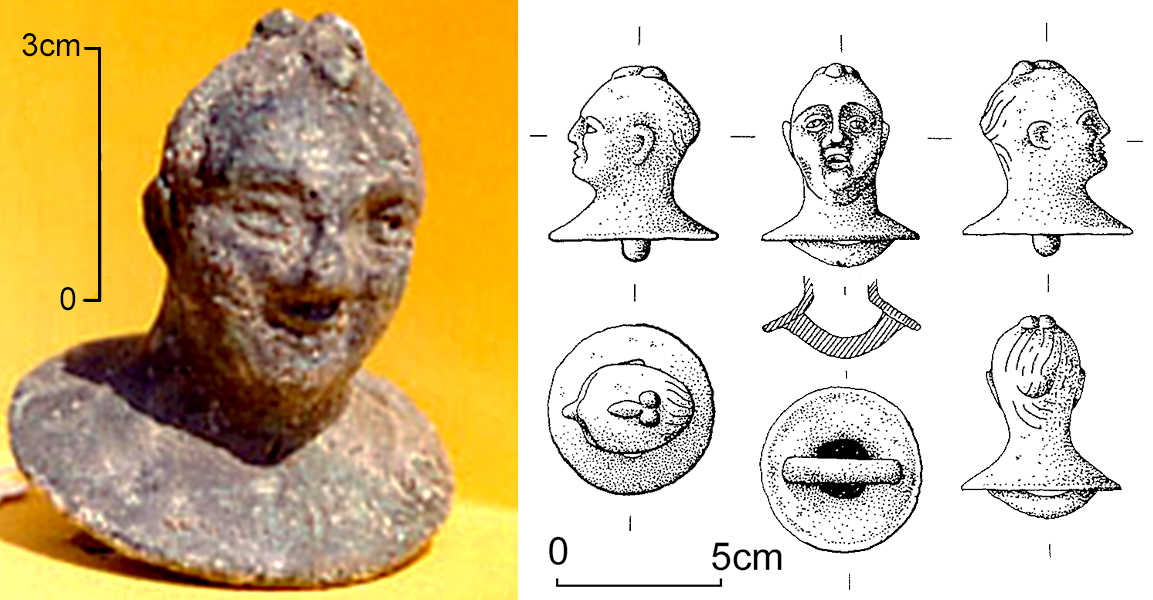
Today’s photo is from the large archive of slides we have from excavations dating back as early as the 1970’s many predating the Trust for Thanet Archaeology. This slide shows a Roman Bronze, no longer in our possession, excavated in 1981 by the Isle of Thanet Archaeological Unit, from a second century chalk quarry at St Peter’s Footpath near Draper’s Mills, Margate.  Alongside the slide are Dr Dave Perkins’ illustrations which show it in more detail.
The head is bald and shows a lock of wavy hair at the back. There is a phallus and a pair of testicles modelled on top of the head; a symbol used to ward off the ‘Evil Eye’.
The head is hollow and measures 63mm high with a 50mm diameter base. It was probably a decorative mount for a horse harness and intended as a good luck charm.

The full details of the Boxer were published in Kent Archaeological Society’s journal Archaeologia Cantiana 97 pages 307-311 by the late Dr David Perkins.

VM_365 Day 4

Is this Thanet’s earliest art?

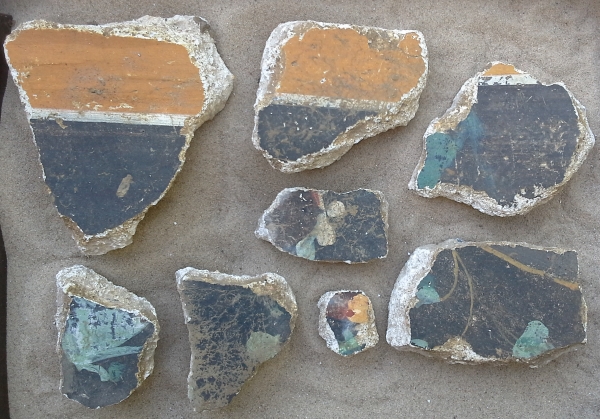
Following on from yesterdays image, today’s VM_365 picture is of some fragments of painted plaster found at the Abbey Farm Roman Villa at Minster in Thanet.

VM 4
Painted wall plaster from Abbey Farm Villa, Minster-in-Thanet

We have over 7,500 pieces of painted wall and ceiling plaster from the site ranging in size from a few centimetres to roughly the size of an A4 page.

As the technique used here was fresco, where the paint was applied directly to fresh plaster, we know that the artist who painted these designs must have been on the Isle of Thanet carrying out the work. This makes them one of the earliest artists in the area.

Visit the Virtual Museum to see some of the other pieces of plaster from the site.

VM_365 Day 3

Fragment of Romano-British mosaic
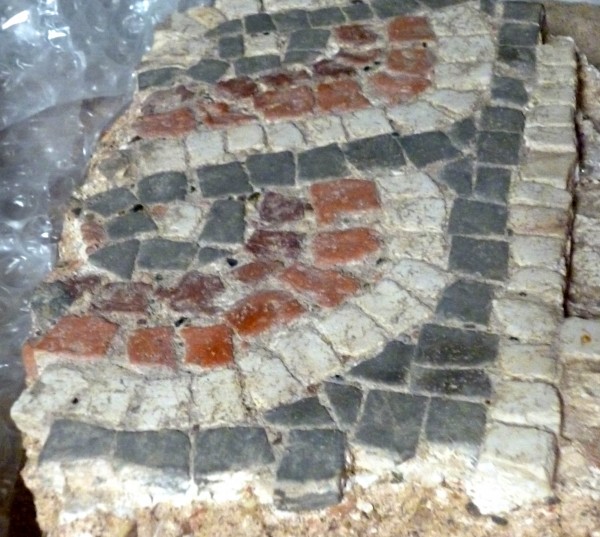
Fragment of Romano-British mosaic from Minster in Thanet

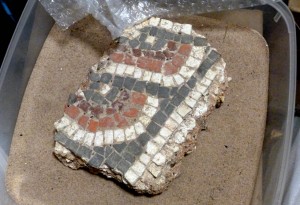
The image for our VM_365 project today is of a fragment of Roman Mosaic with part of a guilloche pattern that was found in the excavation of a Roman Villa at Minster in Thanet.

One of the most impressive Roman buildings to have been discovered on the Isle of Thanet to date and almost certainly on of the most important places in the area in the Roman period.

VM 3-1
Mosaic fragment in its storage container

Several of these small fragments of Mosaic from the excavation are in storage, but there were no floors of any size surviving in the excavated remains of the villa. The pieces we have survived because they had been broken up and had fallen into a deep chamber within the northern apse of the building.

2001_0101_000620AA
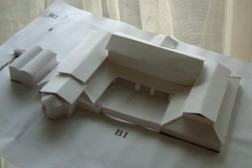
This architectural model is one of our attempts to show what the building was like in one of its major periods of use.

It is useful to try to reconstruct the shape and size of the Villa building with its main range, wings and detached bath house building, which was served by its own piped water supply.

With only the ground plan visible from the robbed remains of walls it is difficult to know exactly what the structure of the building was like, but with the few mosaic fragments we have, we can at least assume that like other buildings of the period it had several of these grand decorative surfaces. The full history of the building and the details of exactly who may have lived in and around it will probably remain unknown.