Category Archives: Places

VM_365 Day 198 Middle Iron Age painted pottery

Image of Iron age paint decorated pottery
Early to middle Iron age polychrome decorated pottery

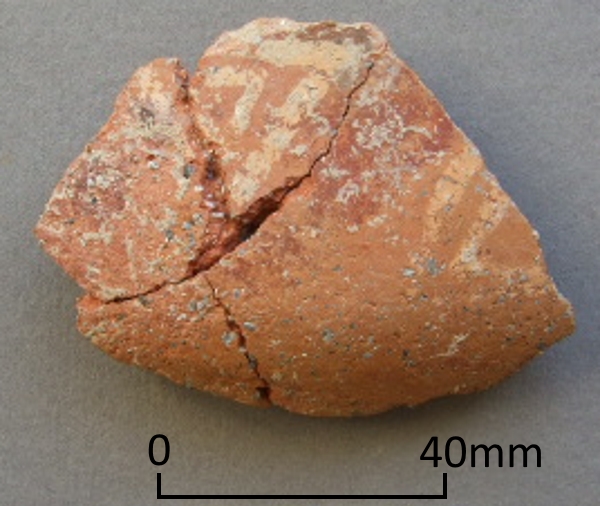
The image for Day 198 of the VM_365 project is of a sherd of multi-coloured or ‘polychrome’ decorated fineware pottery, dating from the Early to Middle Iron Age.

This group of conjoining sherds from a small-diameter beaker or round bodied jar, made in a fine fabric, was found at Sarre in 1991. The exact dating could be narrowed down further in the future, but it can be safely dated to between  around 450-350 BC.

The body of the vessel is painted with a triangular or chevron decoration in cream to white pigment.  The triangles are infilled with red iron-oxide pigment. This fragment of vessel is probably the best example that we currently have of this type of polychrome decorated pottery from Thanet.

Although only a small fragment of the pattern is present, it is possible to reconstruct the shape of the body of the pot from the curve of the sherds and to imagine how the pattern extended over the whole surface of the  exterior of the vessel.


VM_365 Day 197 Fragments of Late Bronze Age Sword from Manston

VM 197

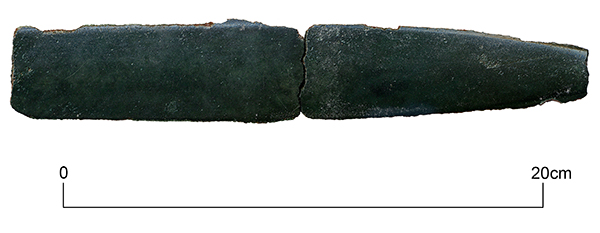
Today’s  image for Day 197 of the VM_365 project shows two fragments from a sword blade found as part of a Late Bronze Age Bronze Hoard at Manston in 1994.

These two joining fragments of a leaf-shaped sword blade were found along with the narrow -bladed palstave axe and pegged spearhead shown in previous VM_365 posts. Traces of the ground edge of the sword  can just be seen on both fragments.

VM_365 Day 195 Another reconstructed Jar from the Roman Kitchen at Broadstairs

VM_195

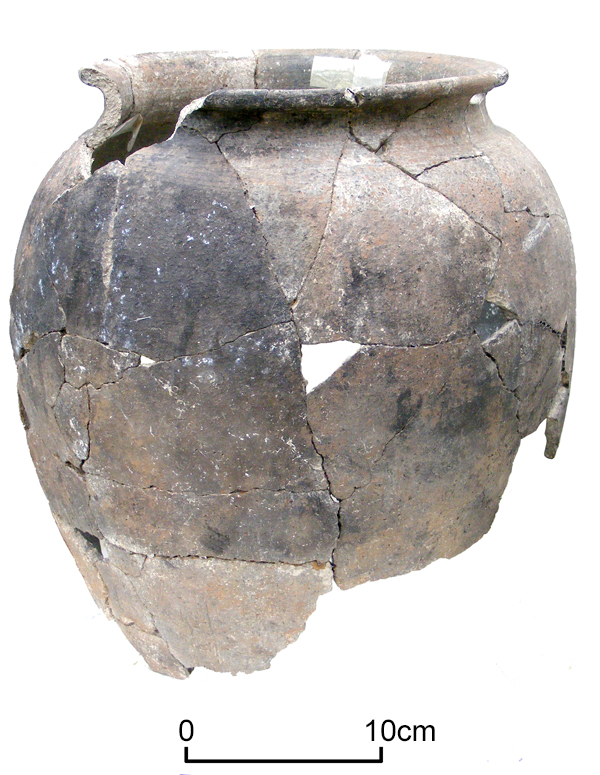
The image for Day 195 is of another vessel from the Roman Kitchen found in the remains of a Roman building excavated at Broadstairs, a Knife-trimmed necked-jar in a grey-black Native Coarse Ware with grog and sand filler. The diameter around the exterior of the rim is 240 mm. and the surface is fired grey with patchy black and pink surfaces. This particular style of vessel can be dated to around 170-250 AD.

One hundred and twenty fresh sherds from the vessel were recovered from the thick deposit of pottery, making up nearly three quarters of this pot. Previous VM_365 posts have shown how vessels from the thick layer of pottery in one context have been reconstructed and this is the last of large jars that has been carefully pieced together by one of the Trust’s volunteers.

Like many of the other pots recovered from this deposit, the vessel appears to have been deliberately destroyed. A series of holes has been punched along the widest part of the body, as if the pot was systematically pierced with a thin rod or blade. Reconstructing the vessels has shown this pattern of holes punched with  sharp object to be preserved in the distribution of sherd breaks in several of the larger pots and a moratorium recovered from the deposit.


VM_365 Day 192 One tool, many styles in range of Mid Iron Age vessels

Comb and impress decorated Middle Iron Age sherds from Thanet
Today’s image for Day 192 of VM_365 shows several sherds of decorated Early-Mid Iron Age ceramic vessels, dating from c.550-350 BC.
All the sherds are from relatively high quality vessels, finewares or sub-finewares , which have been decorated with either comb-point, comb-finished or impress-decorations.
The sherds were all found on excavations in Thanet, (shown clockwise from top left) from Margate, South Dumpton Down near Broadstairs and two from Fort Hill and Trinity Square in Margate.

The images illustrate the variety of decorative styles that could be created using a comb, or with a regular impressed pattern,

and illustrate the care that was taken over decorating the better quality pottery vessels in this period in prehistory.

VM_365 Day 191 Candelabra design Roman Painted Plaster

VM 188

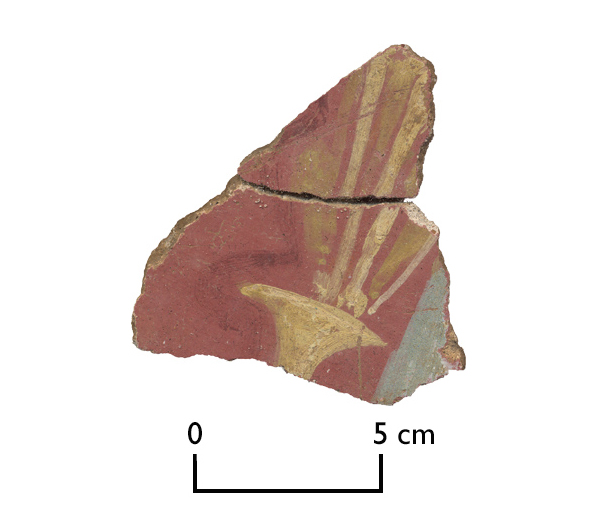
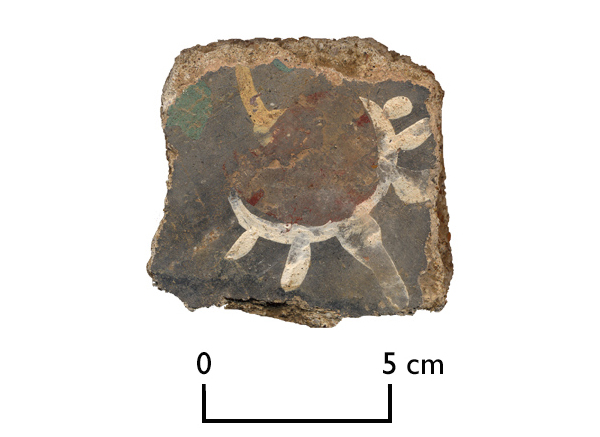
The image for Day 191 of the VM_365 project shows another example of a fragment of painted plaster from the Roman villa at Minster. Other examples of fragments of painted plaster have been featured on Day 178, Day 182 , Day 185 and Day 188.

This fragment shows part of an elaborate candelabra type design painted in yellows and white against the smooth red background, a darker red outline can just be seen on the left hand side of the motif. The greenish blue paint on the right hand side may represent part of a border or alternativley may be part of a foliage design. Candelabra designs are well known in the Roman world and examples of similar themed designs have been found at Verulamium and London.

VM_365 Day 190 Roman baby feeding bottle spout

VM 190

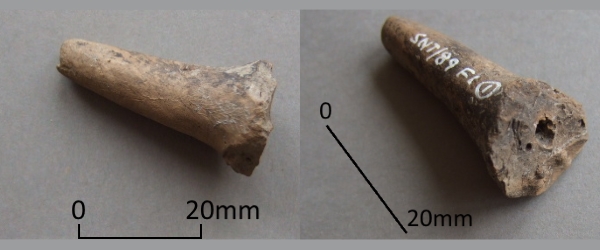
The image for VM_365 Day 190 shows two views of a small ceramic object, found in an excavation at St. Nicholas in Thanet, which has an interesting and perhaps unexpected origin.
The image on the right  shows that the object is hollow, so likely to be some form of spout. At the bottom right of the flat end are four little ceramic pins, that were used to key the spout on to the body of a vessel .
The object can be identified from other examples as a spout from a baby feeding bottle, dating to the Mid Roman period, probably the later second century AD.  Baby feeding bottles of many different shapes and forms are known from many periods in history. The spout would have been be attached to a small round-bodied pot, which was comfortable hold in the palm and fingers, probably with a flat base to allow it to put down to stand without spilling the contents.
This object is perhaps one of the most interesting examples of the way that humans have created objects to supplement or even replace natural processes. In this case the object may have been used in circumstances where perhaps natural feeding was not possible, extending the potential of a baby to survive and grow.
The pottery fabric  suggests that the vessel may have been made by Romanised indigenous people, rather than by Roman Gauls or even Romans from Italy.  Perhaps the pre-Roman people had their own ways to feed babies, but in this case they seem to have adopted Romanised version of the baby feeder.

VM_365 Day 188 More painted plaster from Minster – Artist(s) unknown

VM 365 191

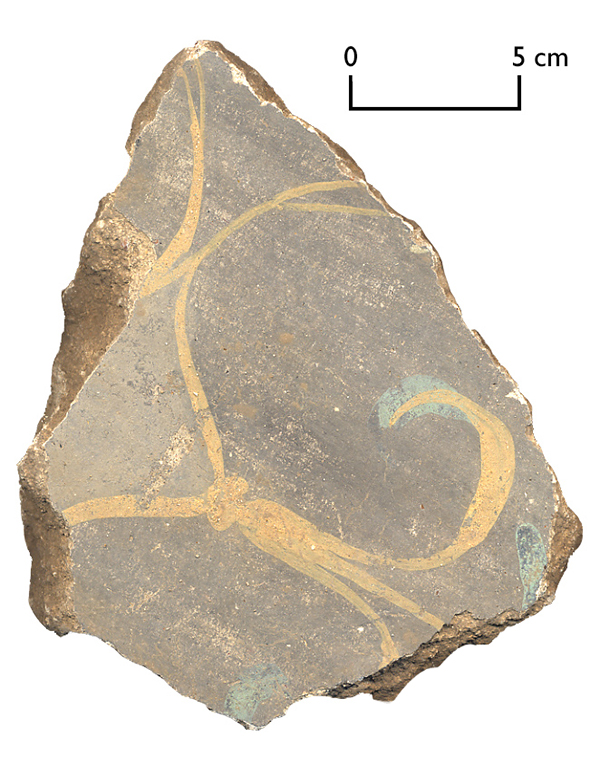
For Day 188 of the VM_365 project the image shows another fragment of the painted plaster from Minster. This time showing a delicate yellow painted swag painted overpainted on a dark blue grey background. The centre of the swag is filled with a lighter  blue grey pigment. An abstract leaf is  picked out in green paint under the end of one of the finer swags, which are probably meant to suggest the stems of a plant.

Perhaps we should pause to consider the artist who painted these freehand patterns. Each of the patterns is painted using a ‘fresco’ type of technique where the paints are bonded into a fine layer of plaster skim over the thick coat that covered the walls below. These thin plaster layers and all the patterns would have had to have been applied and painted in a single process, perhaps in sections over the space of a whole room, and then over the extensive area of the villa.

Although to our eyes the painting can sometimes appear gaudy, there are sections of delicate painting that indicate skill and control of pigments and drawing. Perhaps there was a team of painters with some delegated to covering large areas of ground with colour washes, borders and easily produced geometric patterns and borders.  Perhaps only a master-painter would have been trusted to produce the finer free hand elements and the figurative work that lifted the panels into a higher artistic plane.

In later centuries the master painters of Fresco painting have become household names, yet the paintings and painters who contributed to the Minster Villa, although perhaps equally skilled, are largely forgotten.

VM_365 Day 185 Roman painted plaster inspired by nature

VM 185

The image for Day 185 of the VM_365 project shows another fragment of painted wall plaster from the Roman villa at Minster. Fragments of painted plaster from the same site were featured on Day 178 and Day 182.

This fragment of decoration depicts a seed head or flower, painted on a dark grey background. The edge of the flower or seed head has been painted in white with a yellow stem. The internal part of the flower may have originally been painted the same colour as the stem  with additional detail in dark red although the paint is now worn away. Green leaves, possibly extending from the stem can be seen on the edge of the fragment.

In contrast to the figurative painting of the Deer shown on Day 178 and the architectural emulation of marble shown in Day 182, this fragment shows an abstraction from nature where a natural object has been used to inspire a painted motif.

VM_365 Day 184 Kilns, malt, sugar and beer in the Roman period

VM 184

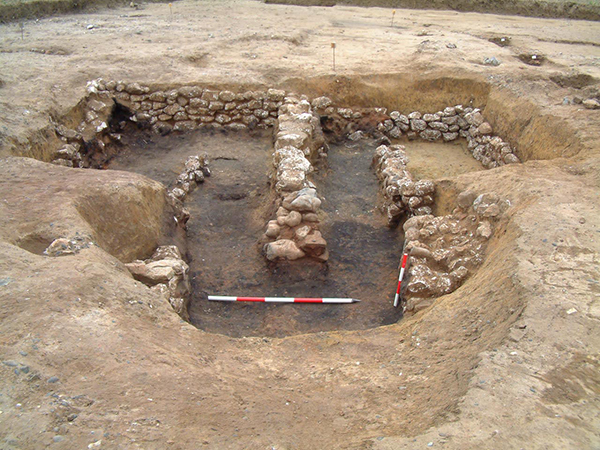
Our image for Day 184 0f the VM_365 project is of one of the later buildings associated with the Roman Villa at Minster which has featured in a number of previous posts about important finds and artefacts that have been discovered at the site. The picture shows the two chambered furnace of a kiln that was built in the open space of the courtyard to the south of the main villa building, toward the end of the period of occupation on the villa site at the end of the 3rd century AD.

In the picture the furnace is viewed from the stoke hole across the two chambers of the kiln.

The structure was created by lining a rectangular pit that was cut into the natural clay geology with walls formed of chalk blocks. The central dividing wall was constructed partly of chalk blocks with some large rounded beach cobbles. The chalk walls were coated internally with clay, which had been fired into a hard surface by the hot air running from the stoke hole through the chambers and out through some form of chimney or vent on either side  At some point one of the two chambers had been blocked and abandoned. Post holes aligned with the outer edges of the furnace demonstrated that it originally stood at the north east end of a post built barn. What had this structure been used for?

Within the soot filling the chambers were burnt grains of wheat and other cereals which suggest it was used for processing these staples of Roman agriculture. Buildings like this are often called ‘corn-driers’, but in the Roman period it would not have been necessary to reduce the moisture content of grain for storage in bulk, as is the practice in the present day. It is more likely that buildings combining long barns with kilns at one end, which are common on Roman Villa sites, were used for a process such as malting, where the controlled germination of grains allowed enzymes to turn starch into natural sugars, which could be extracted and used in other processes. Substances with a high sugar content could be used in a variety of ways to create highly nutritious or long lasting sources of food and drink, but there were few natural sources of sugars in the Roman period.  One common application of artificially created sugars would have been to produce alcohol by fermentation.

Malting required the application of heat to grains over several progressive stages. To create sugar from cereals in the malting process, the grains must be made to germinate by creating the right levels of heat and moisture. The right conditions could be created  by laying out the grain in the long barn, watering it and raising the temperature  by firing up the kiln. As germination proceeded, it could be controlled by moving the grain up the length of the barn floor toward the heat source. Finally, once germination had reached the point where sufficient natural sugars had been created in the grain, it was arrested by laying the grain directly on to a high heat, probably by putting it on to a surface that lay directly above the two heated chambers of the kiln. The sugars in the malted grains could be washed out  with hot water, the resulting sugary solution being used to feed yeasts and brew the liquid into alcohol, or the liquid malt extract could be refined into malt syrup.

The barn and the active kiln would have been a smoky and unsightly presence within the yard in front of the main villa buildings, suggesting that at this point in time it had declined in status. However, the villa complex always contained several bathhouses and heated rooms and would perhaps have had a smoky and semi-industrial character itself. The addition of another furnace in the complex was possibly less significant than it appears. Throughout its life the building had been used to direct the flow of clean water from a nearby spring, to feed the hot and cold pools of the bath-houses. The control and direction of clean hot water was a skill that would have been developed by the people who operated the villa’s facilities and it would not have been a major leap to controlling the furnaces of the malt kilns or managing the supply and heating of clean water that would have been needed to brew with the malted grains.

Many modern breweries were founded on artesian wells, using gravity to control the flow of their brewing process through its various stages. Perhaps the rest of the heated rooms and furnace chambers in the villa building had been put to similar use, the natural downhill flow of the water that had been supplied to the pools of the  bathhouse being utilised for a new industrial use? The conversion of the villa complexes from grand houses into industrial facilities has been seen as a symptom of decline in status for these sites. However, the products of the malting industry would have been valuable commodities. Perhaps it is better to see the conversion of the villa site to a malting as the utilisation of a location that combined significant resources for a new use, which rendered the ornamental aspects of the earlier occupation redundant.
VM_365 Day 183 Repaired Roman Pottery

VM 183

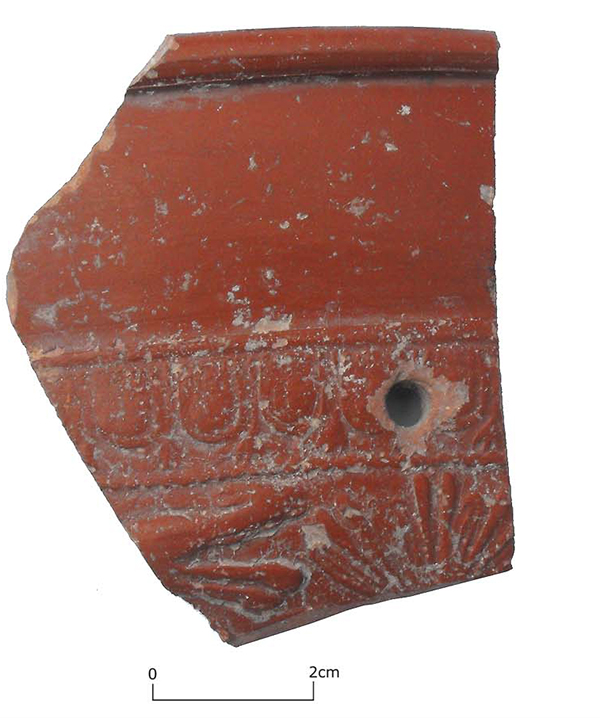
The VM_365 image for Day 183 shows a sherd of samian pottery from the excavations at the site of a Roman Buildings at Broadstairs which has had a hole drilled through it, so that the vessel could be repaired.

The sherd is from a first century Dragendorf 37 form bowl. made at the La Graufesenque workshops in Southern Gaul. The decoration on the bowl showed a bead border with a running animal motif, but it  was poorly impressed.

The vessel must have been broken at some point and the area represented by the  sherd in the picture was drilled through so that a lead rivets  could be used to repair it. Lead wire was passed through two holes and either joined in a loop, or the ends may have been cut off and hammered flat on the inside of the bowl.

Other Roman pottery from this site has already featured in the VM_365 project.