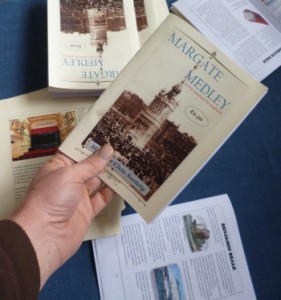
We’ve been able to use our publishing skills to help out with a project organised by Margate Civic Society,
A while ago we bought a nifty laser printer that is able to produce small booklets automatically, letting us produce short run publications for ourselves and others. Its a little labour intensive, as we have to fold and staple each copy by hand and then press them for a few hours. A bit of an old school publishing practice.
This week the Trust has been rolling out a new publication from our presses on behalf of the Margate Civic Society, printing and binding copies of a small publication called Margate Medley, packed with snippets from Margate’s history. It has a short article by the Trust’s Director on the history of Margate Pier, based on the talk she gave at our 25th Anniversary conference last year. There are many other interesting pieces on historical sites and events that have contributed to Margate’s unique character.
The book is for sale at £2.50 from Margate Civic Society, or at the Time Ball celebration events. Proceeds from the sales will support the Civic Society and their Fund Raising for the Time Ball project and other local activities.
The Trust were invited back to Upton School in Broadstairs on Wednesday 26th February for a day of archaeological activities for the school’s History day.
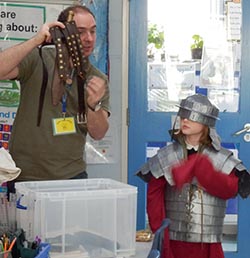
Teaching about the equipment of a Roman soldier
Adam and Lauren of the Trust ran four sessions on the archaeology of the Roman period over the day, starting with an overview of the history of Roman settlement in Britain and an experience of the everyday life of the Roman soldier, the first of the Roman people to arrive in Kent.
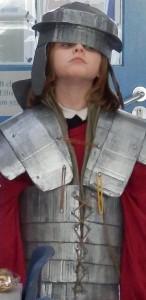
A weary Roman legionary
Volunteers from among the children didn’t just get a taste for the commitment to long service, but also had a sense of the gruelling routine of marching in full armour and a pack full of equipment; an experience that has been compared to carrying one of your friends around on your back with the weight of a frozen chicken on your head.
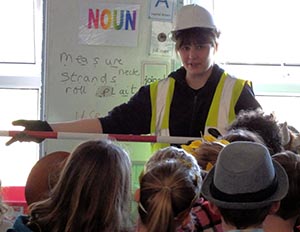
The archaeologists explained how the evidence for our understanding of Roman life is gathered from the remains that are left behind, and what a wide range of equipment to excavate, record and then report discoveries is needed.
Finding out about archaeological equipment
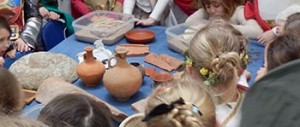
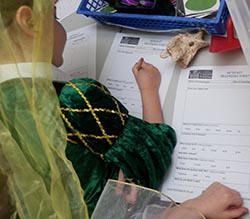
Eventually it was time for the children to Dig and Discover for themselves, excavating an artefact then carrying out their own analysis of the find using one of the Trusts specially designed recording sheets. Each of the junior archaeologists could have a first-hand experience of their Roman past from the real Roman objects that could be investigated and drawn.
Learning about Roman artefacts
It wasn’t just the Roman period that got the archaeological treatment, our Anglo-Saxon skeleton activity and costume were put to use by the teachers. Using the skeleton and replica items, they could examine how investigation of the rich culture of Anglo-Saxon burials can teach us about this important period of our history.
Drawing and recording Roman finds
Our opportunity to introduce the children of Upton school to archaeological investigation has been a great way to use the rich resources the Trust has available and give a hands on experience of the past. We are grateful for the opportunity to share our interest with the next generation of archaeological investigators.
Tuesday’s curatorial conundrum from the Virtual Museum of Thanet’s Archaeology is finally answered.
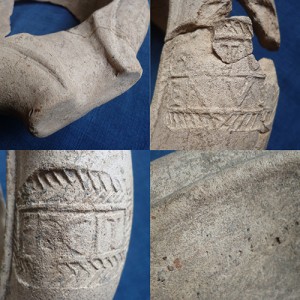
The two questions we asked were; What on earth is it? and Who made it?, the answers to both can be found by looking at the pictures.
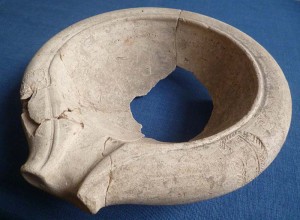
The pictures we posted were of a type of Roman mixing bowl, called a Mortarium. The example we have in our collection was found in the excavation of the Roman Villa at Abbey Farm, Minster in Thanet. Two of the sections of the image show the stamps on the rim that allow us to identify the manufacturer, although part of the stamp is damaged and part of the name is unreadable.
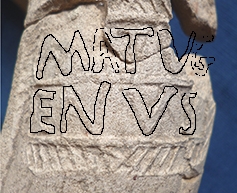
The mortarium was made in the factory of MATUGENUS, the name shown in two parts in the first stamp. The second stamp reads FECIT, that is ‘he made it’ in Latin.
The stamp reads MATUG ENUS in two parts
Matugenus is a well known manufacturer, working near Verulamium, the Roman town near St.Albans in Hertfordshire between 80 and 125AD. Stamps tell us that Matugenus was the son of an earlier maker of mortaria, Albinus.
These heavy clay mixing bowls with their distinctive thick lipped pouring spouts were covered on their inner surface with find grits, embedded in the dense yellowish brown fabrics of the clays they were made from.
In the case of the vessel from Minster, the grits had been worn down so far the surface was nearly flat, and it is very likely the base of the vessel had been almost rubbed through, allowing it to break and leaving a large hole in base before it was finally smashed and cast with other rubbish into the outer boundary ditch to the north of the villa. The sherds of the vessel had not moved far and were found in a tight group that allowed the vessel to be nearly completely reconstructed after the dig.
Matugenus made this Mortarium – it says so on the tin
Our Virtual Museum has no buildings, although the image we use on the website is borrowed from elements of real buildings. We had hoped to add to our building as time went on, but it remains small.
Without the resources to create a dedicated archaeological Museum in Thanet, an area which richly deserves one, the idea of the Virtual Museum of Thanet’s Archaeology was created in 2005 over a stimulating fry up in the Beano Café in Broadstairs (the digital hub of the Isle of Thanet heritage community in that year!).
With limited resources and equally limited, but increasing understanding of the technology, the idea of the Museum developed into a statement of intent and then into a functioning website, which we have since then used as tool to communicate with our community. With no bells and whistles, our little Museum does what it can to hold up the remains of Thanet’s archaeological past to view by the public. We share three aspirations that Museums all around the country will understand:
Dedicated: We still feel the need for the museum almost a decade after we started our project.
Donate: We could do so much more to reveal the hidden discoveries of Thanet’s past if we had more resources. Find out how you can contribute.
The idea of a virtual Museum is nearly as old as the World Wide Web; a virtual Museum was one of the first sites to work with the early Mosaic Browser around 1992-93 shortly after Tim Berners-Lee created the Web as we know it. There’s an interesting academic article on the origin and function of Virtual Museums here:
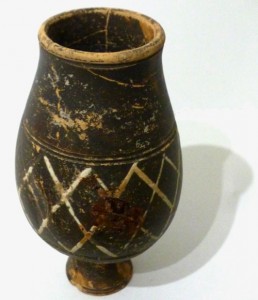
This Roman Beaker features in the group of Roman pots that currently forms the mastheads of our social media pages.
Roman colour coated Beaker, decorated with white painted lattice pattern. Possibly manufactured in Gaul, 3rd or 4th century, found in Ramsgate 2007.
Found in a grave excavated in Ramsgate, it is one of a group of finds with great significance to understanding the Roman occupation of Thanet and Ramsgate’s ancient role as a sea port. Located at the eastern limit of an ancient track that followed the Isle’s central chalk ridge, this is the easternmost of a series of small Roman cemeteries that once lined the road.
More remarkable was the survival of the intact vessels on the small archaeological site, despite the demolition of the buildings above and the use of a large toothed mechanical excavator bucket to grub out the foundations of the building that stood above it.
Despite the discoveries made on large scale excavations that have been carried out more recently, this small excavation was located in a perfect place to fill in the physical details of several antiquarian references and observations in the area which can not now be verified as the finds and records have been dispersed or lost.
Perhaps the story of greater human interest held by this vessel are the impressions of the fingers of someone who grasped the body of the vessel before the clay had dried and left a lasting memorial of their otherwise unrecorded existence on this beautiful vessel.
The vessels and the other finds from this site form a key part of the collection of artefacts the Trust holds and uses as part of the teaching material of the Virtual Museum. The excavation remains a milestone in our history of archaeological discoveries which have added to our knowledge of Thanet’s distant past.
The week of March 24-30 2014 sees the first ever #MuseumWeek taking place on twitter. Museums and galleries from across the UK and Europe will be taking part.
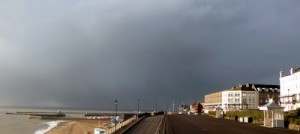
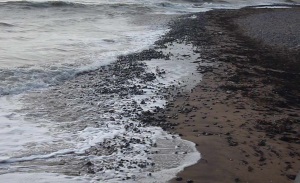
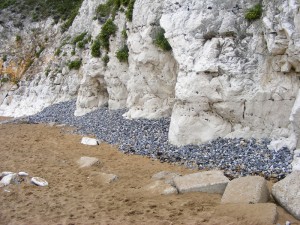
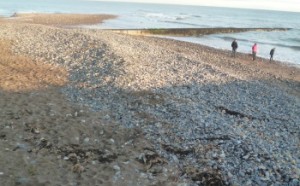
On a rainy day in the winter you might not think that there was much of archaeological significance to see on Thanet’s coast. However, the wind and high seas of January and February are causing one of the most important phenomena of the coast of the Isle of Thanet. the raging seas are driving thousands of flints up the beach, battering at the feet of the chalk cliffs.
Waves driving shingle up the beach at Ramsgate
If you’ve ever wondered why cliff falls happen so often along Thanet’s coast in stormy weather, you don’t need to look any further than the relentless pounding these little grey hammers give to the chalk with each wave that rushes to the shore. Eventually the lower reaches of the cliff face are hollowed out by the rolling cobbles, the chalk above isn’t supported at the base any more and something has to give and down comes another stretch of the coast in a spectacular fall.
The process has a proper name – ‘Corrasion‘ and has been going on for a many centuries. John Lewis, the great 18th century historian of Thanet, wrote of ‘the rage of the sea and the falling of the land’ and recounts that in his time a Roman wall had fallen into the sea near the cliffs at Dumpton. Even now pits, ditches and graves of our ancient past are occasionally exposed at the cliff faces around the coastline, soon falling to the beach below.
Shingle at the foot of the cliffShingle bank with wave cut steps east of Ramsgate harbour
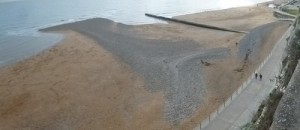
The waves and tides have another effect, collecting great banks and drifts of flint shingle in the shallows where the chalk has been cut to form a flat platform. One bank lies off the coast at Ramsgate, to the east of the harbour, growing and shrinking over time and occasionally, when the tide is unusually low, it is possible to walk far out along its length.
Some of the flints bound up in the depths of bank are irregular nodules of huge dimensions, pitted with undulating depressions and pierced with holes. Before the stone harbour was built Ramsgate’s haven was shielded by a similar deep bank of shingle braced with timber breakwaters. Some timber piles that were destroyed when the slipway in Ramsgate Harbour was built were thought by one observer, a former Harbour Master at Ramsgate, to have have dated to the Roman period. Perhaps the great Stonar Bank, which once stretched across Pegwell Bay and was once firm enough to support a medieval village, looked something like this .
Shingle bank east of Ramsgate harbour
In Thanet the record of the power of the sea to shape our landscape is all around us and has been present since the earliest times in our history.
An interesting collection of studies has been added to the Anglo-Saxon section of the Trust’s archaeological library.
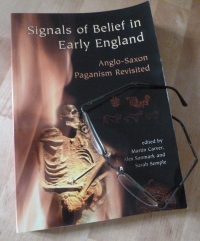
Signals of Belief
Edited by professor Martin Carver, Alex Sanmark and Sarah Semple, Signalsof Belief explores the history and character of ‘pagan’ Anglo-Saxon belief before and after Christian ideas began to spread after Augustine’s mission to covert the English arrived in 597 AD, The subject is significant to the archaeology of Thanet because of the number of important Anglo-Saxon cemeteries located on our chalk downland landscape. The Island would have been an important cultural community, linking the ideas of the people of north Germany and Scandinavia with what remained of the Roman world in Britain and on the continent.
Of course, Augustine’s mission sent by Pope Gregory the Great to convert the Anglo-Saxon kingdoms was one of the most significant events in the story of ideas and beliefs in the Anglo-Saxon period and, the 8th century historian Bede tells us, the first connections between the two cultures took place somewhere in Thanet.
Although Bede gives us a general account of the progress of Christian ideas through the Anglo-Saxon Kingdoms based on contemporary accounts, starting with the great King of Kent Aethelbert, we know little more than hints and glimpses of the beliefs held by the Anglo-Saxon people Augustine met.
What were their beliefs about life and death and what lay beyond the material world that held before the ideas of Christianity entered the culture so strongly? It is hard to discover because little pre-Christian written evidence survives that allows us to enter the minds of the people, and we can only examine the possible answers from the records left by observers from the outside.
In eight essays, Signals of Belief examines the hints given by contemporary Christian observers of the culture they met with in England and the clues that can be extracted from archaeological evidence and contemporary artistic representation. The essays look at the light that can be cast by poetry and other literary works and later documentation that discusses the beliefs of people of the German and Scandinavian lands where the Saxon English drew part of their ancestry. However most of this literary evidence all comes from a later period and has to be distilled by the writers into themes that they try to recognise in the early Saxon culture that are revealed by archaeological studies of the art and artefacts of the Anglo-Saxons.
There are attempts in some essays to take the hints and fit them with anthropological understandings of Shamanism and magical practise of some of the people of Scandinavia and Siberia. The book contains a useful discussion of how the ideas of Historians and archaeologists about the date and nature of Anglo-Saxons has developed over time, from the 16th to the 20th century, as they realised that the period after the Roman Empire and before the better known history of the later Medieval period had to be examined and researched using new ideas on the lifestyles and beliefs of the period.
Some of these attempts at projection, and conjectural reconstruction, are more convincing than others. A few pieces use a complicated style of language to say some fairly simple things; the Saxons used Horse imagery extensively; their halls may have had a religious as well as political role; they believed that all the things around them had some form of spiritual character. However some of the signals are louder than others, it is striking and important to Thanet’s archaeological and historical record that the ancient burial mounds of prehistory remained significant places to the Anglo-Saxons. However, a later writer warns that some of the anthropological ideas applied to the problem are spread so thinly as to have lost their significance.
In an afterword, the well-known historian of cultural beliefs Ronald Hutton warns that while the essays point the way to undertstanding the beliefs of the Anglo-Saxons, without new evidence we can never really know the internal world of their ideas. Using a telling analogy he compares the search to trying to find out the contents of a tin with no label. The discussions in the book are edging closer to a better description of the size and shape of the container, which could tell us something about the contents, but we do not have the tools to open the tin and really get to the inner contents. A lesson that applies to many historical periods that are known only through archaeological remains.
This book is not an easy read, the academic style of some of the pieces is quite dense, but it is an essential work for anyone who wants to explore in depth the inner life of the one of the population of one of the most important periods represented in Thanet’s archaeological record. Despite the dense texture the content is though provoking and stimulating and worth working through.
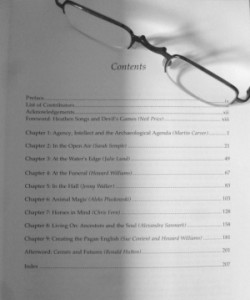
Contents page of Signals of Belief
In the foreword Professor Martin Carver provides a coherent summary of the problems of understanding Anglo-Saxon mentalities from archaeological data and a good overview of the ideas that might lead to solutions, as well as adding insightful comments of his own. Ronald Hutton’s afterword brackets the essays with his warning on the potential limits of our knowledge and the potential of the research which is a sobering round off to the wide ranging content of the book.
Carver, M., Sanmark A., Semple S. (eds), 2010. Signals of Belief in Early England, Anglo-Saxon Paganism Revisited. Oxbow Books. Oxford.
Reading more about Anglo-Saxon Thanet
There’s a useful overview of Thanet’s Anglo-Saxon archaeology on our Virtual Museum website and wider overview in Ges Moody’s book The Isle of Thanet from Prehistory to the Norman Conquest. The landing of Augustine in Thanet and the effect on the contemporary Anglo-Saxon culture of Thanet is dealt with in depth in St Augustine’s First Footfall, also by Ges Moody and published by the Trust for Thanet Archaeology.
Why have so many holes and voids opened up all over Thanet in the recent rainy weather?
That’s the question people keep asking us and we’ve seen plenty of evidence recently that Thanet’s rich underground world has surprises to reveal.
But, should we find it so unusual. Thanet’s chalk geology was a source of lime for Brick making and spreading on fields, tunnels and mines were cut through the solid chalk and air raid shelters, stores and drains were dug all over the Isle. The ground beneath us holds many subterranean secrets.
Many of these were forgotten when their entrances were lost or covered over. Some underground sites have stayed hidden for many decades until finally the wet weather washing away the crumbling chalk has brought these hidden sites to our attention.
Underground Thanet
Underground Thanet by Rod LeGear, a small book published by the Trust, gives a great round up of the hidden world of caves, tunnels and other voids in the chalk that lies beneath our feet.
A few copies of the first edition of this book are still available to order from our website. If you really want to know about Thanet’s Underground heritage its a great place to start finding out.
Underground Thanet is available for £8.00 +£2.00 post and can be ordered now with secure online PayPal payment, no PayPal account needed.
To order by post use our mail order form which you can get from here: Order form
Our new year message is that exploring your past is a rich and rewarding thing to do, helping you to understand the the way you live today.
There are many ways to get involved in exploring the past, finding out about the places that you live in and discovering something about your own place in the world. Who were your ancestors, who lived before you in your town or even your house?
The range can be wide, exploring the past over thousands of years or even just the the last few years, or even the last few minutes. You could simply ask how we all arrived here together at this moment to begin thinking about how our history affects our current place in the world.
There are so many ways to explore the past, through television programmes and the internet or even taking part in research through archives or in an archaeological dig. You can experience another way of life through costume and re-enactment or visit a museum and see the objects from the past that have been preserved because of what they tell us about a way of life which may have changed forever.
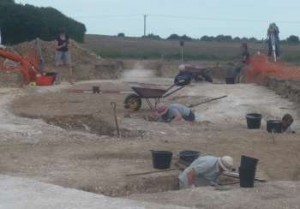
Taking part in an archaeological dig
You don’t need to have any technical skills, the only thing you need to do is listen to your own interests. Begin to explore the questions that you ask yourself about your own life and find some way to answer them through reading or taking part in some sort of activity. Begin with who, where what and most important, when.
There is always someone or some resource out there to help you discover what you want to know. You can work alone or better still join a group of people with the same interests. If you don’t like or understand one way of exploration, find another way, most importantly find your own way.
Make it your resolution for 2014 to find out something about the past and what it could tell you about your own life.
Sharing our favourite historical resources
Who will write our history?
So here’s a recommendation for a start to your new historical year from our Deputy Director: Its a book called ‘Who will write our History: Rediscovering a hidden archive from the Warsaw Ghetto’ by Samuel D. Kassow. The book is about people who made the effort to enquire about their own lives and circumstances under terrible conditions. In researching and recording the experience and history of those around them a dedicated group of researchers created a lasting record of their lives that endured the almost total destruction of everything around them. A very moving book about humanity in adversity, a great read. You can find a link to the book on Amazon here.
Tell us about your favourites
What are the books and resources that have had the most effect on your interest in the past? We would love to see your comments.