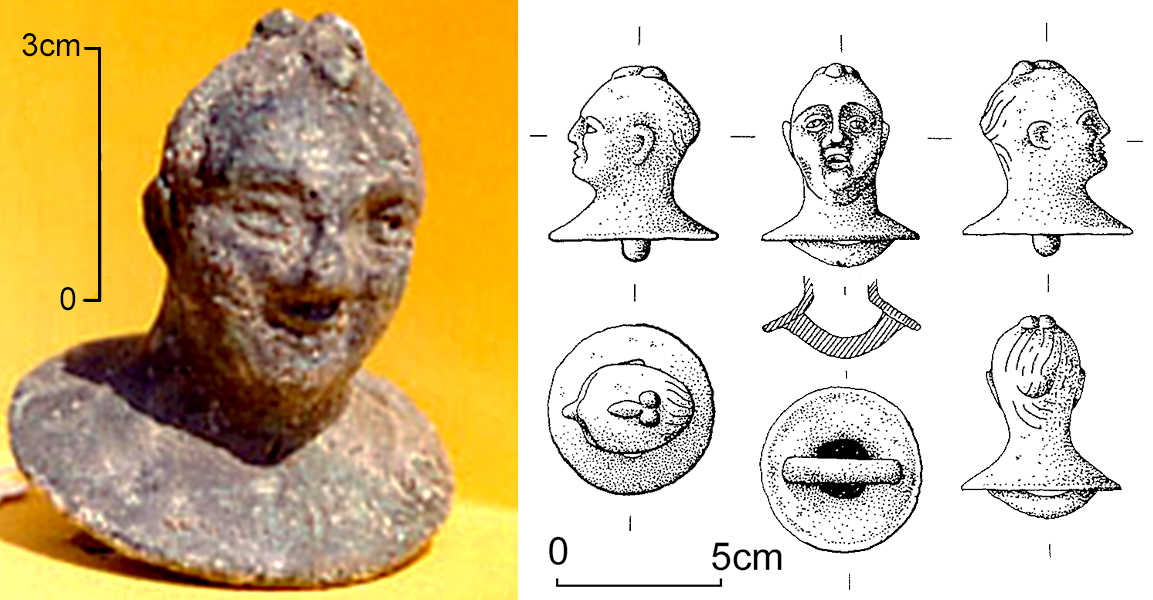
Today’s photo is from the large archive of slides we have from excavations dating back as early as the 1970’s many predating the Trust for Thanet Archaeology. This slide shows a Roman Bronze, no longer in our possession, excavated in 1981 by the Isle of Thanet Archaeological Unit, from a second century chalk quarry at St Peter’s Footpath near Draper’s Mills, Margate. Alongside the slide are Dr Dave Perkins’ illustrations which show it in more detail.
The head is bald and shows a lock of wavy hair at the back. There is a phallus and a pair of testicles modelled on top of the head; a symbol used to ward off the ‘Evil Eye’.
The head is hollow and measures 63mm high with a 50mm diameter base. It was probably a decorative mount for a horse harness and intended as a good luck charm.
The full details of the Boxer were published in Kent Archaeological Society’s journal Archaeologia Cantiana97 pages 307-311 by the late Dr David Perkins.
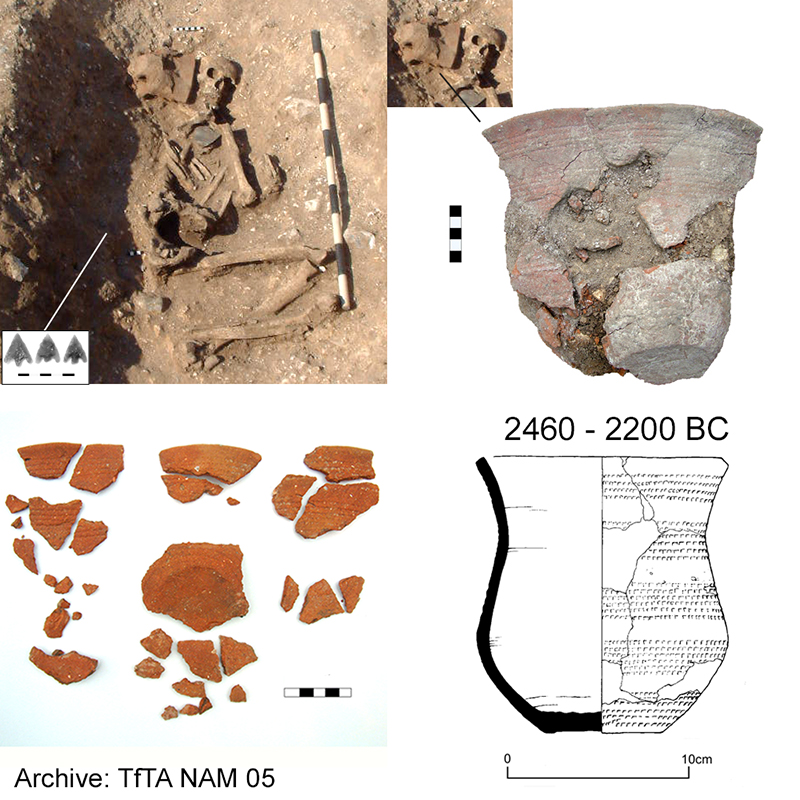
Following on from VM_365 15, today’s image shows how it is possible to reconstruct vessels when only fragments remain.
The sherds from a once complete Beaker vessel were found in the grave of a 40 to 50 year old male, radiocarbon dated to 2460-2200 BC, excavated near the QEQM Hospital, Margate. The vessel had been crushed as the grave structure decayed and some sherds had eroded completely making it impossible to reassemble. The vessel was reconstructed instead with a drawing by taking careful measurements of joining sections of remaining sherds and using the measurements to complete a full profile and section.
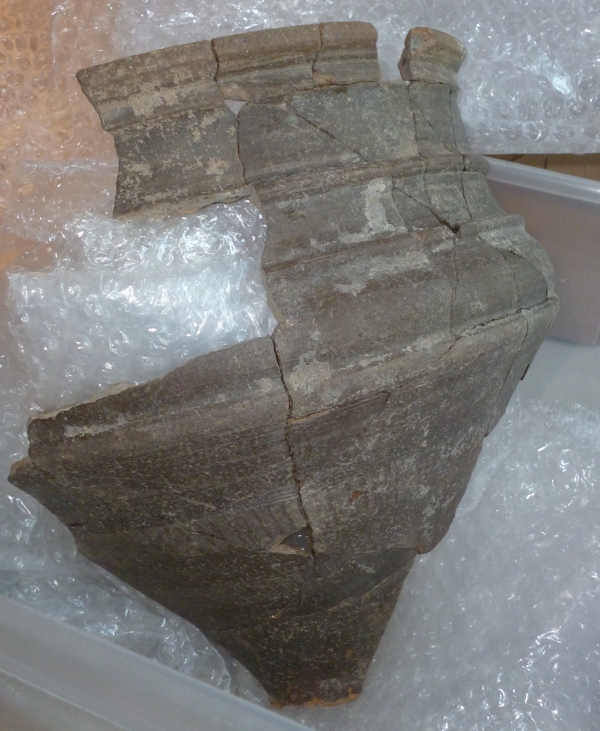
Late Iron Age Fineware Jar 25 -75AD, Found at Hartsdown, Margate in 2003
The image from the Virtual Musuem 365 project today is of a Late Iron Age ‘Belgic’ Fineware jar, which was reconstructed from sherds that were found together in an archaeological feature at a site excavated at Hartsdown, Margate in 2003.
The joins between each sherd were matched and carefully glued to reconstruct the profile of this vessel which now forms part of the Trust’s display collection.
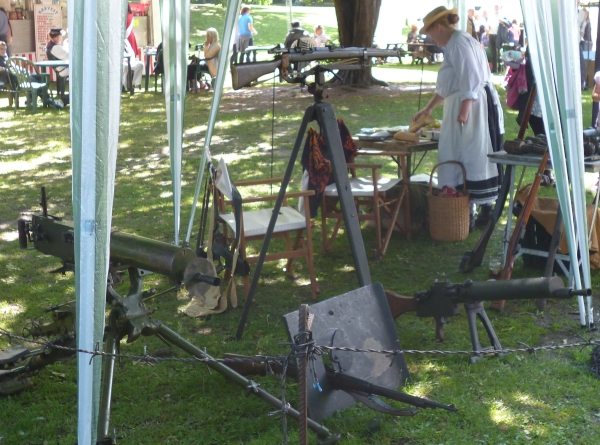
Artefacts of conflict, display of weapons from World War One, Ellington Park, Ramsgate
Our image today is of a display of World War One weapons and equipment at a day of commemoration of the 100th anniversary of the start of the war, held at Ellington Park, Ramsgate.
Archaeology is all about using material remains to understand cultures and societies of the past, including the recent past. By collecting and curating examples of the objects that contributed to major periods of history, the scale of the events and the technologies involved become easier to appreciate.
From model trains to classic cars, curated collections are a form of archaeological research, creating ordered series of objects to demonstrate the form, function and change over time of objects that have been significant to the development of our ways of life.
In this centenary of such a momentous event in the lives of so many Europeans, the curation and display of objects associated with World War One provide a way to demonstrate ‘history from things’, which is really a form of archaeology.
Today’s image comes from Archaeology for You, our annual event for the National Festival of Archaeology, held in the gardens of the Powell-Cotton Museum.
It has been a long day for the Trust and our volunteers, with many people taking part in our archaeological activities.
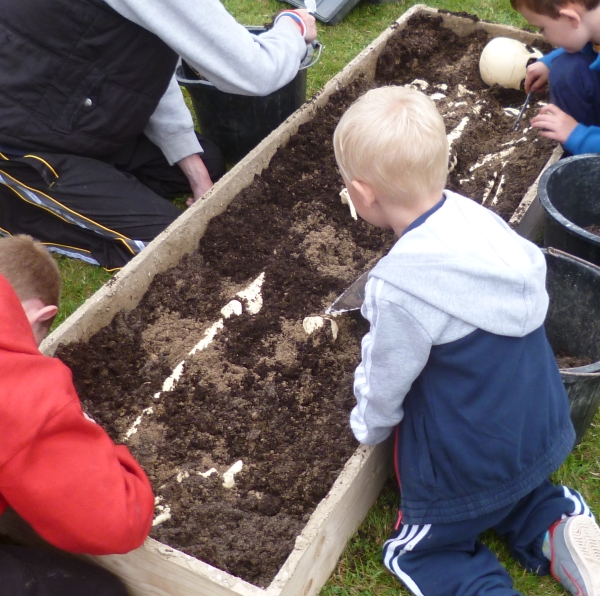
This image is of the new skeleton excavation for our Bones and Burials area. Good fun and some very good and careful excavation carried out by our archaeologists of the future.
If you weren’t there you missed interesting, educational and entertaining day!
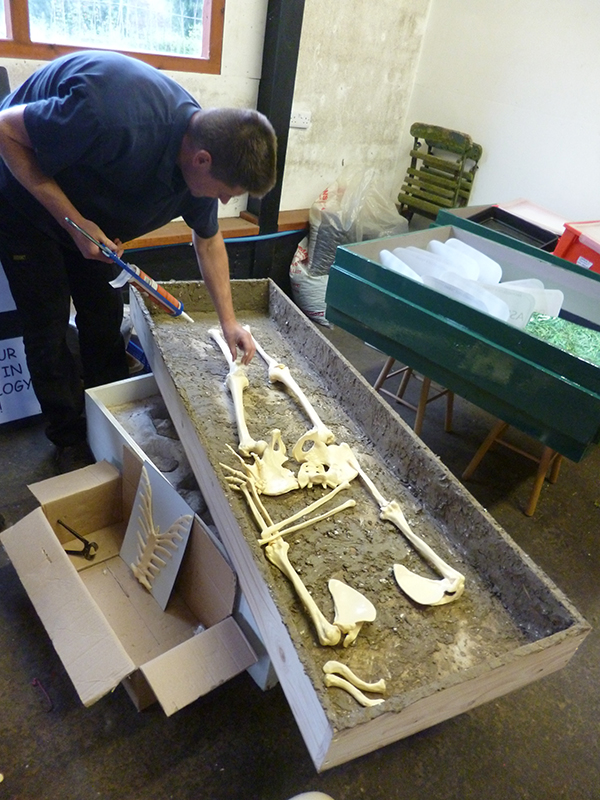
Today’s image is of our preparations for the Bones and Burials activity for Archaeology for You which will be taking place tomorrow! Last week we showed you the skeleton arriving, today we show you it being fixed in place to be used to teach people how to excavate a skeleton.
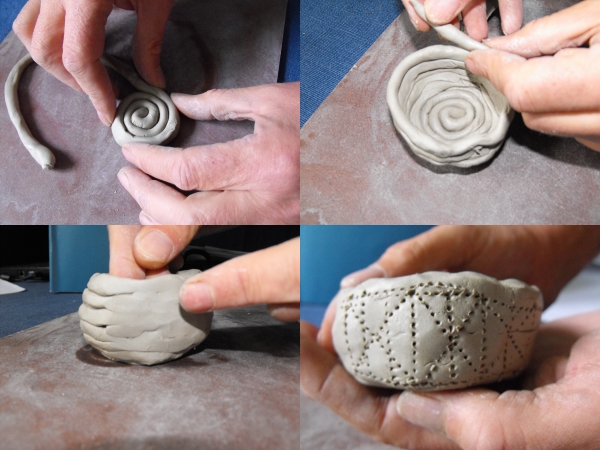
Coil, build, smooth, decorate; the four stages of building a coil pot, inspired by prehistoric pottery excavated locally. This is one of the activities you can take part in at Archaeology for You in the Inspired by the Past area on Saturday.
Only three days left to go until Archaeology for You on Saturday the 12th July at the Powell-Cotton Museum. One of our activities on Saturday will be ‘Give it a Swirl’ where you can find out how archaeologists find out about evidence for ancient environments and diets from soil samples taken at dig sites.
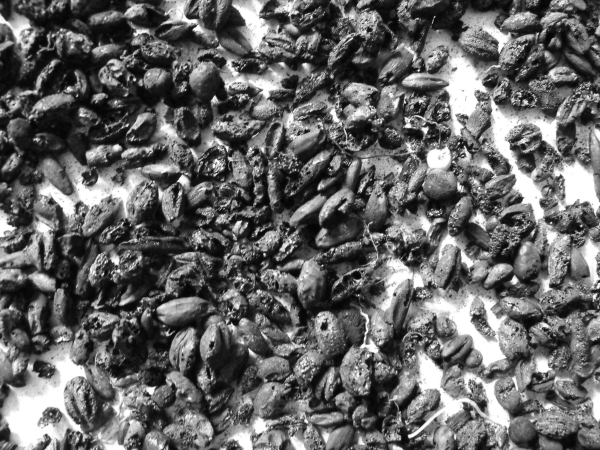
Today’s picture is of some charred grain, seeds, charcoal and tiny shells that were found in a soil sample taken from a Medieval ditch near Manston.
The process we use to retrieve this evidence is called flotation. This is where soil samples are swirled in water in a tank over a fine mesh. The light artefacts such as charred seeds and grain, charcoal and small bones float to the top and are retrieved for identification by pouring the water off through a fine seive. Heavy artefacts such as the odd stone, piece of pot or larger bone sink and are retained by the fine mesh and the soil particles sink right to the bottom of the tank.
We will be using a simplified version of this process on Saturday using buckets and plenty of water, so come along, get your hands dirty and Give it a Swirl!
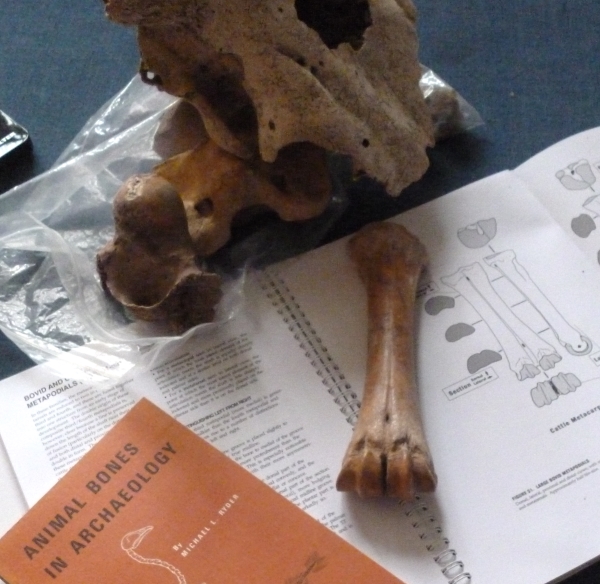
Finding our away around animal bones with a guide book
Animal bones are one of the most common finds in archaeological excavations, often forming large elements of the assemblage of finds.
Man has brought many animals into the routine of life, to use for food and to provide muscle power and as a source of other useful raw materials and resources. Many animals share the human world as companions, being fed and given a space to live because of some return they give for their keep. Some animals live as parasites, living off waste or on the by products of agriculture and industry. All can be represented in the collections of animals bone collected from archaeological sites. The size of each bone reflects the range of animals that share our world, from rodents and amphibians to cattle and in the earliest of sites some of the largest animals that have lived, like hippos and mammoths.
Understanding the patterns of distribution and the species that are represented are part of the process of reconstructing both the environment of the past and the patterns of consumption and exploitation of animals by humans. Part of the process of archaeological investigation is the identification the species of bones and bone fragments, quantifying the range of species represented and comparing them with the use of animals in cultures from the historic past and present. The evidence of the animal bones allows us to piece together the relationships between animals and humans, when we have no other written evidence to reconstruct them with.
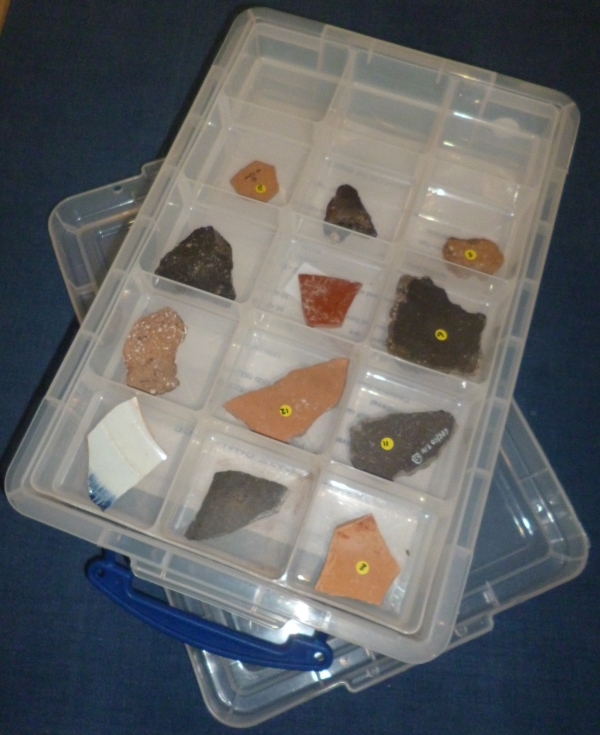
Today’s image is of the Pottery Dating game, a simple introduction to understanding how ceramics are used in archaeological investigation to generate knowledge about people and culture in the past. The pottery dating game is one of the activities we have developed to help people understand the basics of archaeological investigation and analysis, which you can try out at our Archaeology for You event.
Developing the ability to make ceramics was one of the most significant inventions of prehistoric people. Everyday pottery vessels, familiar in form and uses to our own, link us in a long chain to first Neolithic potters, with almost every step of the journey marked with innovations in form, fabric and technological advances and retreats.
Studying ceramics in the archaeological record can grow to a full time occupation, with a whole body of subtle detail that a ceramic specialist needs to become familiar with. The scope of interest in ceramic material ranges from the variety of vessels and fabrics present in the archaeological record, to observing how modern potters manipulate clay and construct objects from it. Piecing together the sequence of the potters craft involves tracing cultural cross references, short lived fads and long lived styles that defy the creative urges of the moment in favour of utility, familiarity and tradition.
From the earliest days of archaeological research there has been a recognition that an archaeologist should be familiar with the range of ceramics that are common in their area of research, in the period they study and the geographical regions they focus on. Indexing and sequencing the ceramic types associated with a field of study is a basic building block in establishing regional time lines and tracing common ways of life.
How does the pottery dating game work?
To become familiar with the methods used to analyse ceramics, there’s no substitute for hands on experience. But, as in many unfamiliar activities. people are not confident of their own abilities and are nervous about making mistakes. The pottery dating game is a confidence building exercise which shows that we all have the skills of reasoning and observation that form the foundation of the systems used to analyse and classify ceramics.
The dating game box contains a set of sherds of pottery ranging in date from the early prehistoric to the modern era, all with distinctive characteristics. We invite you, without any previous experience of archaeological pottery, to place the sherds in the order from earliest to latest according to your own ideas and experience. Before we compare the sequence you decide on with the order and dating given by an expert in archaeological ceramics, we ask you to explain the observations and decisions you made in ordering the sherds.
How close do you think you might get to the actual sequence on the first go? How do your observations fit with those of experienced ceramic archaeologists? Perhaps you know more about the technology and craft of the past than you think you do…