Neolithic surprises at Perry Wood

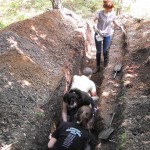
Image of trench excavation
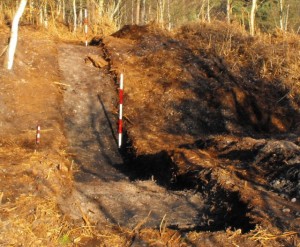
Trench where Neolithic pottery was excavated

Perry Wood is famous for discoveries of flintwork that were left by the first hunter-gatherer groups of Mesolithic people who ranged through the landscape after the last ice age more than six thousand years ago. The excavations we carried out  on Windmill hill earlier this year have uncovered some  rare and important evidence that the first Neolithic farmers settled on the same hilltops two thousand years later.

In a trench excavated to search for evidence of a Roman fort of the the first century AD, we were surprised to  find  some flint-tempered pottery  in the earliest layers which  might be evidence of a settlement three thousand years older than expected.

Several sherds joined to form part of a round bodied vessel, decorated by smoothing and polishing the outer surface of the clay. Traces of soot on the surface suggest the sherds are from a cooking pot likely to date to around 3500 BC, in the Neolithic period.
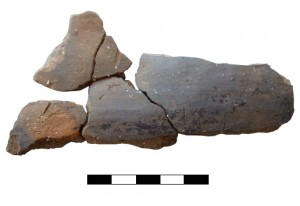
Image of Early Neolithic pottery from Perry Wood
Early Neolithic pottery from Perry Wood

Neolithic people had cleared the ancient forests where their ancestors had hunted wild animals and grew crops like wheat on the cleared land. The farmers settled near their fields making the first distinctive pottery cooking and storage vessels which archaeologists use, along with the remains of the pits and ditches they dug, to recognise the settlements of Neolithic people.

The finds from the small excavation at Perry Wood suggest that there may be more evidence for Neolithic settlement in the area which could be explored in further archaeological excavation.
Archaeology for You 2012

Archaeology for You in the Powell-Cotton Museum Gardens

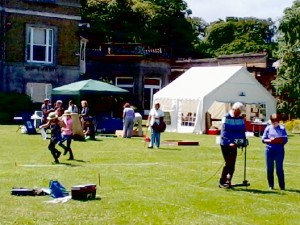
This years Archaeology for You event was held in the beautiful gardens of the Powell-Cotton Museum at Quex Park on the 23rd of July during the National Festival of Archaeology.

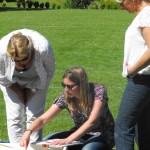
Explaining section drawing
Explaining how sections are drawn to record archaeological features

Our visitors could try their hand at several archaeological activities including techniques for recording archaeological sites and processing and analysing artefacts.

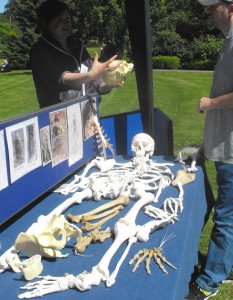
This year we were helped by an enthusiastic expert from the University of Kent’s Biological Anthropology department, on hand to explain how archaeologists analyse human remains for information about the people of the past.

Teaching skelton display
Talking about human remains in archaeology with our teaching skeleton
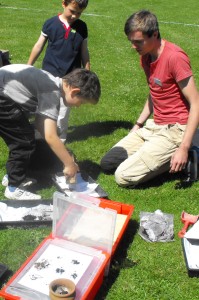
Investigating environmental samples processed by bucket flotation

Another volunteer from the Powell-Cotton Museum supervised visitors in a soil sample processing activity to see how archaeologists explore what our ancestors ate and discover what the environment was like at the time.

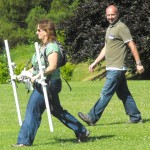
Several visitors were able to take part in an introduction to geophysical survey techniques, with both resitivity equipment, demonstrated by the members of the Isle of Thanet Archaeological Society, and Magnetometry survey, demonstrated by a post-graduate student from the University of Kent using equipment owned by the university’s Classics and Archaeology department. There were also craft activities inspired by archaeological artefacts from the local area and beyond.

demonstrating the magnetometer
Demonstrating the magnetometer in a survey of the museum garden

With so many people from the Trust’s staff and from the wider archaeological community in Kent, there were many opportunities for visitors to make useful contacts for the future. At least two prospective archaeology undergraduates were able to chat with professionals and find out about fieldwork opportunities and events that will help them with their careers.

Once again Archaeology for You was a succesful opportunity to bring Thanet’s important archaeological evidence and research to a wider audience. We look forward to seeing all of you again at the next Archaeology for You event in 2013.

Dig for two days 2012 – Roman days to remember

Bradstow School held their third annual Dig for Two days event for local schools in their grounds at Broadstairs  on the 21st and 22nd of June this year. This year the activities had a  Roman theme and the Trust team ran a Dig and Discover zone based on the Roman archaeology of Thanet.

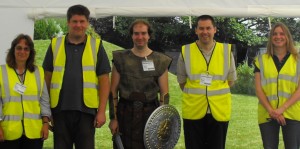
The Trust team for Dig and Discover at Bradstow School  Dig for Two Days
The Team - Pip, Lunk, Spartacus, Simon and Emma

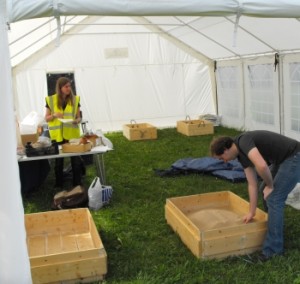
We setup two dig zones in our marquee and found ourselves a Roman to help organise the groups as they arrived.

Setting up for Dig and Discover

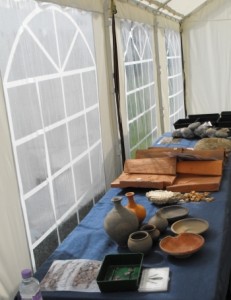
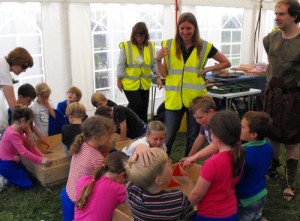
Aspiring young archaeologists were introduced to the artefacts and objects that might be found at the excavation of a Roman site in Thanet before tackling their own excavation of a Roman pit to see what the could Dig and Discover about the Romans.

Artefacts from Roman Thanet

Among the finds were pottery, coins, animal bones and Oyster shells. Sea cobbles used in local buildings were also in the pit, along with Roman tiles, which we all learned the names for  – Tegula and Imbrex. We also learned the word for Roman mosaic tiles – tessarae!

With a new group arriving every 25 minutes and sometimes two groups at once, it was a pretty intense couple of days. Each group already knew so much about archaeology and the Romans and asked excellent questions that it made the whole event very rewarding for all of us that took part.

The Roman theme will continue next year for Dig for Two Days 2013, more Roman soldiers,  more shops, more Roman activities…hope we’ll see you there.

Excavation for Roman finds under way
Excavations for Roman finds under way


Its here! Underground Thanet arrived today

Underground Thanet book arrives

Our stock of the new publication Underground Thanet by Rod LeGear arrived today and they look great. The printers have done a wonderful job and the pictures and plans of all Thanet’s underground sites look really sharp.

All our pre-orders have been posted out and they should be with you very soon if you’ve ordered one.

Underground Thanet is available for £8.00 +£2.00 post and can be ordered now with secure online PayPal payment, no PayPal account needed.


To order by post use our mail order form which you can get from here: Order form


In the Store – Clay tobacco pipes – Votes for Women!

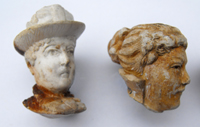
I recently opened a small box marked clay pipes expecting to find lots of broken pieces of stem and found a number of interesting decorated pipe bowls from the 18th to early 20th centuries that had been donated to the Trust many years ago. Among them are decorated bowls from the Royal Antediluvian Order of Buffalos (RAOB), The Royal Inniskillings and one with a football theme showing a foot kicking a ball.

My favourites show human heads and include General Custer and a Napoleonic soldier. One bag contains two bowls depicting Florence Nightingale and Emmeline Pankhurst. Unfortunately their labels have been mixed together and I’m unsure which is which or even if they have been correctly identified. As I’ve been recently reading about the Suffragete movement, I’m most interested in identifying Emmeline Pankhurst. I think she is the one on the left wearing the hat.

What do you think?

EJB

Underground Thanet Book

In July 2010 the Trust organised a talk on Underground Thanet by Rod LeGear, founder of the Kent Underground Research Group (KURG).

Those of you who came to this sold out event will be interested to hear that Rod has written a fine introduction to the underground heritage of the Isle of Thanet. Underground Thanet book cover image

Published by the Trust for Thanet Archaeology, the new book explores our rich heritage of caves, tunnels, quarries, mines and air raid shelters, as well as the important vistor attractions like the Shell Grotto at Margate and the Margate Caves. The book also explores Ramsgate’s air raid shelter complex and many other sites that make up Underground Thanet.

Underground Thanet is available to pre-order  from the Trust at a special offer price, with copies available from 18th June 2012

To pre-order a copy of the book use this link to download our order form:

Order form

Romans, Thanet and the Wantsum Channel

The Trust’s Deputy director recently gave a presentation on the Isle of Thanet in the Roman period at the University of Kent. The presenation explored the settlement of the area in the Roman period and  the history of the Wantsum channel between Thanet and the mainland, which  was an important feature of the Roman landscape. The origin and history of the landscape of the Wantsum Channel is explored in the book, The Isle of Thanet from Prehistory to the Norman Conquest.

Front cover of The Isle of Thanet from Prehistory...
Click to order

The book has been said to offer ‘an appealing glimpse of a seldom visited part of Kent’ and is a very readable account of the long history of the area and its archaeological discoveries. The Isle of Thanet from Prehistory is available in bookshops, or order from the link on the book image.


What have we been doing at Perry Wood?

Young Archaeologists excavating
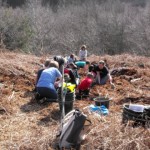
Canterbury young archaeologists at work on the southern ditch

In the last couple of months we have been doing some more exploratory excavation and survey work on Windmill Hill at Perry Wood, near Selling.

With the help of volunteers from the local community, students from the University of Kent and Canterbury Young Archaeologists we are building on the work we did with the Perry Wood Archaeology Project between 2009 and 2010.

You can read the report for that work here

More sections have been excavated through the rectangular earthwork on the hill. This time we’re hoping for some proper dating evidence!

ditch profile viewed from the west
Ditch profile at the north east of the enclosure viewed from the west

We’re also looking for the remains of that Windmill.

We’ve got two trenches open in the windmill area but nothing conclusive yet!

We have a few more days of digging planned so hope there will be more news soon…